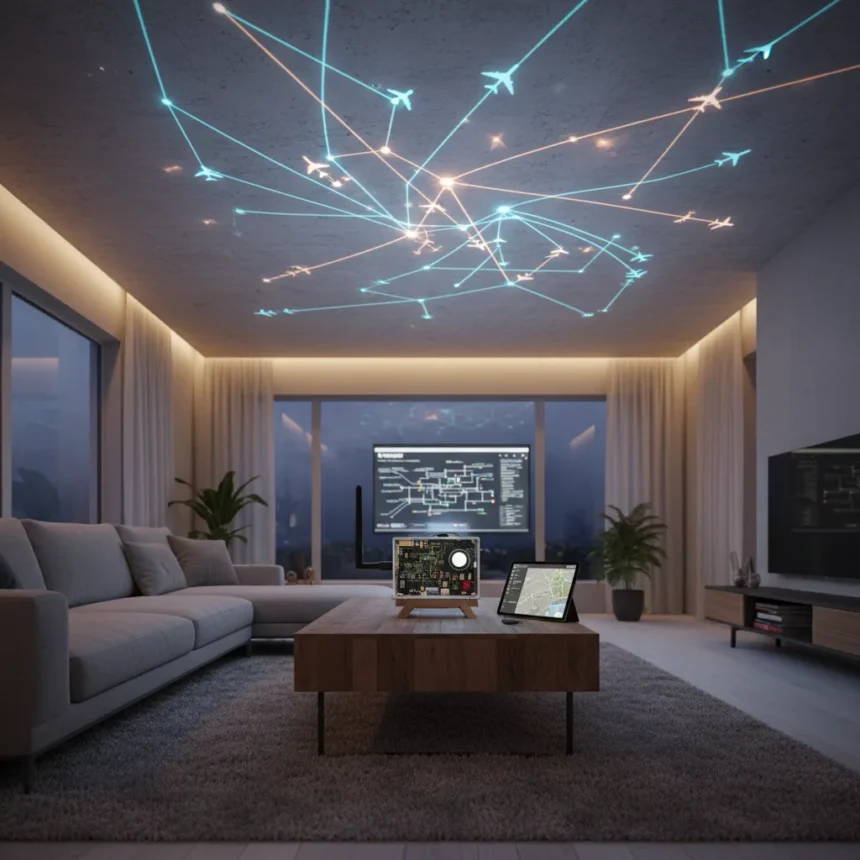
Skylight aircraft tracker is an open-source system built by software engineer Cameron Paczek that transforms a Raspberry Pi and ADS-B radio receiver into a real-time ceiling display of aircraft flying overhead. Instead of watching flight data on a screen, the system projects live aircraft trajectories directly onto your ceiling—a genuinely novel take on aviation enthusiast hardware that has caught attention across maker communities.
Key Takeaways
- Skylight aircraft tracker uses Raspberry Pi and RTL-SDR radio to receive ADS-B signals from aircraft
- Open-source design means the full build plans and software are freely available to modify and customize
- Basic Raspberry Pi ADS-B builds start around $45, with optional upgrades bringing total cost to $65–85
- Reception range depends on antenna placement but typically covers 100–300 miles for aircraft signals
- Ceiling projection differentiates Skylight from standard flight-tracking dashboards like FlightAware and Flightradar24
How Skylight Aircraft Tracker Works
The Skylight aircraft tracker receives Automatic Dependent Surveillance–Broadcast (ADS-B) signals—radio transmissions that aircraft broadcast automatically containing their position, altitude, and identity. A Raspberry Pi running Paczek’s software decodes these signals and drives a projector aimed at the ceiling, creating a live map of aircraft trajectories overhead. The visual output transforms what would normally be a map interface into an immersive, real-time display of air traffic in your immediate airspace.
At its core, the hardware setup is straightforward: a Raspberry Pi single-board computer, an RTL-SDR USB radio dongle (which costs around $20 to start), and an antenna to capture ADS-B broadcasts. The radio dongle intercepts the 1090 MHz frequency that aircraft use for ADS-B transmission, and the Raspberry Pi’s processor handles the decoding and visualization pipeline. This is the same fundamental architecture used by aviation enthusiasts running FlightAware’s PiAware ground station or Flightradar24’s Pi24 client, but Skylight’s distinguishing feature is the ceiling projection rather than a traditional dashboard.
What makes Skylight compelling is its simplicity relative to its visual impact. You are not building a complex multi-component system—you are assembling modular, off-the-shelf components and running open-source software that handles the rest. The Raspberry Pi does the heavy lifting, decoding thousands of aircraft signals per second and calculating flight paths in real time.


Skylight Aircraft Tracker vs. Competing Flight Systems
FlightAware’s PiAware and Flightradar24’s Pi24 are the closest technical competitors, both offering Raspberry Pi-based ADS-B reception and flight visualization. PiAware can track aircraft within 100–300 miles depending on antenna installation, while Flightradar24’s Pi24 extends range to 200–400 miles and automatically shares your reception data with Flightradar24’s global network. Both are mature, well-documented projects with large user bases.
The critical difference is interface. PiAware and Pi24 display flight data on web dashboards or map applications—perfectly functional, but familiar. Skylight aircraft tracker reimagines the entire experience as a ceiling display, turning passive data monitoring into an ambient visualization. You watch aircraft move across your ceiling in real time rather than clicking through a web interface. This shift from dashboard to immersive display is why Skylight has gained traction in maker communities—it is not just functionally equivalent to existing trackers, it is a fundamentally different way of experiencing the same data.



Cost and Setup for Skylight Aircraft Tracker
A basic Raspberry Pi ADS-B build can cost around $45 for a starter kit. Adding a higher-quality USB tuner and antenna—both recommended for better signal reception—typically adds $20–40 to the total. For Skylight aircraft tracker specifically, you would also need a projector, which adds significant cost depending on the model you choose. Budget projectors start around $100–150, making a complete Skylight setup feasible for under $300 if you already own a Raspberry Pi.
The real cost advantage of Skylight aircraft tracker is that it uses commodity hardware and open-source software. You are not paying for a proprietary service or locked-in ecosystem. Every component can be sourced independently, and the software is free to download, modify, and redistribute. For aviation enthusiasts who enjoy tinkering, this approach is far cheaper than commercial flight-tracking subscriptions or dedicated aviation hardware.
What Data Does Skylight Aircraft Tracker Display?
When integrated with flight-tracking services, ADS-B systems like Skylight aircraft tracker can display aircraft origin, destination, aircraft type, route, altitude, and real-time position. The ceiling projection shows flight paths as they unfold—you watch a blip representing an aircraft move across your ceiling as it flies through your airspace, with altitude and speed updating in real time. This transforms abstract flight data into something visceral and immediate.
The scope of what you see depends on your antenna placement and local air traffic density. If you live near a major airport or flight corridor, your Skylight aircraft tracker will show constant activity. In rural areas, you might see fewer aircraft but with more detail about each one. The open-source nature of the project means users have customized the display—some show only commercial flights, others filter by altitude or aircraft type, and some add additional data overlays.



Is Skylight Aircraft Tracker Actually Practical?
Skylight aircraft tracker is less a practical tool and more an artistic statement about data visualization. You will not use it to book flights or plan trips. But as a real-time window into the air traffic above your home, it is genuinely compelling. It transforms your ceiling into a dynamic, living map of the sky—something that appeals equally to aviation enthusiasts, data visualization nerds, and people who simply enjoy watching things move.
The open-source model also means the project will continue evolving. Contributors can add features, optimize signal processing, or experiment with different projection methods. Unlike proprietary flight-tracking services, Skylight aircraft tracker belongs to its community, not to a company with quarterly earnings pressures.
Can I Build Skylight Aircraft Tracker Myself?
Yes. The project is open-source, which means all the software and build instructions are publicly available. If you have basic comfort with Raspberry Pi setup and Linux command-line tools, you can assemble a working Skylight aircraft tracker in an afternoon. You will need to source the hardware, flash the software, configure the antenna, and aim the projector—none of which requires advanced technical skills, though some soldering or antenna assembly might be involved depending on the components you choose.
The barrier to entry is lower than building a custom drone or a home server. For makers and hobbyists, Skylight aircraft tracker represents the sweet spot: simple enough to build, complex enough to be interesting, and visually rewarding enough to justify the effort.
Why Has Skylight Aircraft Tracker Gone Viral?
The project has gained attention because it solves an aesthetic problem that existing flight trackers do not. Watching aircraft on a map is functional but dull. Watching them move across your ceiling in real time is mesmerizing. In an era where technology often feels invisible or abstract, Skylight aircraft tracker makes the invisible visible—you are literally watching the sky above your home projected onto your ceiling.
The open-source angle also resonates. In a tech landscape dominated by closed ecosystems and subscription models, a project that is completely free, hackable, and community-driven stands out. You own the hardware, you own the software, and you can modify it however you want.
How does the Skylight aircraft tracker compare to commercial flight-tracking apps?
Commercial apps like Flightradar24 or FlightAware offer polished interfaces, global flight data, and mobile access—conveniences that Skylight aircraft tracker does not provide. But those apps are designed for travelers and aviation professionals. Skylight aircraft tracker is designed for enthusiasts who want to see their local airspace in real time and do not mind getting their hands dirty with hardware setup. The apps are passive; Skylight is participatory.
What antenna do I need for the Skylight aircraft tracker?
Most Raspberry Pi ADS-B builds use a simple 1090 MHz antenna, which can be a basic dipole antenna or a commercial aviation-band antenna. Antenna choice directly affects reception range—a basic antenna might give you 50 miles of coverage, while a well-positioned external antenna can extend that to 200+ miles. The research brief does not specify which antenna Skylight aircraft tracker recommends, but standard ADS-B antenna options from aviation supplier retailers are compatible with RTL-SDR receivers.
Is the Skylight aircraft tracker legal?
Receiving ADS-B signals is legal in most countries—you are passively listening to broadcasts that aircraft transmit publicly. You are not transmitting anything, intercepting private communications, or interfering with aviation systems. However, regulations vary by country, so if you live outside North America or Europe, verify local rules before setting up. The open-source community around Skylight aircraft tracker and similar projects operates within legal bounds in major markets, but individual responsibility applies.
Skylight aircraft tracker succeeds because it takes a technical hobby—ADS-B reception—and transforms it into something genuinely beautiful. It is not the most practical flight tracker, but it is arguably the most memorable. For makers, aviation enthusiasts, and anyone curious about what is happening in the sky above their home, it is worth building.
Where to Buy
RTL-SDR Blog V4 | Raspberry Pi 5 | Optoma GT2100HDR
Edited by the All Things Geek team.
Source: Tom's Hardware