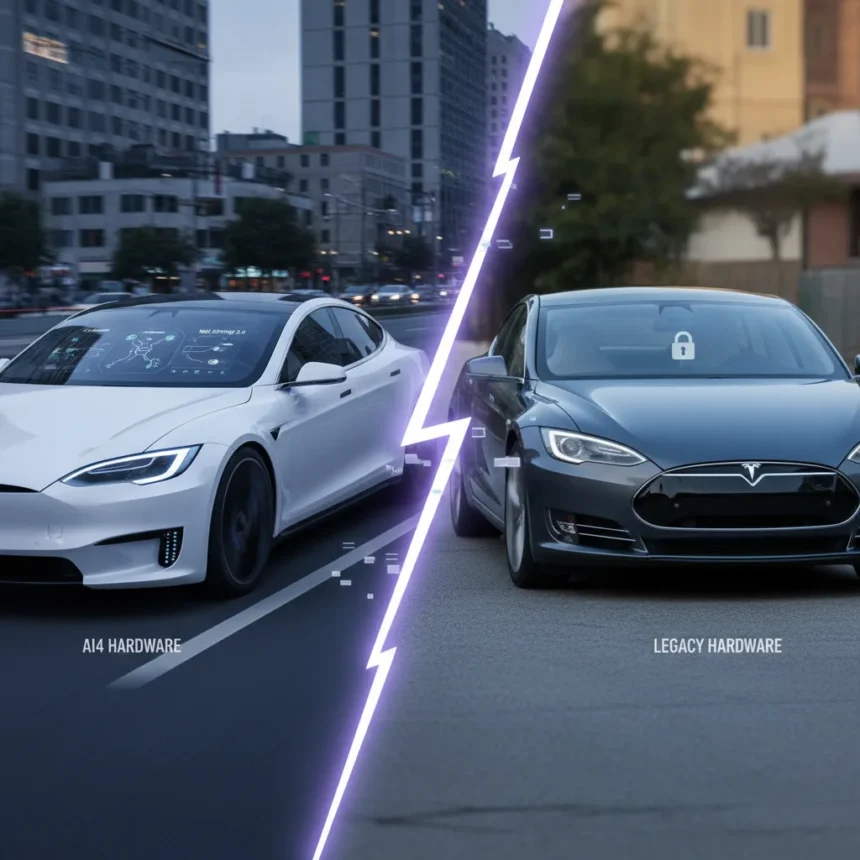
Tesla’s Spring 2026 update is rolling out now as one of the company’s most feature-dense releases in years, but it comes with a stark hardware divide: vehicles without AI4 computers are locked out of the new Self-Driving app and other key features. This split signals Tesla’s shift toward an autonomy-focused future, even as it leaves older owners behind.
Key Takeaways
- Spring 2026 update introduces 12 new features including a dedicated Self-Driving app exclusive to AI4 hardware vehicles
- FSD v14.3 achieves 20% faster reaction times via upgraded vision encoder and rewritten AI compiler
- New “Hey, Grok” hands-free wake word brings xAI’s Grok AI into Tesla vehicles for the first time
- Older cars without AI4 hardware cannot access the Self-Driving app, new visualizations, or full feature set
- Tesla discontinued standalone Autopilot in January 2026, pushing owners toward FSD Supervised
The Self-Driving App Changes Everything—If You Have the Right Hardware
The new Self-Driving app is the headline feature of the Tesla Spring 2026 update, but only vehicles equipped with AI4 (Hardware 4) computers can use it. The app lets owners subscribe to FSD with a single tap, view usage statistics across days and months, and access FSD tutorials without navigating buried menus. For Tesla owners who have been pushing for easier subscription management, this is a genuine quality-of-life improvement. For owners of older Teslas, it is a reminder that hardware constraints now determine feature access in ways software alone cannot overcome.
This hardware gatekeeping is not accidental. Tesla has been moving toward AI4 as its standard for years, and the Spring 2026 update makes that transition explicit. The company is signaling that the future of FSD—and by extension, Tesla’s autonomy roadmap—depends on newer silicon. Owners of pre-AI4 vehicles can still use FSD Supervised, but they will not get the streamlined app experience or access to features built specifically around the new hardware’s capabilities.
FSD v14.3 Marks a Leap in Real-World Performance
Beyond the app redesign, the Tesla Spring 2026 update delivers meaningful improvements to Full Self-Driving’s core performance. FSD v14.3 achieves a 20% faster reaction time through an upgraded vision encoder and a completely rewritten AI compiler and runtime using MLIR technology. That speed boost translates to tangible improvements in real-world driving: better handling of traffic lights at complex intersections, smoother navigation of curved roads, and more precise yellow-light stopping behavior.


The upgrade also enhances Tesla’s fleet learning system, reducing disengagements where drivers had to take manual control. This is where Tesla’s architecture diverges from rule-based autonomous systems used by competitors—the more miles the fleet drives, the more the AI learns from actual driving scenarios. A 20% reaction time improvement might sound incremental, but in autonomous driving, milliseconds matter. Faster responses mean fewer edge cases that surprise the system, and fewer surprises mean fewer moments where human intervention becomes necessary.
Voice AI and Quality-of-Life Features Round Out the Update
The Tesla Spring 2026 update is not all about autonomy. Tesla added “Hey, Grok” as a hands-free wake word for xAI’s Grok AI, marking the first in-car arrival of the system since its July 2025 debut. Owners can now ask Grok questions, get real-time information, and control vehicle functions without touching the screen. Location-based reminders round out the voice improvements—the system can remind you to pick up groceries when you arrive home, for example.



Music queue improvements address a friction point many owners have complained about. You can now swipe right to add tracks to your queue in Apple Music or Spotify, tap-and-hold for Apple Music Favorites, and swipe left for Spotify Liked Songs. These are small changes, but they show Tesla paying attention to the daily friction points that matter to users. Maps and navigation now include Waze-like features with real-time weather and supercharging integration, plus support for Apple CarPlay.
Tesla’s Hardware Naming Shuffle Signals Bigger Shifts Ahead
Buried in the Tesla Spring 2026 update are naming changes that hint at the company’s strategic direction. “Navigate on Autopilot” is now “Navigate on Autosteer,” and “FSD Computer” is now “AI Computer”. Tesla’s own release notes emphasize that these changes are cosmetic—”This change only updates the name of certain features and text in your vehicle, and does not change the way your features behave”. But the renaming reflects a philosophical shift. By calling it the “AI Computer” instead of the “FSD Computer,” Tesla is positioning the hardware as a general-purpose AI platform, not just a self-driving system.
That positioning aligns with Elon Musk’s comments at Davos in January 2026, where he stated that “Tesla is really moving into a future that is based on autonomy”. The Spring 2026 update is the product roadmap made visible. Standalone Autopilot was discontinued in January 2026, forcing owners toward FSD Supervised as the primary driver assistance offering. The trajectory is clear: Tesla is consolidating around FSD and treating it as the core product, not a premium add-on.
The Hardware Divide Will Only Widen
Tesla’s Spring 2026 update creates a two-tier ownership experience. Owners of newer vehicles with AI4 hardware get the Self-Driving app, higher-quality car visualizations on the parked screen, and access to features built from the ground up for the new hardware. Owners of older Teslas get bug fixes, performance improvements, and voice features, but they are locked out of the ecosystem Tesla is actively building around autonomy.



This is not unusual for tech companies—iPhones with older chips get fewer features, and Android manufacturers drop support for older devices regularly. But in the automotive world, where cars are expected to last a decade or more, it stings differently. A Tesla owner who purchased a Model 3 or Model Y five years ago is now driving hardware that Tesla considers legacy. As the company pushes deeper into autonomy, that gap will only widen.
What About Older Tesla Owners?
Older Tesla vehicles can still receive the Spring 2026 update and will get performance improvements from FSD v14.3, voice enhancements, and quality-of-life features like improved music controls. What they cannot do is access the new Self-Driving app or take advantage of features that depend specifically on AI4’s architecture. If you own a Tesla without AI4 hardware and you want the full Spring 2026 experience, you are looking at a future trade-in or upgrade. Tesla is not explicitly pushing owners toward new purchases, but the feature roadmap sends a clear signal about where the company’s investment is going.
Is the Tesla Spring 2026 update available now?
Yes, the Tesla Spring 2026 update is rolling out via over-the-air (OTA) push to all owners, starting around April 13, 2026. The rollout is staged, so not all vehicles receive it simultaneously. Check your vehicle’s software menu to see if the update is available for your car.
Do I need AI4 hardware for the new Self-Driving app?
Yes, the Self-Driving app is exclusive to vehicles with AI4 (Hardware 4) computers. If your Tesla has an older hardware version, you will not be able to access the app, though you can still use FSD Supervised and other features included in the update.
How much faster is FSD v14.3 compared to the previous version?
FSD v14.3 achieves 20% faster reaction times through an upgraded vision encoder and rewritten AI compiler. This translates to better handling of complex intersections, curved roads, and yellow-light scenarios, plus fewer disengagements where drivers need to take control.
The Tesla Spring 2026 update is a watershed moment for the company’s autonomy ambitions. It is also a watershed moment for Tesla’s ownership structure, drawing a line between newer vehicles that get the full autonomy experience and older cars that get the performance crumbs. If you own an older Tesla, the update is still worth installing for the speed improvements and voice features. But if you are shopping for a Tesla right now, the Spring 2026 update makes the case for buying new hardware stronger than ever.
Edited by the All Things Geek team.
Source: TechRadar