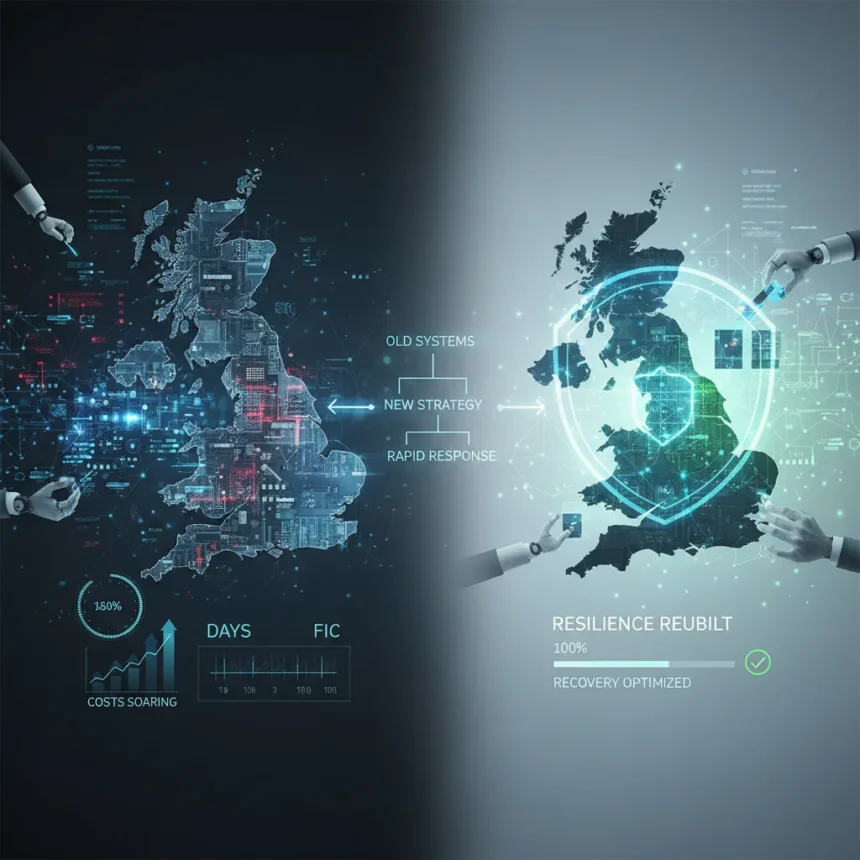
UK business cyber recovery is failing. Not slowly—catastrophically. While cyberattacks on British organisations hit record levels in 2025, the ability to bounce back from them has stalled. Organisations that should be hardened against threats are instead limping through multi-day recovery processes, burning millions in the process, and leaving themselves exposed to follow-up attacks.
Key Takeaways
- 43% of UK businesses experienced cyberattacks in the past year; 74% of large organisations were hit
- Zero CISOs reported recovering from incidents within one day in 2025; 57% took over 4.5 days
- Average UK incident recovery costs £2.5 million, with insurance payouts jumping 230% year-on-year
- UK organisations are 21% less likely than global peers to have dedicated recovery environments
- Resilience gaps leave businesses vulnerable to cascading attacks during extended downtime
Why UK Businesses Can’t Bounce Back Fast Enough
The numbers are brutal. In 2025, not a single CISO reported recovering from a cyberattack within a single day. More than half—57%—needed over 4.5 days for full remediation. That is not a speed bump. That is a structural failure. For context, every hour of downtime compounds the damage: lost revenue, eroded customer trust, regulatory exposure, and the terrifying certainty that attackers are still inside the network, moving laterally, stealing data, or planting dormant malware.
The cost reflects the pain. Average UK incident recovery costs now sit at £2.5 million per incident, and insurance payouts surged 230% year-on-year, reaching £197 million in 2024. These are not abstract figures—they represent businesses forced to choose between rebuilding systems and keeping the lights on. Small and mid-sized firms, which lack the redundancy budgets of enterprise competitors, face existential pressure when recovery drags on.
What makes this worse is the vulnerability window it creates. A five-day recovery is not five days of isolation. It is five days of attackers potentially still active in the environment, five days of incomplete visibility, five days where a second wave of attacks can land on an already-compromised network.


The Resilience Gap Holding UK Organisations Back
UK business cyber recovery is hampered by a specific architectural weakness: only a minority of British organisations have built dedicated recovery environments. Compared to global peers, UK organisations are 21% less likely to maintain isolated backup systems or failover infrastructure designed specifically for rapid incident recovery. That gap is not a minor efficiency loss—it is the difference between recovering in hours and recovering in days.
A dedicated recovery environment is not exotic technology. It is a segregated, pre-hardened system—or cluster of systems—kept offline or air-gapped from production networks, regularly tested, and ready to spin up the moment an incident is detected. When an attack hits, organisations with this infrastructure can fail over to the clean environment while forensics and remediation happen on the compromised network. Without it, they must rebuild from scratch, validate every component, and pray nothing was missed.



The absence of these systems explains why so many UK business cyber recovery timelines are measured in days, not hours. Organisations are not just fighting the attack—they are fighting their own architecture. And they are losing.
How to Fix UK Business Cyber Recovery: A Practical Path Forward
Building faster recovery requires three parallel moves. First: invest in isolated recovery infrastructure. This does not mean mirroring your entire production environment—it means maintaining a hardened, minimal-viable-recovery system that can restore critical functions while the main network is still under investigation. Test it monthly. Automate failover where possible. Document every step so recovery becomes a choreographed process, not a panic response.
Second: map your recovery dependencies ruthlessly. Most organisations have no idea which systems need to come online first, which data is truly critical, and which processes can wait. Cyber recovery fails not because systems cannot be restored, but because they are restored in the wrong order, breaking downstream workflows. Create a recovery runbook—a detailed, step-by-step guide—for each critical service. Test it under incident conditions, not just in theory.
Third: change how you think about backups. Backups are not just for disaster recovery anymore—they are your primary defence against ransomware and data destruction attacks. Ensure backups are immutable (attackers cannot delete or encrypt them), geographically dispersed, and tested regularly. A backup you have never restored is a backup you cannot trust.



These steps address the architectural and procedural gaps that leave UK organisations vulnerable. They are not glamorous, and they require sustained investment. But they are the difference between recovering in days and recovering in hours—and in a cyberattack, hours matter.
What Does a Strong Recovery Look Like?
The goal is not perfection—it is speed and confidence. A strong UK business cyber recovery posture means you can detect a breach, isolate affected systems, restore critical functions, and return to normal operations within hours, not days. It means your team knows exactly what to do because they have drilled it. It means your insurance company sees you as a lower-risk client because your recovery infrastructure is documented and tested.
Most importantly, it means attackers cannot hold you hostage. Ransomware only works if the victim is desperate enough to pay. Organisations that can recover quickly have no incentive to negotiate. That reputation alone—the knowledge that you will not be an easy target—is worth the investment.
Is UK business cyber recovery improving?
Not yet. While awareness of the problem is rising, actual recovery infrastructure and incident response capabilities remain weak across most of the UK business landscape. The 21% gap compared to global peers suggests British organisations are still playing catch-up. Investment in recovery systems is starting, but it is not yet the default practice.
How much does it cost to recover from a cyberattack in the UK?
Average incident recovery costs £2.5 million, though this varies widely depending on the attack type, industry, and size of the organisation. Insurance can offset some costs—payouts reached £197 million in 2024—but many organisations still absorb significant uninsured losses.
Why do UK cyberattack recoveries take so long?
Most UK organisations lack dedicated recovery environments and have not tested their recovery procedures under realistic conditions. Without isolated backup systems, pre-hardened failover infrastructure, and documented recovery runbooks, remediation becomes a slow, ad-hoc process rather than a coordinated response. The gap between UK and global peers suggests this is a solvable problem—it requires investment and discipline, not new technology.
UK business cyber recovery is fixable. But it requires treating recovery not as an afterthought, but as a core part of your security architecture. The organisations that do will recover in hours. The ones that do not will still be down days later, watching their costs climb and their reputation erode. The choice, for now, belongs to each business—but the clock is ticking.
Edited by the All Things Geek team.
Source: TechRadar