






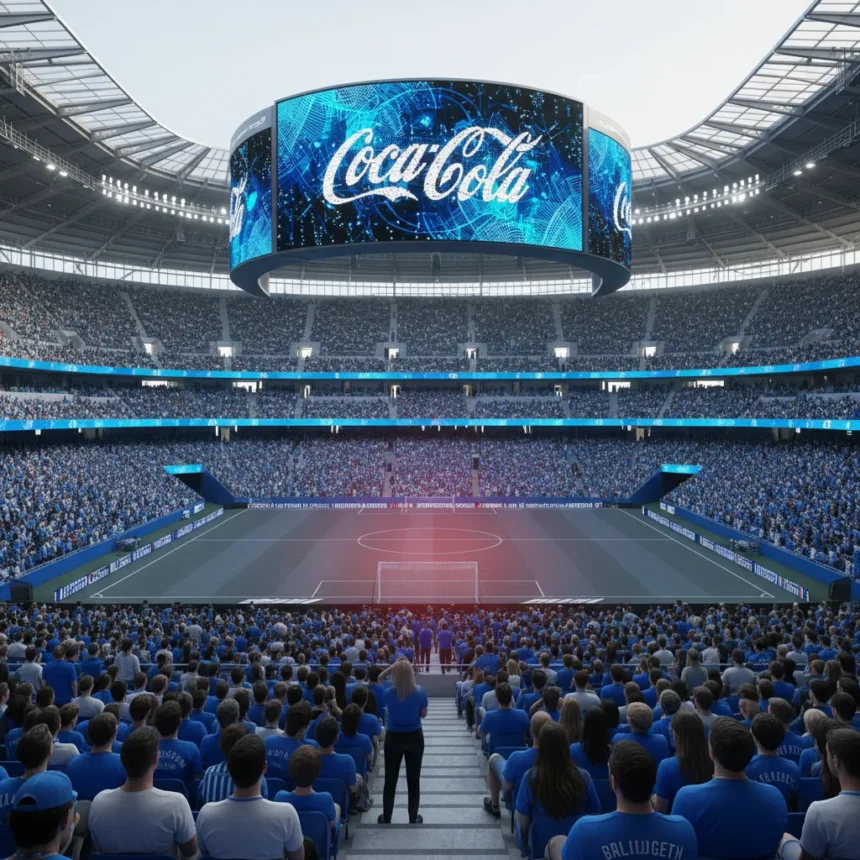
Coca-Cola’s optical illusion marketing campaigns represent a bold answer to an old sponsorship problem: what happens when your signature color is banned from the venue? The “You Must Love Coke” campaign, launched across Argentina and Brazil, solves this by making viewers perceive red without displaying a single red pixel.
Key Takeaways
- Campaign uses zero red pixels while relying on contrast and complementary colors to create red perception.
- Deployed in stadiums where red is historically off-limits due to rival team associations, including Estadio Presidente Perón and Arena do Grêmio.
- Placements span out-of-home advertising along supporter routes, stadium perimeters, and social channels.
- Creative execution blends into blue-team colors without visual clash or forced branding.
- Campaign respects football rivalries by honoring stadium color restrictions while maintaining brand presence.
How Coca-Cola’s optical illusion marketing campaigns work
The campaign turns a constraint into creative strength. In blue-team stadiums where red signifies rival supporters, Coca-Cola cannot simply plaster its trademark color across advertising. The optical illusion marketing campaigns solve this by constructing visuals that trick perception into seeing red through blue, black, and other approved colors. The technique relies on contrast ratios, complementary color theory, and the brain’s pattern-recognition habits—viewers familiar with Coca-Cola’s branding automatically fill in the missing red.
This approach demands precision. Every pixel must comply with stadium color codes while the overall composition creates the illusion of Coca-Cola’s red. The campaign executes across matchday atmospheres, blending into the blue-team ritual and environment without jarring the viewer or breaking sponsorship rules. The creative agencies behind the work—WPP’s Open X and Ogilvy—designed placements for supporter routes, stadium perimeters, and fan gathering points where the illusion hits hardest.
Why stadium color bans exist and why Coca-Cola’s solution matters
Football stadiums in Argentina and Brazil enforce strict color codes tied to team identity and supporter culture. Racing Club’s Estadio Presidente Perón and Grêmio’s Arena do Grêmio are historically blue territories where red represents enemy teams and their sponsors. Traditional sponsorship would force Coca-Cola to choose between abandoning the venue or clashing visually with the stadium’s identity. The optical illusion marketing campaigns sidestep this false choice by making the brand visible to supporters without triggering the visual hostility of displaying a rival’s color.


The campaign respects football rivalries rather than ignoring them. By honoring the stadium’s color restrictions, Coca-Cola positions itself as a brand that understands supporter passion and identity—a calculated move that turns a sponsorship limitation into cultural credibility. Social channels amplify the illusion, allowing supporters to discover the trick and share it, extending reach beyond physical placements.
Does optical illusion marketing campaigns like this actually work?
The campaign’s success hinges on whether viewers actually perceive red where none exists. Coca-Cola and its creative partners claim the illusion functions as designed, but independent verification of pixel analysis or viewer perception studies remains absent from public reporting. The promotional framing emphasizes subtlety and sophistication—the brand is “present without being visually intrusive”—but measurable impact data has not been disclosed.



What is verifiable is the campaign’s novelty and cultural timing. Football sponsorship typically relies on direct color presence and logo repetition. An approach that inverts this—using absence to create presence—stands out in a crowded sponsorship landscape. Whether the illusion converts supporters into Coca-Cola consumers or simply generates buzz remains an open question.
Is this the first time a brand has used optical illusions in advertising?
Optical illusions have appeared in advertising before, but the scale and specificity of Coca-Cola’s approach—designing perception tricks to circumvent stadium color bans in two countries—represents an unusual deployment of perception science for sponsorship compliance.
Can Coca-Cola use this technique in other stadiums?
The campaign targets specific blue-team venues where red is off-limits. The technique would need adaptation for other stadiums with different color restrictions or cultural contexts. The core principle—using complementary colors and contrast to create brand perception—is transferable, but execution depends on understanding each stadium’s specific rules and supporter culture.
Coca-Cola’s optical illusion marketing campaigns represent a rare moment where sponsorship restriction becomes creative opportunity rather than obstacle. By respecting stadium color codes while maintaining brand presence through perception tricks, the campaign signals that big brands can honor local identity and still win attention. Whether this approach spreads to other sports, venues, and markets depends on whether the illusion actually drives business results—a question the brand has yet to answer publicly.



This article was written with AI assistance and editorially reviewed.
Source: Creativebloq