



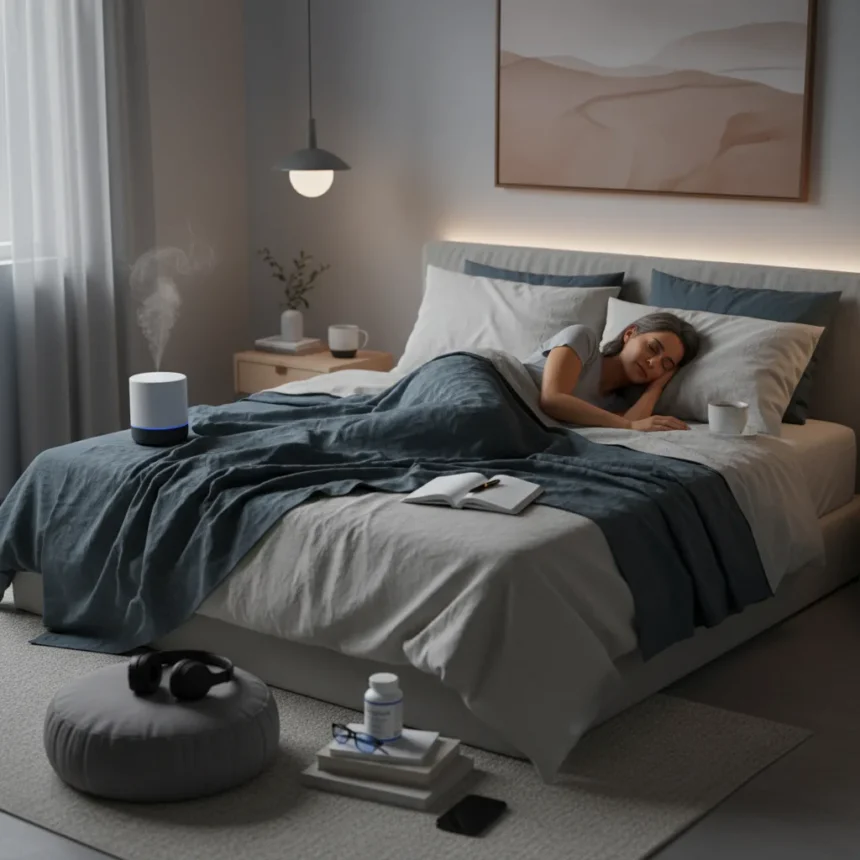
Stress-driven sleep loss is now the dominant reason Americans cannot sleep. Nearly three-quarters of us (74%) report sometimes, always, or often experiencing disrupted sleep due to stress, according to the American Academy of Sleep Medicine. Anxiety and depression follow closely behind, affecting 68% and 55% of the population respectively. The result? Sleep-anxious Americans lose roughly 7 hours per week—about 364 hours annually.
Key Takeaways
- 74% of Americans experience stress-driven sleep loss; anxiety affects 68% and depression 55%
- Sleep-anxious adults lose ~364 hours of sleep per year, with stress and anxiety cited as top sleep disruptors by 54%
- Environmental factors like noise, light, and temperature account for 44% of sleep issues; pre-bed showers help 58% fall asleep
- A white noise machine and aromatherapy are among 9 bedroom essentials that create a relaxing sleep environment
- Improving sleep quality reduces depression risk by 10x and anxiety risk by 17x compared to untreated insomnia
Why Stress Disrupts Sleep More Than Any Other Factor
Stress and anxiety now outpace every other sleep disruptor. According to the Dreem Health 2025 report, 54% of adults cite stress or anxiety as their top barrier to falling asleep, compared to 44% who struggle with environmental factors like noise and light, and just 21% affected by snoring or breathing issues. The mechanism is straightforward: stress triggers adrenaline and cortisol release, elevating heart rate and blood pressure—the opposite of what your body needs to drift off.
The stakes are real. Research shows that untreated insomnia raises depression risk tenfold and anxiety risk seventeenfold. Yet most people reach for quick fixes—scrolling phones, drinking alcohol—that worsen the problem. The solution lies in deliberate environmental and behavioral changes that signal safety to your nervous system.
The 9 Nighttime Essentials That Actually Work
A structured bedtime routine with the right environmental setup addresses stress-driven sleep loss at its source. The author of the original guide identifies nine essentials that create a calming bedroom sanctuary. The most critical: a sound-masking white noise machine. Noise disrupts sleep by spiking adrenaline and cortisol levels; a white noise machine blocks these disruptive sounds and masks external disturbances that trigger wakefulness.


Aromatherapy ranks second. Dreamy scents—lavender and similar calming fragrances—engage the olfactory system to promote relaxation without requiring conscious effort. The remaining essentials focus on the sleep environment itself: blackout curtains eliminate light pollution, comfortable bedding supports proper spinal alignment, and temperature regulation keeps the room cool (the ideal sleep temperature is around 65–68°F according to sleep science, though this varies individually). A dark, quiet, cool bedroom with quality bedding forms the foundation recommended by the American Academy of Sleep Medicine.
Beyond the bedroom, pre-bed rituals matter. According to the Sleep Foundation, 58% of adults who shower or bathe before bed report it helps them fall asleep. The warm water relaxes muscles and signals the body that sleep is coming. Journaling or meditation rounds out a complete routine—practices that interrupt the stress-to-insomnia cycle by giving your mind permission to release the day’s worries.


How These Essentials Compare to Other Sleep Solutions
White noise machines and aromatherapy are not the only tools available. Environmental modifications like blackout curtains and temperature control address 44% of sleep disruptions stemming from light and temperature. Pre-bed showers help 58% of adults, offering a behavioral alternative to purchasing new bedroom gear. Some people find success with a Sunday reset routine—a weekly ritual that reduces anxiety for 69% of those who practice it.
The advantage of the nine-essential approach is that it combines multiple interventions simultaneously. Rather than betting on a single solution, you layer environmental comfort (white noise, darkness, temperature), sensory calm (scents, comfortable bedding), and behavioral ritual (shower, journaling) to create redundancy. If the white noise machine fails one night, the cool room and blackout curtains still support sleep. This layered approach is why the routine works for stress-driven sleep loss specifically—it addresses both the nervous system hyperarousal and the environmental triggers that keep anxious people awake.
The Science Behind Sleep and Mental Health
Improving sleep quality is not just about feeling rested. Meta-analysis research shows that better sleep reduces depression symptoms with a composite effect size of -0.63, anxiety by -0.51, and stress by -0.42. In plain terms: fixing your sleep is one of the most powerful interventions for mental health, often matching the impact of therapy or medication for mild to moderate conditions.
This bidirectional relationship means that stress disrupts sleep, and poor sleep amplifies stress—a vicious cycle. Breaking it requires addressing both the mind (through relaxation techniques like meditation or journaling) and the environment (through the nine essentials). You cannot think your way out of a bedroom that is too bright or too noisy, just as you cannot sleep through untreated anxiety without support.



Can you fall asleep faster with these 9 essentials?
Yes, but not instantly. The nine essentials work by reducing physiological arousal and environmental disruption, which typically takes 2–4 weeks of consistent use to show full effect. White noise and blackout curtains provide immediate relief from external stimuli, while scents and comfort improvements compound over time as your body learns to associate the environment with sleep.
Do I need all 9 essentials or just a few?
Start with the highest-impact items: a white noise machine and blackout curtains address 44% of environmental sleep issues. Add a comfortable pillow and cool room temperature next. Aromatherapy and pre-bed rituals (shower, journaling) are powerful but secondary—implement them once the core environment is optimized.
How does stress-driven sleep loss differ from other sleep problems?
Stress-driven sleep loss involves nervous system hyperarousal—your mind races and your body stays alert even when tired. This differs from sleep apnea (breathing interruption) or circadian misalignment (wrong sleep schedule). The nine essentials target hyperarousal specifically by calming the nervous system and removing environmental triggers. If you suspect apnea or other medical sleep disorders, consult a healthcare provider.
Stress-driven sleep loss is reversible. The 74% of Americans losing sleep to stress are not trapped—they are simply missing the right combination of environmental and behavioral tools. A white noise machine, blackout curtains, cool bedroom, quality bedding, aromatherapy, and a consistent pre-bed ritual form a complete system that works because it addresses both the nervous system and the sleep space simultaneously. Start tonight with one essential. Add another next week. Within a month, you will have reclaimed the 7 hours per week that stress currently steals from you.
Where to Buy
10% OFFMuse ApothecaryRelaxing Room Mist$7.18$7.98shop now | 9% OFFSilk Road OrganicLavender Essential Oil Roll-on $9.95$10.95shop now | LoopQuiet 2 Ear Plugs$24.95shop now | 22% OFFUmisleep100% Pure Mulberry Silk Mask$14.99$19.24shop now | 10% OFFwarmiesWeighted Stuffed Animals$26.42$29.50shop now
Edited by the All Things Geek team.
Source: Tom's Guide