





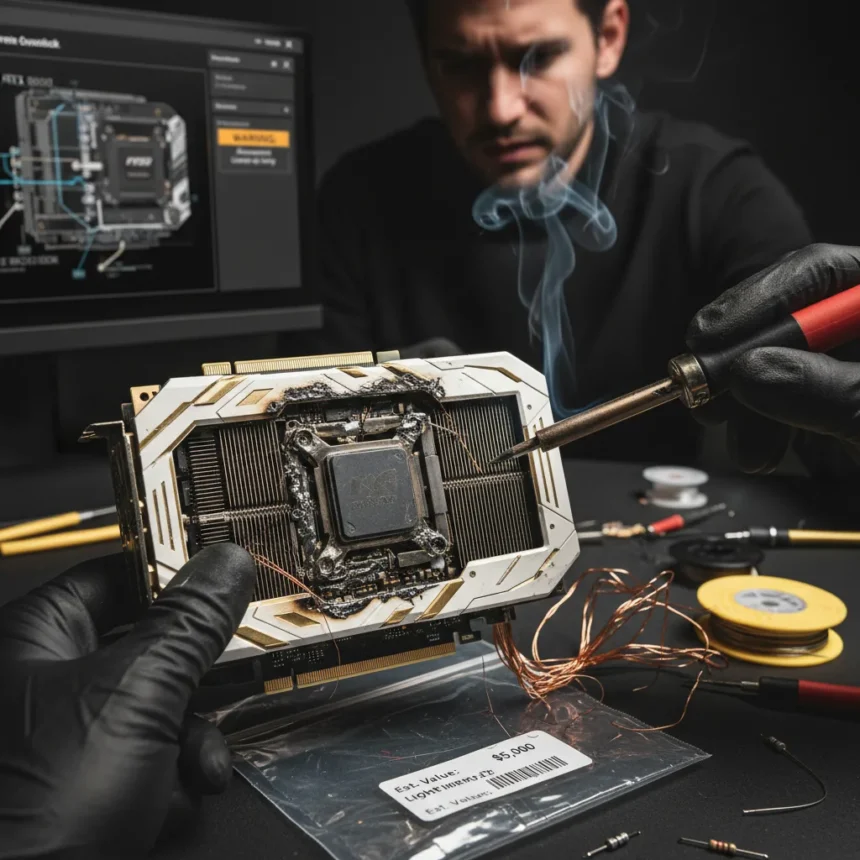
The RTX 5090 Lightning Z is a limited-edition graphics card made by MSI, priced at $5,000, with only 1,300 units manufactured worldwide. One owner learned an expensive lesson about hardware modification when they destroyed their unit by attempting to solder components onto the board as a learning exercise.
Key Takeaways
- Only 1,300 MSI RTX 5090 Lightning Z units exist globally, making replacement nearly impossible.
- The owner attempted soldering to enable the XOC BIOS, a 2,500W extreme overclocking mode restricted to the card.
- The XOC BIOS was leaked; users discovered a resistor modification could bypass retail restrictions.
- The GPU features dual 600W power connectors and 40-phase VRMs for extreme power delivery.
- Standard RTX 5090 cards have a 575W limit; MSI’s model offers 800W and 1,000W modes plus the unrestricted XOC option.
How a Soldering Hobby Destroyed a $5,000 Graphics Card
What began as a learning opportunity turned into a financial catastrophe when the GPU owner attempted to solder tiny 0402 resistors directly onto the RTX 5090 Lightning Z board. The goal was straightforward in theory: modify the hardware to unlock the XOC BIOS, an extreme overclocking mode that pushes power delivery to 2,500W—nearly five times the standard RTX 5090’s 575W limit. Instead, the modification resulted in a completely non-functional card.
The owner sent the destroyed GPU to NorthridgeFix, a California-based hardware repair shop, where the damage became apparent. The repair technician’s response captured the absurdity of the situation: “He tried to ‘learn soldering’ on an extremely rare MSI 5090 Lightning Z GPU of which only 1,300 units were ever made worldwide. I’m speechless”. With such limited production numbers, finding a replacement is virtually impossible, making this one of the most expensive practice runs in hardware modding history.
Why the XOC BIOS Became Worth the Risk
The RTX 5090 Lightning Z wasn’t designed as a standard consumer product. MSI engineered it specifically for extreme overclocking enthusiasts, equipping it with dual 600W 12V-2×6 connectors and a 40-phase VRM power delivery system. The card supports three power modes: standard OC at 800W and Extreme at 1,000W for retail users, plus the restricted XOC BIOS at 2,500W for professional overclockers only.


When the XOC BIOS leaked into the enthusiast community, users discovered that retail units could theoretically access this unrestricted mode through a hardware modification. The workaround required soldering an additional resistor onto the GPU’s circuit board—a precision task that demands steady hands, proper equipment, and genuine expertise. For someone learning to solder for the first time, practicing on a $5,000 piece of hardware with only 1,300 units in existence worldwide was the worst possible classroom.
The RTX 5090 Lightning Z vs. Standard RTX 5090 Models
The standard NVIDIA GeForce RTX 5090 operates within a 575W power envelope, making it accessible to most high-end gaming and workstation builds. The MSI RTX 5090 Lightning Z exists in a different category entirely, designed exclusively for extreme overclockers willing to invest in specialized power supplies and cooling systems. Alternative high-end RTX 5090 variants, like MSI’s Suprim Liquid, offer enhanced cooling and higher power delivery than reference designs, but none match the Lightning Z’s XOC capabilities or rarity.


The Lightning Z’s scarcity—just 1,300 units globally—means each card represents not just expensive hardware but a collector’s item. Destroying one through amateur soldering is roughly equivalent to learning to drive on a limited-edition supercar. The financial and practical consequences are immediate and irreversible.
What This Teaches Enthusiasts About Hardware Modding
The incident underscores a critical principle in hardware modification: never practice new skills on irreplaceable or expensive equipment. Soldering 0402 resistors—components roughly the size of a grain of rice—requires a microscope, a temperature-controlled soldering iron, and hours of practice on disposable test boards. Professional overclockers and repair technicians spend months developing this skill before attempting modifications on valuable hardware.
The allure of unlocking restricted BIOS features can cloud judgment. The XOC mode’s promise of 2,500W power delivery and extreme performance gains motivated the owner to bypass the professional-only distribution, but the cost of failure was always going to be catastrophic. For context, a single mistake during soldering—a cold joint, a bridge between pads, or thermal damage to surrounding components—can render a GPU permanently inoperative.
Can the RTX 5090 Lightning Z Be Repaired?
Once soldering damage occurs on a modern GPU, repair is often impossible. The damage typically extends beyond the soldered component itself, affecting nearby capacitors, resistors, or power delivery traces. Without detailed schematics and specialized micro-soldering equipment, even professional repair shops face a losing battle.


Why Is the RTX 5090 Lightning Z So Expensive and Rare?
The $5,000 price tag reflects both the card’s extreme engineering and its deliberate scarcity. MSI manufactured only 1,300 units, positioning it as a collector’s item for the wealthiest overclockers and enthusiasts. The dual 600W connectors, 40-phase VRM, and access to the 2,500W XOC BIOS justify the premium for intended users—professional competitors who can afford the specialized infrastructure required to safely use such extreme power delivery.
Should Enthusiasts Attempt Hardware Modifications on Expensive GPUs?
Absolutely not. Hardware modification on high-end graphics cards should only be attempted by individuals with documented experience, proper equipment, and expendable hardware for practice. Learning soldering on a $5,000 GPU is equivalent to learning to perform surgery on a paying patient. The RTX 5090 Lightning Z incident will likely serve as a cautionary tale in the overclocking community for years—a stark reminder that some hobbies have price tags measured in thousands of dollars, and mistakes are permanent.
Edited by the All Things Geek team.
Source: Tom's Hardware




