





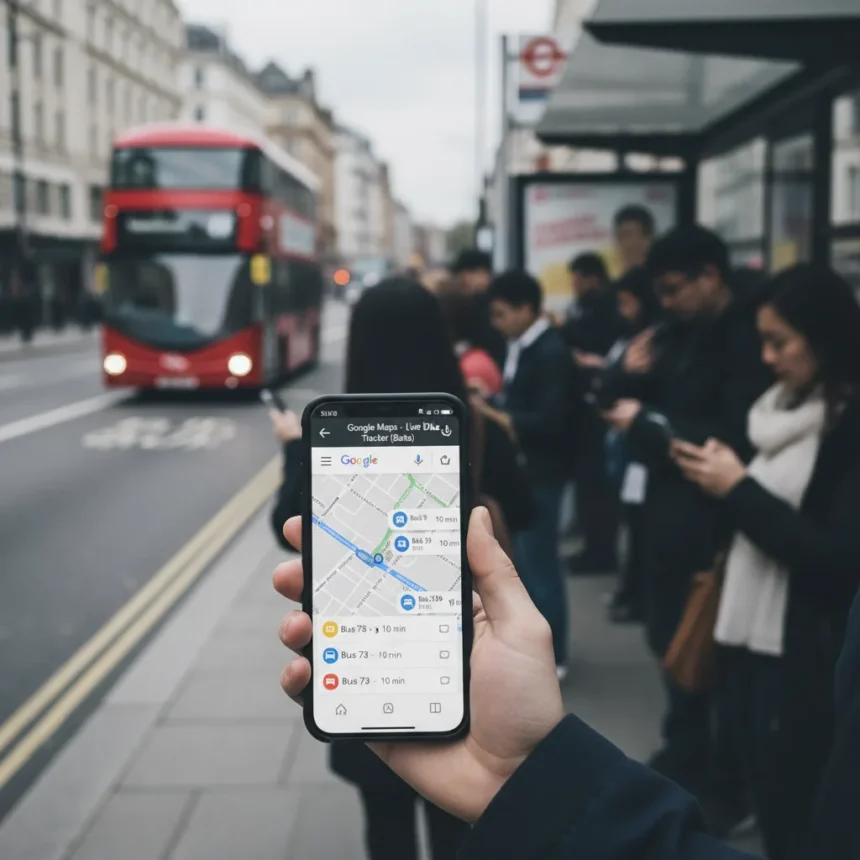
Google Maps bus tracking UK is now live across England, giving millions of commuters real-time arrival times for buses through a partnership between Google and the UK Department for Transport. The feature rolled out on 2 April 2026 as part of the government’s “Better Connected” national transport strategy, promising to simplify journey planning and boost sustainable travel. After testing it in practice, the feature delivers on its core promise but stumbles on refinement.
Key Takeaways
- Google Maps bus tracking UK launched 2 April 2026 across England via government partnership.
- Provides real-time bus arrival times and stop tracking directly in the Maps app.
- Particularly beneficial for rural areas where bus services run less frequently.
- Free feature accessible to all Google Maps users in the UK.
- Functional but lacks some refinements competitors have already solved.
How Google Maps Bus Tracking UK Actually Works
The feature integrates live bus data directly into Google Maps navigation. To use Google Maps bus tracking UK, open the app, search your destination, select Directions, choose the bus option from transport modes, and view real-time timings and route recommendations. The interface shows which buses are arriving, how long until they reach your stop, and which routes get you there fastest. It sounds straightforward, and mostly it is.
Sarah-Jayne Williams, Director of Geo Partnerships at Google Maps, framed the rollout around confidence and sustainability: “By integrating real-time bus information across England into Google Maps, we are giving millions of passengers the confidence to plan their journeys accurately”. The quote emphasizes accuracy, though real-world testing reveals nuance. Live arrival times are accurate when transit agencies feed data to Google promptly—but delays in data updates mean sometimes the app shows buses that have already passed or misses ones that are minutes away.
Google Maps Bus Tracking UK vs. Existing Transit Apps
Before this rollout, UK commuters relied on fragmented solutions: local transit apps for specific regions, TfL Go for London, or generic journey planners that lacked real-time reliability. Google Maps bus tracking UK consolidates this into a single app most people already carry. That is the genuine win—not a technical breakthrough, but a convenience consolidation.



However, dedicated transit apps in other countries have solved problems this feature still wrestles with. Stop clustering in dense urban areas makes it hard to distinguish between nearby bus stops on the map. The feature also does not clearly distinguish between frequent services and rural routes with sparse schedules, which means a rural user might see a bus arriving in 45 minutes and not realize the next one after that is tomorrow. These are not new problems—they are solved problems that this rollout did not fully address.
Where Google Maps Bus Tracking UK Succeeds
Rural connectivity is the genuine strength. In areas where bus services run every two hours or less frequently, knowing exactly when the next bus arrives changes whether a journey is feasible at all. A user in a village outside Manchester can now pull up Google Maps, see that a bus arrives in 32 minutes, and plan accordingly—something that was previously guesswork or required hunting through multiple local transit websites.



Integration with car and walking directions is seamless. If you search a destination, Google Maps recommends a bus journey without forcing you into a separate transit app. For casual users who do not regularly use public transport, this lowers friction significantly. You are not learning a new app; you are using the one you already know.
What Still Needs Fixing
Real-time accuracy depends entirely on how quickly local transit authorities upload data. Some bus operators update live positions continuously; others batch-update every few minutes. Google Maps bus tracking UK does not flag this inconsistency to users, so you might trust an arrival time that is already stale. A simple indicator—”last updated 2 minutes ago”—would solve this instantly.
The app also lacks predictive intelligence. If you are at a bus stop and three buses serve that location, Google Maps shows all three with their live times, but does not help you choose. A feature that flags “this route gets you there 8 minutes faster” or “this bus is historically late 40% of the time” would be a genuine upgrade. Existing transit apps in cities like San Francisco and Singapore offer this; the UK rollout did not.
Stop identification is another gap. In central London or Manchester, a single street corner might host four different bus stops serving different routes. Google Maps bus tracking UK marks them on the map but does not clearly separate them. You have to zoom in and squint to figure out which stop is which—frustrating when you are standing on the pavement with seconds to decide.



Who Benefits Most Right Now
Occasional bus users in rural areas are the primary winners. Someone who takes the bus once a week from a village into town no longer has to remember schedules or call the transit authority. Urban daily commuters will find it useful but not revolutionary, since they already know their routes and many cities have better dedicated apps. International visitors will appreciate having bus directions in the same app as everything else, though the feature is currently UK-only.
FAQ: Google Maps Bus Tracking UK Questions
Is Google Maps bus tracking available everywhere in the UK?
The feature rolled out across England as of 2 April 2026. Scotland, Wales, and Northern Ireland are not yet included, though the partnership between Google and the Department for Transport may expand coverage. Check the app directly to confirm availability in your region.
Do I need to pay for real-time bus tracking in Google Maps?
No. Google Maps bus tracking UK is free for all users with the standard Google Maps app. There is no premium tier or subscription required to access live arrival times.
How accurate are the real-time bus arrival times?
Accuracy depends on how frequently transit operators upload data to Google. In areas with continuous live tracking, arrival times are typically within 1-2 minutes of reality. In regions with less frequent data updates, times can be 5-10 minutes off. The app does not currently show you how fresh the data is, which is a limitation worth knowing.
Google Maps bus tracking UK is a solid foundation that solves a real problem—fragmented, region-specific transit information. For rural users, it is genuinely useful. For urban commuters, it is convenient but not yet a reason to abandon existing transit apps. The feature works, but Google has left room for meaningful improvements in accuracy transparency, stop identification, and predictive routing. That is not a failure; it is an honest assessment of a v1 product that does the job but knows it could do better.
Edited by the All Things Geek team.
Source: Tom's Guide