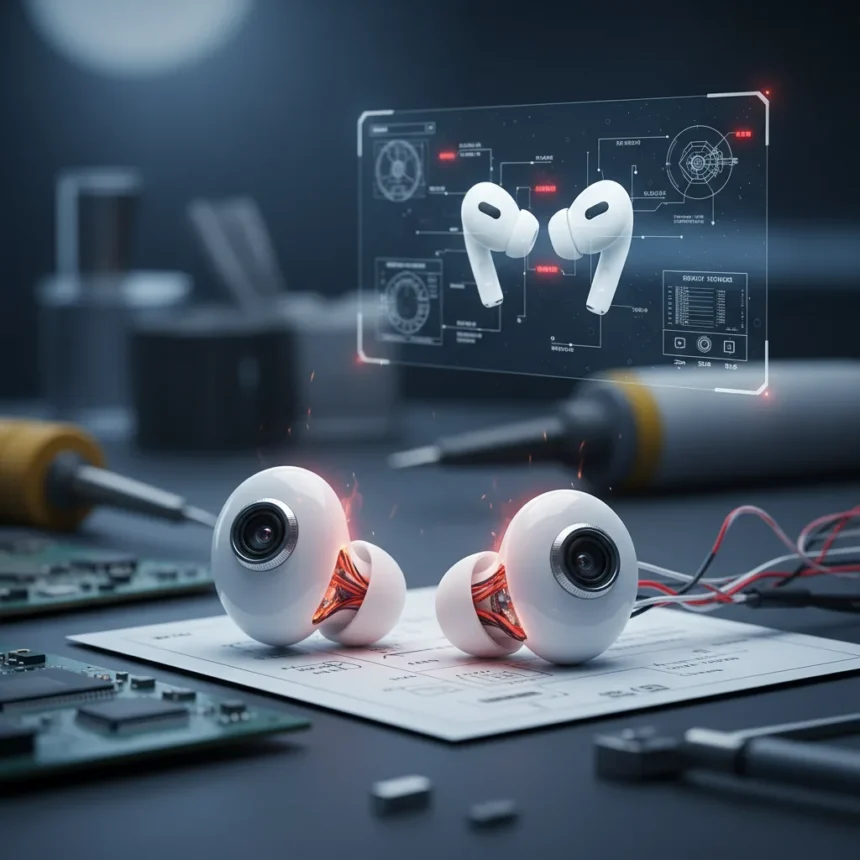
AirPods with cameras represent one of the most anticipated—yet technically daunting—product concepts in Apple’s pipeline, but new research suggests the company cannot simply bolt optics onto existing earbuds without fundamental redesigns. The convergence of miniaturization, power constraints, and thermal management creates engineering obstacles that demand far more than incremental improvements to current AirPods architecture.
Key Takeaways
- AirPods with cameras require complete redesign of current earbud architecture, not minor modifications.
- Power consumption and battery life present the most critical technical barrier to implementation.
- Thermal dissipation from camera sensors poses significant challenges in such a compact form factor.
- Apple would need to substantially increase earbud size or reduce other features to accommodate camera hardware.
- Timeline expectations suggest production may not begin until 2026 at the earliest.
Why AirPods with Cameras Face Engineering Impossibility Today
The fundamental problem is not whether cameras can be miniaturized—they already have been—but whether they can function within the severe power and thermal constraints of a device that must fit inside an ear. Current AirPods prioritize battery efficiency above all else, running for hours on tiny batteries measured in milliwatt-hours. Adding camera sensors, image processors, and the supporting electronics would demand a complete reimagining of power distribution and thermal management. The battery alone would need to expand significantly, which immediately conflicts with the form factor users expect from wireless earbuds.
Apple’s existing approach to AirPods prioritizes thinness and comfort over capability. Any camera implementation would require engineers to choose between maintaining the current size—which is nearly impossible with added optics—or accepting noticeably larger earbuds that users may find uncomfortable during extended wear. This is not a minor trade-off; it directly contradicts the product philosophy that made AirPods successful in the first place.
Power and Battery Constraints: The Real Showstopper
Power consumption emerges as the single most intractable barrier to AirPods with cameras. Image sensors and their associated processors demand continuous power to capture, process, and transmit visual data. Even with aggressive power optimization, a camera system would drain the battery in a fraction of the time users currently expect from wireless earbuds. Extending battery life would require either dramatically larger batteries—which contradicts the compact form factor—or accepting drastically reduced usage time, neither of which is commercially viable.



The challenge intensifies when considering what the camera would actually do. If it merely captures still images, the power overhead might be manageable. But if Apple intends for AirPods with cameras to enable video calling, augmented reality features, or continuous environmental monitoring, the power demands become astronomical relative to the available space. A camera-equipped earbud would likely require charging every few hours rather than the current full day of typical use, fundamentally changing user expectations and adoption likelihood.
Thermal Management in a Confined Space
Camera sensors generate heat during operation, and in an earbud positioned directly against skin, thermal dissipation becomes a serious concern. Current AirPods already operate at the edge of acceptable thermal ranges during extended use. Adding active electronics that generate additional heat would risk user discomfort or even safety issues if the earbud becomes too warm against the ear. Solving this problem requires either better thermal materials and designs—which adds cost and complexity—or accepting lower performance from the camera system itself.



Apple’s engineering teams would need to develop entirely new thermal architectures specifically for camera-equipped earbuds, potentially incorporating specialized heat-dissipating materials or redesigned internal layouts. This is not something that can be solved with a software update or a minor hardware tweak. It demands fundamental rethinking of how an earbud manages energy and heat simultaneously.
Timeline and Market Expectations
Industry analysts have speculated that AirPods with cameras might enter production around 2026, though this timeline assumes Apple can overcome the technical barriers outlined above. That timeframe suggests the company is still in the research and design phase, exploring whether the engineering challenges are even solvable within acceptable form factors and power budgets. If 2026 is the production target, users should not expect to see these devices in retail until 2027 at the earliest.
The delay reflects the genuine complexity of the task. Unlike adding a new processor or improving wireless connectivity—incremental advances Apple handles regularly—camera integration demands rethinking nearly every aspect of earbud design simultaneously. It is not a feature that can be bolted onto existing platforms; it requires a ground-up architectural rethink.
What Changes Would Apple Actually Need to Make?
To make AirPods with cameras viable, Apple would likely need to increase earbud dimensions noticeably, accept significantly reduced battery life, or develop breakthrough materials and power management techniques that do not yet exist in production form. None of these options is appealing from a product strategy perspective. Larger earbuds alienate users who value the current compact form factor. Reduced battery life contradicts the wireless earbud value proposition. And relying on breakthrough materials means betting the product on technology that may not materialize on schedule.



The company might also reduce or eliminate other features to make room for camera hardware. This could mean removing certain audio processing capabilities, reducing noise cancellation performance, or simplifying the wireless connectivity. Each compromise carries its own market risk and user backlash potential.
How Do AirPods with Cameras Compare to Current Alternatives?
Existing wearable cameras—like those found in action cameras or specialized sports glasses—are significantly larger than earbuds and still require frequent charging. These devices prove that miniaturizing camera technology to earbud scale while maintaining usable performance remains unsolved. The fact that no competitor has successfully launched camera-equipped earbuds despite years of research suggests the technical barriers are even steeper than they initially appear. Current AirPods excel because they optimize for audio, connectivity, and battery life. Adding cameras forces a three-way compromise that may leave the product worse at all three.
Is Apple Actually Building AirPods with Cameras?
Apple has filed patents related to camera-equipped earbuds, and reports from industry analysts suggest the company is exploring the concept. However, patent filings do not guarantee a product will ever reach consumers. Apple files thousands of patents annually for technologies that never ship. The research suggesting significant technical barriers adds credibility to the theory that AirPods with cameras remain in the exploratory phase, with no guarantee they will ever become a commercial product.
When Could AirPods with Cameras Actually Launch?
If Apple can overcome the engineering obstacles, production might begin around 2026, with retail availability potentially following in 2027. However, this timeline assumes the company successfully solves the power, thermal, and form factor challenges. If any of these barriers prove insurmountable—or if solutions require unacceptable compromises—the launch could be delayed indefinitely or the project could be abandoned entirely.
The gap between current AirPods and camera-equipped AirPods is not merely a matter of adding a new component. It represents a fundamental shift in product architecture, power management, and thermal design. Until Apple can bridge that gap without sacrificing the qualities that made AirPods successful in the first place, camera integration will remain a theoretical concept rather than a shipping product. The research showing these barriers exist is valuable not because it kills the idea, but because it clarifies why bringing this product to market will require genuine innovation, not just miniaturization.
Edited by the All Things Geek team.
Source: TechRadar