



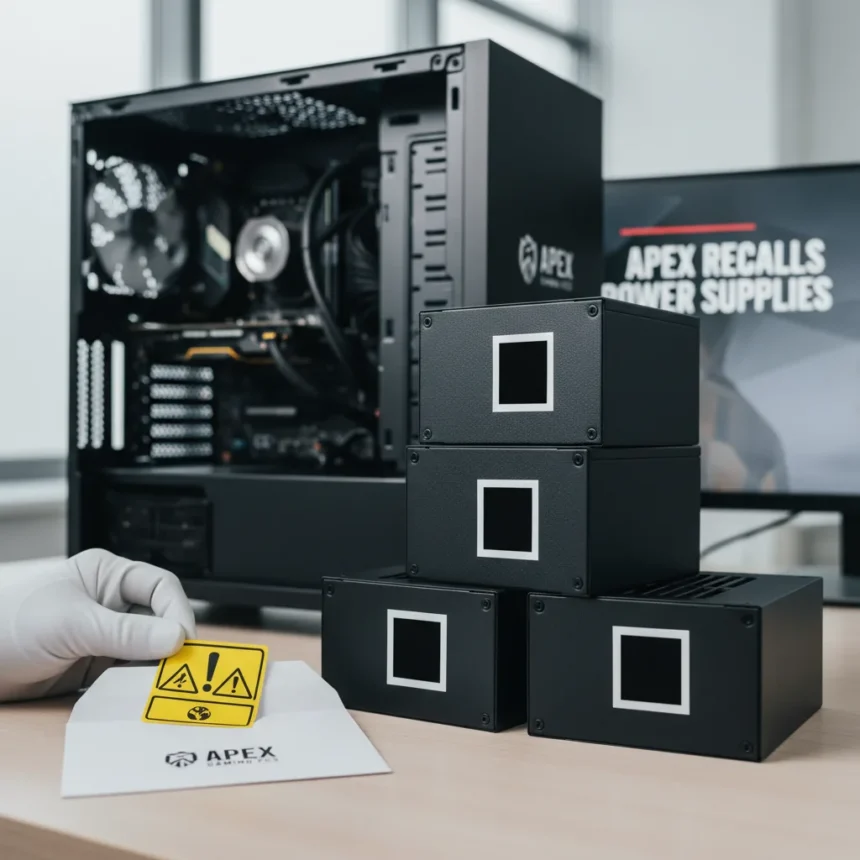
Apex Gaming PCs power supply recall announced April 16, 2026, affects nearly 18,000 units across the U.S. and Canada, but here is the twist: the units work fine. The recall addresses a single missing element—a permanent warning label on the product itself.
Key Takeaways
- Apex Gaming PCs recalled ~17,730 U.S. units and ~500 Canadian units of Manik and Apex-branded ATX power supplies sold December 2021 through February 2026.
- Hazard: missing permanent on-product warning label for electrical shock risk; no performance defect exists.
- Free remedy: adhesive safety label mailed by the company or free replacement unit with prepaid return label.
- Affected wattages: 450W, 750W, 1000W, and 1200W models in black or white.
- Contact Apex Gaming PCs at 833-946-1418 (U.S.) or 1-215-565-1069 (Canada) for the remedy.
What Triggered the Apex Gaming PCs Power Supply Recall
The U.S. Consumer Product Safety Commission (CPSC) and Health Canada jointly issued the recall because Apex-branded and Manik-branded ATX power supplies lack a permanent, on-product warning label alerting users to electrical shock and electrocution hazards. The units themselves carry no functional defect. “The power supply units are not being recalled due to a performance defect. The recall addresses the absence of a permanent on-product warning label,” according to Apex Gaming PCs’ official recall statement. The hazard emerges only if someone opens or disassembles the unit—something consumers should never attempt on a power supply.
The affected power supplies were sold both as standalone components and bundled inside pre-built gaming PCs from the Houston-based company between December 2021 and February 2026. Wattages range from 450W to 1200W, and units come in black or white housings. The design includes four precision-sized screws, with one covered by a security seal, making internal access intentionally difficult.
How the Remedy Works and What You Should Do Now
Apex Gaming PCs is offering two free remedies: consumers can request an adhesive safety label—UL-recognized, heat-resistant, and ANSI-compliant—mailed directly to their address, or they can request a replacement unit shipped with a prepaid return label for the original. Neither option costs the customer anything. The company is not asking affected users to stop using their power supplies immediately in the sense that they pose an active danger during normal operation; the risk only materializes if someone attempts to open the unit.

To claim the remedy, contact Apex Gaming PCs directly. U.S. customers can call 833-946-1418 (10 a.m.–5 p.m. CT, Monday–Friday), Canadians can reach 1-215-565-1069 (10 a.m.–5 p.m. CST, Monday–Friday), or anyone can email [email protected] or use the live chat at apexgamingpcs.com/pages/psu-recall. Have your product information ready when you contact them.
Why This Recall Matters for PC Builders
Power supplies are non-user-serviceable components. Opening one voids the warranty, risks severe electrical injury, and serves no legitimate maintenance purpose for most users. Yet regulatory bodies treat labeling as a critical safeguard against the small percentage of people who might attempt disassembly without understanding the danger. This recall underscores how even mature, established product categories face tightening compliance requirements. Unlike recalls tied to design flaws or manufacturing defects, this one targets a labeling gap—a reminder that regulatory oversight extends beyond performance to communication and user safety messaging.
The recall also highlights the distinction between a product being “safe” and a product being “compliant.” Apex’s power supplies operate without functional issues, but the absence of a permanent warning label creates regulatory liability. The remedy—a simple adhesive sticker—transforms a non-compliant unit into one that meets standards. This approach is far less disruptive than a full product replacement program, which is why the company is offering both the label and the replacement option.
Pricing and Availability of the Recalled Units
The recalled power supplies were priced between $70 and $150 USD when sold through ApexGamingPCs.com. They are no longer actively listed for sale as new stock, but existing units in customer systems remain in circulation. The free remedy ensures that anyone holding an affected unit can bring it into compliance without purchasing a replacement. This approach is consumer-friendly compared to recalls that offer no remedy or require out-of-pocket upgrades.
Frequently Asked Questions
Which Apex power supplies are affected by the recall?
The recall covers Manik- and Apex-branded ATX Computer Power Supplies in 450W, 750W, 1000W, and 1200W models, available in black or white, sold from December 2021 through February 2026. Check your unit’s label to confirm the brand and wattage, then contact Apex Gaming PCs if it matches.
Do I need to stop using my Apex power supply immediately?
No. The power supply poses no risk during normal operation. The hazard exists only if you attempt to open or disassemble the unit, which you should never do. Request the free warning label or replacement to ensure full compliance and peace of mind.


How long does it take to receive the warning label?
The research brief does not specify delivery timelines for the adhesive label. Contact Apex Gaming PCs directly at 833-946-1418 (U.S.) or 1-215-565-1069 (Canada) to ask about expected delivery dates when you request the remedy.
This recall is routine regulatory housekeeping, not a sign of systemic danger. If you own an affected Apex power supply, claim your free remedy and move on. The sticker takes minutes to apply and eliminates any compliance concern.
This article was written with AI assistance and editorially reviewed.
Source: Tom's Hardware