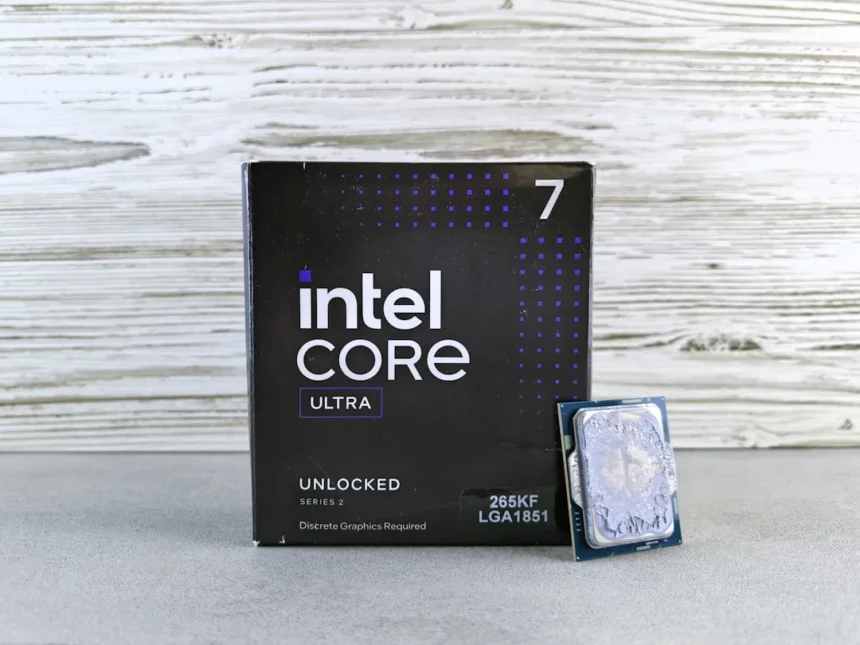
The Intel Core Ultra 7 270K Plus is Intel’s latest high-end desktop processor, part of the Arrow Lake refresh, and Newegg is currently selling it in a bundle priced at $1,499.99 that includes a Z890 motherboard, 64GB of DDR5 RAM, a 2TB SSD, a PC case, and an AIO cooler — everything you need except a GPU and PSU. For anyone planning a high-performance build from scratch, this is one of the most complete starting points on the market right now.
Key Takeaways
- The Newegg bundle costs $1,499.99 and includes CPU, Z890 motherboard, 64GB DDR5, 2TB SSD, case, and AIO cooler.
- The Intel Core Ultra 7 270K Plus has 24 cores and 24 threads, with a boost clock up to 5.4 GHz on performance cores.
- The 270K Plus adds four extra E-cores over the previous 265K, jumping from 20 to 24 total cores.
- A smaller Newegg bundle with 32GB DDR5-6000 and a Z890 board is available for $769.99, down from $1,009.97.
- To complete the full build, you still need a GPU and power supply — budget accordingly.
What Does the Intel Core Ultra 7 270K Bundle Actually Include?
The $1,499.99 Newegg bundle delivers the Intel Core Ultra 7 270K Plus CPU, a Z890 chipset motherboard, 64GB of DDR5 memory, a 2TB SSD, a PC case, and an AIO liquid cooler. That is a genuinely comprehensive foundation — the kind of component list that would take hours of cross-compatibility research to assemble manually. Add a GPU and PSU, and you have a working machine.
The CPU itself is no slouch. The Intel Core Ultra 7 270K Plus runs 8 performance cores and 16 efficiency cores for a total of 24 cores and 24 threads. Performance cores boost up to 5.4 GHz, efficiency cores reach 4.7 GHz, and the chip carries a 36MB L3 cache alongside a 40MB L2 cache, all under a 125W TDP. The Z890 motherboard supports both PCIe 5.0 and PCIe 4.0, which means there is headroom for next-generation storage and GPU connectivity.
How Does the Intel Core Ultra 7 270K Compare to Its Predecessor?
The Intel Core Ultra 7 270K Plus is a meaningful step up from the previous Core Ultra 7 265K. Intel added four efficiency cores — going from 12 to 16 — pushing the total core count from 20 to 24, while L2 cache expanded from 36MB to 40MB. That extra thread count matters most in workloads that can spread across many cores simultaneously.


In code compilation benchmarks, the 270K Plus completed tasks 22.6% faster than the Core Ultra 5 250K Plus. For video editors working in DaVinci Resolve, the chip’s multi-threaded architecture translates into noticeably faster render times. These are the scenarios where the extra cores justify the premium over mid-range options. Pure single-threaded gaming is a different story — the gains are less dramatic there, which is worth keeping in mind if your primary use case is 1080p competitive gaming.
Against AMD’s current lineup, the 270K Plus competes in the same tier as the Ryzen 9 9800X3D and 9850X3D. AMD’s 3D V-Cache chips have historically dominated in gaming-specific benchmarks, and that dynamic hasn’t changed with Arrow Lake. Where the 270K Plus pulls ahead is in productivity and mixed workloads — the kind of tasks that benefit from raw core counts rather than cache-heavy gaming optimisation.



Is the Intel Core Ultra 7 270K Bundle Worth the Price?
At $1,499.99, this bundle represents solid value if you were going to buy all these components anyway. Sourcing a Z890 motherboard, 64GB DDR5, a 2TB SSD, a case, and an AIO cooler separately would almost certainly cost more — and take far longer to configure. The bundle removes the compatibility guesswork that trips up first-time builders.
For those who don’t need the full kit, Newegg also offers a smaller bundle pairing the Core Ultra 7 270K Plus with a Z890 board and 32GB of G.Skill Trident Z5 RGB DDR5-6000 memory for $769.99, down from $1,009.97 — a 24% saving of $239.98. That option makes sense if you already own storage, a case, or a cooler from a previous build.
One pairing worth considering: team this bundle with an AMD Radeon RX 9070 XT GPU, which averages around $700, and you have a high-performance gaming and creative workstation for under $2,300 all-in (excluding PSU). That’s a compelling proposition compared to building around AMD’s own 9800X3D platform, where the CPU alone commands a significant premium.
Should you buy the Intel Core Ultra 7 270K bundle or build separately?
If you are starting from zero — no existing components, no spare DDR5 RAM sitting in a drawer — the $1,499.99 bundle is almost certainly cheaper and faster than buying each part individually. Bundle pricing typically reflects a discount over retail sum, and the included AIO cooler alone saves you from a separate purchase decision. If you already own some components, the smaller $769.99 bundle or buying the CPU standalone makes more financial sense.



How does the Core Ultra 7 270K Plus compare to AMD Ryzen for gaming?
AMD’s Ryzen 9 9800X3D and 9850X3D remain the go-to choices for pure gaming performance, thanks to their 3D V-Cache architecture. The Intel Core Ultra 7 270K Plus closes the gap in multi-threaded workloads and productivity tasks, making it the stronger pick for creators and developers who also game, rather than dedicated gamers who do little else.
What else do you need to complete the build?
The Newegg bundle explicitly requires a GPU and a power supply unit to function as a complete PC. The Z890 platform and a chip with a 125W TDP will demand a capable PSU — factor that into your total budget before committing. The bundle does not include a monitor, peripherals, or an operating system either, so the true all-in cost will run higher than $1,499.99.
The Intel Core Ultra 7 270K bundle is a rare deal that actually delivers on its promise — a near-complete, high-performance build foundation at a price that would be hard to replicate by shopping individually. It won’t suit every buyer, but for anyone ready to commit to Arrow Lake and the Z890 platform, this is the most efficient path to a powerful machine available right now.
Where to Buy
deeper | into | our | specialized | pages
Edited by the All Things Geek team.
Source: Tom's Hardware