






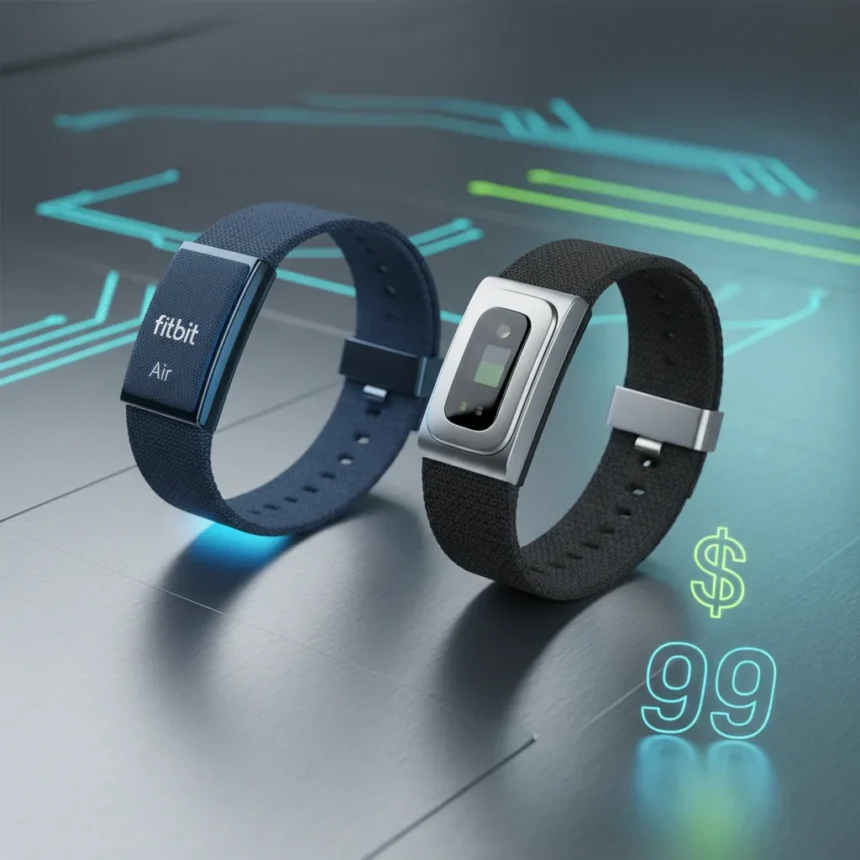
The Fitbit Air screenless tracker is a rumored lightweight fitness band from Google positioned as a direct challenge to Whoop’s market dominance, expected to launch this summer at approximately $99. Google teased the device at the end of March 2026, with NBA star Stephen Curry wearing it in an Instagram post featuring a gradient ‘G’ logo—no Fitbit branding visible. The name “Air” references the thinner, ultralight design intended for genuine 24/7 wear, echoing Apple’s MacBook Air naming convention for premium-but-accessible products.
Key Takeaways
- Fitbit Air screenless tracker teased by Google in late March 2026, worn by Stephen Curry in promotional post
- Rumored $99 price point positions it as affordable alternative to Whoop 5.0’s premium positioning
- Summer 2026 launch expected, with retailer leaks citing May 16, 2026 as potential release date
- Requires companion app and subscription service, similar to Whoop’s model
- Part of Google’s broader “Google Health” rebrand of Fitbit Premium with AI coaching features
Fitbit Air Screenless Tracker Design and Philosophy
The Fitbit Air screenless tracker abandons the display entirely—a deliberate move that mirrors Whoop’s strategy of minimizing distraction while maximizing battery life and comfort. This isn’t Google’s first “Air” product; the Fitbit Aria Air smart scale launched in 2019 and remains available at $49.95, establishing the “Air” line as budget-friendly, feature-focused hardware. The screenless approach forces users toward the companion mobile app for all data interpretation, a dependency that Whoop has monetized successfully through subscription tiers.
Leaked images suggest the Fitbit Air screenless tracker will ship with Performance Loop Band options in multiple colorways, prioritizing comfort and durability for continuous wear. The band-only form factor eliminates the bulk that makes traditional smartwatches uncomfortable during sleep or extended wear—a direct jab at Apple Watch and Garmin’s screen-first design philosophy.
How Fitbit Air Screenless Tracker Compares to Whoop 5.0
Whoop 5.0 remains the screenless fitness tracker category leader, but its premium positioning and subscription-heavy model leave room for disruption. The Fitbit Air screenless tracker’s $99 rumored price undercuts Whoop’s positioning significantly, though both devices require paid subscriptions to unlock full functionality. Whoop forces users into its ecosystem and pricing structure; Google’s Fitbit Premium (rebranding to “Google Health”) offers AI-powered health coaching through a different subscription model, giving users an alternative ecosystem.



The critical difference lies in ecosystem lock-in. Whoop users commit to the band and the Whoop app exclusively; Fitbit Air screenless tracker users gain integration with Google’s broader health infrastructure, including Google Fit and other Android-native health services. This ecosystem advantage could matter more than hardware specs for Android-first users already embedded in Google services.
Fitbit Air Screenless Tracker Launch Timeline and Availability
Google’s official announcement is expected “in the coming weeks” as of mid-April 2026, according to multiple leaks. A retailer RRP of approximately $99 suggests aggressive pricing to capture price-sensitive fitness enthusiasts who view Whoop’s $30-per-month subscription as premium positioning. The May 16, 2026 retailer leak date hints at a summer rollout, though Google has not confirmed specifics.



Regional availability remains unclear—the brief mentions no international pricing or rollout strategy. Expect the Fitbit Air screenless tracker to launch first in the US market, with global expansion following typical Google hardware patterns.
What Makes the Fitbit Air Screenless Tracker Significant Now
This is Google’s first new Fitbit-branded wearable in years, arriving as Fitbit Premium undergoes rebrand to “Google Health” with AI health coaching features currently in preview. The timing matters: Whoop has dominated the screenless tracker space by positioning itself as a premium alternative to smartwatches. Google’s Fitbit Air screenless tracker directly challenges that premium perception with budget pricing and ecosystem integration.
The Stephen Curry teaser signals serious marketing commitment—Google is not quietly launching this device. Pairing a celebrity endorsement with aggressive pricing suggests Google views Whoop disruption as a strategic priority, not a side project.
Will the Fitbit Air Screenless Tracker Actually Compete with Whoop?
Price alone does not guarantee market share. Whoop’s $30-per-month subscription costs roughly $360 per year; the Fitbit Air screenless tracker’s subscription pricing remains unconfirmed but will likely undercut Whoop to justify the $99 hardware price. Whoop’s ecosystem is mature and community-driven; Fitbit Air screenless tracker users gain Google’s health AI but lose Whoop’s proprietary strain and recovery algorithms.

The real question: can Google convert Android users who tolerate Whoop’s walled garden? If Fitbit Air screenless tracker integrates meaningfully with Android’s native health stack and Google Fit, it becomes a no-brainer for Android-first users. If it mirrors Whoop’s closed ecosystem, the price advantage evaporates.
Is the Fitbit Air screenless tracker launching in 2026?
Yes, according to retailer leaks and Google’s teaser campaign, the Fitbit Air screenless tracker is expected to launch this summer 2026, with May 16, 2026 cited as a potential release date. An official announcement from Google is anticipated within weeks of April 2026.
How much will the Fitbit Air screenless tracker cost?
The rumored retail price is approximately $99 USD, positioning it as significantly cheaper than Whoop 5.0’s premium positioning. Subscription costs for the companion service remain unconfirmed but are expected to undercut Whoop’s $30-per-month tier.
Does the Fitbit Air screenless tracker have a screen?
No. The Fitbit Air screenless tracker is designed as a screenless band, relying entirely on a companion mobile app for data display and analysis. This mirrors Whoop’s approach and prioritizes comfort and battery life over real-time on-wrist feedback.
Google’s Fitbit Air screenless tracker represents the company’s clearest attempt yet to challenge Whoop’s dominance in the premium-but-accessible fitness tracker space. At $99, it undercuts Whoop’s positioning without sacrificing the ecosystem integration that Android users expect. The real test arrives this summer when the device launches—and when Google reveals subscription pricing that will ultimately determine whether the Fitbit Air screenless tracker becomes a genuine Whoop rival or a footnote in Google’s wearable history.
This article was written with AI assistance and editorially reviewed.
Source: Tom's Guide