




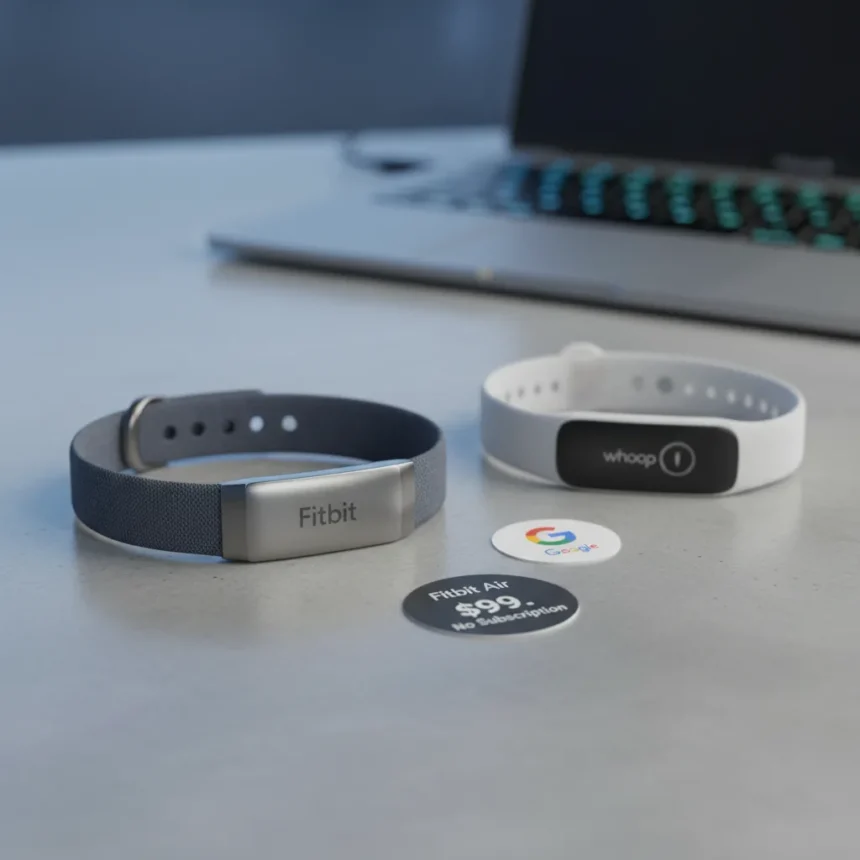
Fitbit Air is a screenless fitness tracker made by Google, expected to launch May 16 at around $99 with no monthly subscription required, marking Fitbit’s return as a direct competitor to Whoop. Multiple leaks from 9to5Google, Droid-Life, Android Central, TechRadar, and Android Authority have revealed the device’s core strategy: lightweight passive tracking without a display, sold as a one-time purchase rather than a subscription trap.
Key Takeaways
- Fitbit Air launches May 16 at approximately $99 with zero monthly fees for core health data
- Screenless design emphasizes minimal weight and simplicity, inspired by early Fitbit pedometers
- Tracks sleep, heart rate, HRV, and activity passively without requiring a display
- NBA star Stephen Curry has been teasing the device on social media
- Google is shifting focus from Apple Watch rivalry to directly challenging Whoop’s subscription model
Fitbit Air vs. Whoop: The $99 Gambit
Fitbit Air’s fundamental advantage over Whoop lies in its pricing structure. Whoop offers free hardware but charges a monthly subscription for access to health insights—a model that locks users into recurring payments. Fitbit Air flips this: you pay $99 upfront, no subscription required for core features like sleep tracking, heart rate monitoring, and activity data. This is Google’s calculated move to undercut Whoop’s ecosystem lock-in, betting that fitness enthusiasts prefer ownership over subscription dependency.
The screenless design mirrors Whoop’s minimalist approach, but Fitbit Air takes it further by reducing the device to its essential function: passive health tracking. No notifications, no screen bloat, no smartwatch pretensions. According to leaked details, the form factor echoes early Fitbit pedometers and sits conceptually alongside devices like the Ultrahuman Ring Air, suggesting Google is targeting users who value simplicity over feature density.
Design and Features: Less is More
Fitbit Air strips away the screen entirely, prioritizing lightweight construction and continuous passive monitoring. The device will track sleep quality, heart rate variability (HRV), activity levels, and general heart rate without requiring user interaction. This passive-first approach suits users who want health insights without managing notifications or battery drain from a display.

Multiple color options will be available at launch, giving buyers aesthetic choice despite the minimalist hardware. The design philosophy echoes the MacBook Air branding strategy—removing perceived complexity to emphasize core utility. Early Fitbit trackers succeeded with this formula; Fitbit Air is betting the market still values it.
Launch Timeline and Pricing
Supplier and retail data leaked by Droid-Life point to a May 16 launch date, with the device priced around $99 as a one-time purchase. No monthly fees apply to core health insights, a direct rejection of Whoop’s subscription model. Google has not officially confirmed the name, launch date, or pricing—all details remain leaked and unconfirmed—but the consistency across multiple sources suggests credibility.


The timing aligns with Google’s broader health strategy. If Fitbit Air launches as expected, it signals Google’s commitment to competing in the premium fitness-tracking space without relying on wearable ecosystem lock-in. The device may eventually integrate with Google Health, a rumored rebrand of Fitbit Premium, deepening Google’s control over health data.
Why Fitbit’s Return Matters Now
Fitbit has been quietly sidelined since Google acquired the company. Fitbit Air represents a strategic pivot: instead of competing with Apple Watch’s smartwatch dominance, Google is targeting a narrower, more profitable segment—users who want health tracking without the bloat. Whoop dominates this space with its subscription model, but Fitbit Air’s one-time payment structure could disrupt that advantage.
Stephen Curry’s public teasing of the device suggests Google is confident enough to use celebrity endorsement before an official announcement, a move that typically precedes a major product launch. This level of pre-launch buzz indicates Google is treating Fitbit Air as a genuine competitor to Whoop, not a legacy product refresh.
What Remains Unconfirmed
The official name remains uncertain—it could be branded as Fitbit Air or Google Fitbit Air depending on how deeply Google integrates the brand. Battery life, exact sensor specifications, and regional availability have not been disclosed. The $99 price and May 16 launch are based on leaked supplier and retail data, not official statements. Until Google makes an announcement, treat all details as informed speculation rather than confirmed facts.


Will Fitbit Air actually compete with Whoop?
Yes, structurally it should. Fitbit Air’s one-time $99 purchase eliminates Whoop’s primary revenue model—the monthly subscription. However, Whoop’s ecosystem, community, and proprietary algorithms give it an entrenched advantage. Fitbit Air wins on price and ownership; Whoop wins on data depth and user loyalty. The real competition depends on whether Google’s health insights are compelling enough to justify switching.
Is Fitbit Air really launching in May?
Droid-Life’s supplier and retail data suggest May 16, but this is not officially confirmed by Google. Leaks are accurate more often than not in the wearables space, but delays happen. Expect an official announcement from Google closer to the launch window.
What happened to Fitbit after Google bought it?
Google acquired Fitbit but largely kept it as a legacy brand, focusing instead on Wear OS smartwatches to compete with Apple Watch. Fitbit Air represents Google’s decision to revive the brand in a new category—screenless health trackers—rather than retire it entirely.
Fitbit Air is Google’s calculated bet that fitness enthusiasts are tired of subscription fees and smartwatch feature bloat. At $99 with no monthly commitment, it undercuts Whoop’s model while maintaining the simplicity early Fitbit users loved. Whether it succeeds depends on execution and whether Google can match Whoop’s data insights without the subscription revenue to fund them. The May 16 launch will be worth watching.
Where to Buy
This article was written with AI assistance and editorially reviewed.
Source: T3