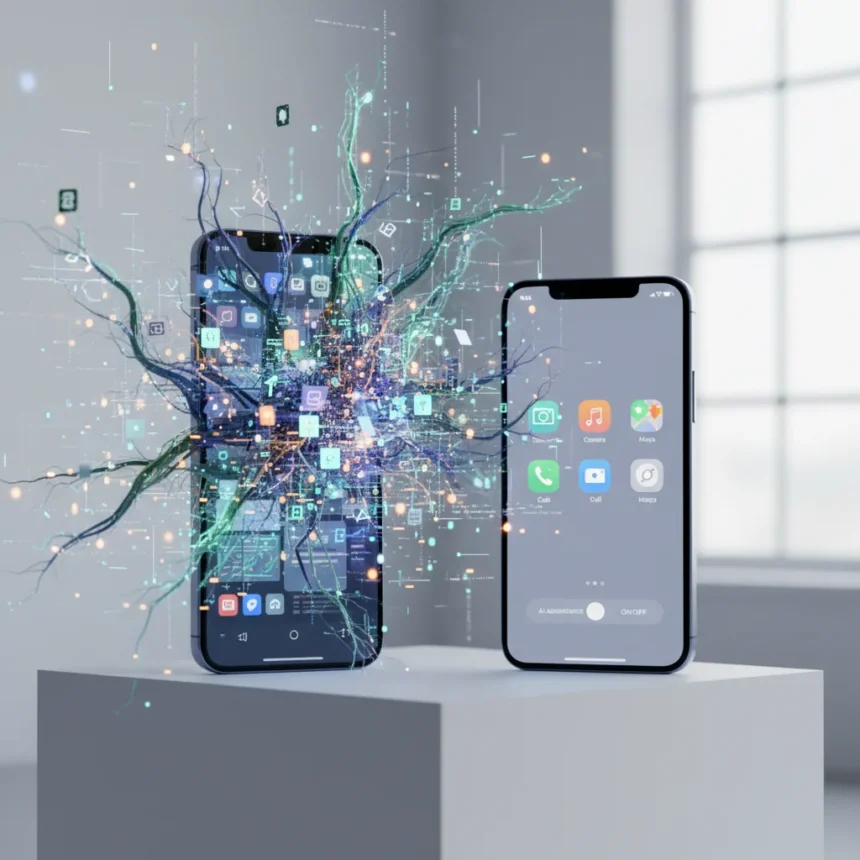
AI smartphone bloat is strangling adoption before it starts. Manufacturers are cramming autonomous intelligence into devices already overloaded with apps, settings, and competing features, yet users continue to ignore specialized AI tools in favor of simple, familiar workarounds.
Key Takeaways
- Smartphone overcrowding with AI features risks alienating users rather than expanding adoption.
- Users prioritize task-focused combinations of generic tools over standalone AI applications.
- Smartphone “smartness” comes from user customization and agency, not built-in autonomous learning.
- Simplicity and flexibility trump feature density in driving real user engagement.
- User-led personalization outperforms top-down corporate AI integration strategies.
Why Smartphones Are Drowning in AI Features
Historically, smartphones have served as the default platform for integrating emerging technologies. Manufacturers assumed the same approach would work for AI, but the strategy is backfiring. Instead of enhancing the device, AI integration is creating cognitive overload. Users face an expanding maze of features, apps, and autonomous functions competing for attention, making the experience less intuitive rather than more.
The problem runs deeper than feature count. Each new AI capability assumes users want corporate-designed intelligence embedded in their phones. Reality tells a different story. Users don’t adopt these features because they don’t solve problems users actually have—or worse, they solve problems users have already solved with simpler tools.
The Simplicity Advantage: Why Users Choose Generic Over Specialized
Users consistently repurpose generic tools across multiple tasks rather than adopting specialized applications designed for single purposes. A user needing health information, workout tips, or medical advice does not open a dedicated health app. Instead, they combine WhatsApp conversations with quick Google searches, crafting a personalized solution on the fly.


This pattern reveals a fundamental truth about smartphone adoption: users value flexibility and control over algorithmic optimization. When a phone offers both a specialized health app and the freedom to combine WhatsApp with search, users choose the latter because it grants agency. They decide what information matters, which contacts provide relevant insights, and how to synthesize answers. Autonomous AI removes that control.
Smartphones succeed when they complement human capacities—extending memory, enabling communication, providing access to information—rather than attempting to anthropomorphize intelligence or mimic human decision-making. The distinction matters. A calculator extends mathematical ability. An AI that “learns your preferences” and makes decisions on your behalf creates friction and distrust.



The User-Driven Craft of Smartphone Personalization
True smartphone “smartness” stems not from built-in AI or autonomous learning, but from user customization. Selecting apps, adjusting settings, curating content, and combining tools in unexpected ways—this is where intelligence emerges. Users are craftspeople, not passive recipients of corporate algorithms.
This user-led approach contrasts sharply with top-down AI imposition. When manufacturers force AI into devices, they assume one-size-fits-all solutions work globally. They do not. A health app designed by engineers in Silicon Valley may ignore how users in other regions actually seek medical guidance. A recommendation algorithm may prioritize engagement metrics over accuracy. But a user who combines WhatsApp with their trusted local contacts and a search engine controls the outcome.
The concept of “Scalable Solutionism” captures this dynamic: users repurpose apps flexibly across varying tasks, extending social connectivity for different group sizes and privacy levels. They are solving problems by remixing existing tools, not adopting new specialized features. Manufacturers who recognize this pattern and prioritize simplicity and interoperability will capture adoption. Those who double down on feature bloat will watch users ignore their innovations.
What Smartphone Makers Should Learn From User Behavior
The path forward requires a fundamental shift in philosophy. Instead of asking “What AI features can we add?” manufacturers should ask “How can we remove friction and expand user agency?” Simplicity is not the absence of capability—it is the removal of unnecessary complexity.



Users across global markets have demonstrated remarkable creativity in personalizing their phones. They combine tools, develop workarounds, and build workflows tailored to their specific contexts. Rather than fighting this instinct with pre-built AI solutions, manufacturers should enable it. Provide clean APIs, ensure apps interoperate smoothly, and let users decide how to combine capabilities.
The irony is sharp: as AI proliferates, smartphone adoption will be driven not by smarter devices, but by simpler ones. Devices that get out of the way. Devices that trust users to decide what intelligence means for their lives. Devices that offer tools rather than algorithms. The smartphone that wins the next cycle will be the one that recognizes this shift and acts accordingly.
Will AI features actually improve smartphone adoption rates?
Not without simplicity. Feature overload has historically reduced adoption, not increased it. Users ignore capabilities they do not understand or cannot easily control. AI features bundled into phones risk the same fate unless manufacturers prioritize clarity, user control, and genuine utility over algorithmic sophistication.
Why do users prefer combining generic tools over using specialized AI apps?
Generic tools offer flexibility and user control. A specialized health app follows one designer’s assumptions about health. Combining WhatsApp with search lets users choose sources, synthesize information, and make decisions themselves. Control and agency drive adoption more reliably than algorithmic optimization.
Is smartphone “smartness” really about built-in AI or user customization?
It is overwhelmingly about user customization. Smartphones become smart when users select apps, adjust settings, and curate content to match their needs. Built-in AI that operates autonomously without user input often reduces perceived smartness by introducing unpredictability and limiting control.
The smartphone industry faces a choice. Continue packing devices with AI features designed in corporate headquarters, or step back and recognize that true intelligence on smartphones comes from users themselves. Simplicity, flexibility, and user agency are not obstacles to adoption—they are the foundation of it. Manufacturers who embrace this reality will lead the next era of smartphone adoption. Those who don’t will watch their innovations gather dust in settings menus.
Edited by the All Things Geek team.
Source: TechRadar