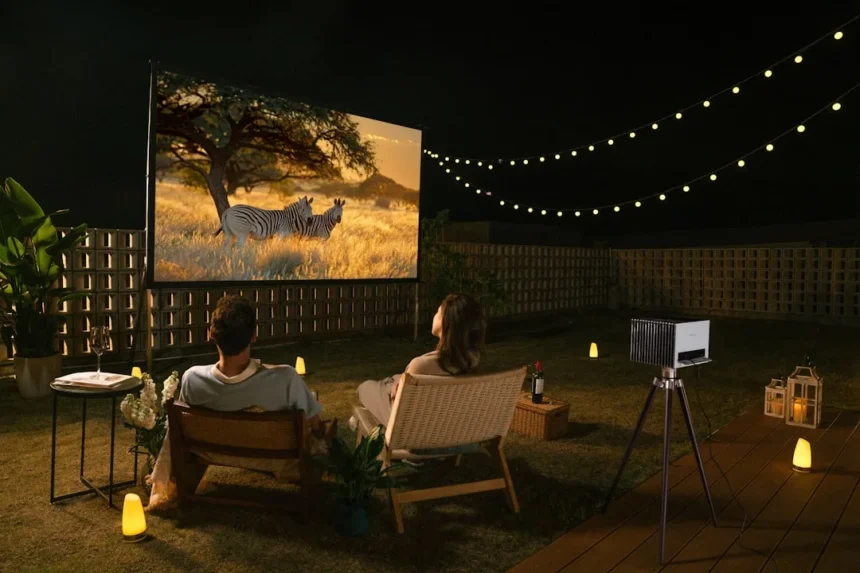
Setting up an outdoor cinema portable projector correctly can transform your garden into an entertainment venue, but most people skip critical steps that determine whether the experience succeeds or fails. Summer is peak season for outdoor entertaining, and a portable projector offers flexibility that fixed installations cannot match. Yet without proper setup fundamentals, even premium models underperform.
Key Takeaways
- Portable projectors require specific environmental conditions to deliver their rated brightness and image quality
- Screen placement and ambient light control are more important than projector wattage alone
- Cable management and power solutions directly impact both safety and viewing comfort
- Regular maintenance extends projector lifespan and prevents mid-season performance drops
- Budget for accessories—a quality screen costs as much as some entry-level projectors
Outdoor Cinema Portable Projector Placement Matters More Than You Think
Where you position your outdoor cinema portable projector determines everything from image size to heat management. Most users place projectors on tables or tripods at random distances from their screen, then adjust settings afterward. This is backward. Start by measuring your space. Portable projectors have fixed throw ratios—the relationship between distance and image size. Place the projector too close and you get a small, dim image. Too far and the lens struggles to focus. Calculate your ideal throw distance before buying or setting up, not after. A projector designed for 1.5:1 throw ratio needs to be positioned at a specific distance to fill a given screen size correctly.
Heat dissipation becomes critical outdoors. Unlike indoor setups where air conditioning helps, garden cinemas expose projectors to ambient temperatures and restrict airflow around vents. Position your projector where it receives shade or can sit on a heat-dissipating surface. Metal tables work better than wood because they radiate heat away from the device. If your projector sits in direct sun for hours before viewing, internal components will throttle performance or shut down entirely as a safety measure. Plan your setup with shade in mind, even if it means repositioning furniture or using a pop-up canopy.
Screen Quality Determines Your Entire Image
A white wall or bedsheet is not a screen. This is the single biggest mistake outdoor cinema enthusiasts make. Portable projectors produce lower light output than fixed installations, so every lumen counts. A proper outdoor projector screen has gain—a reflective coating that bounces projected light back toward the audience instead of scattering it. Gain values typically range from 1.0 (no amplification) to 1.5 or higher. Even a 1.2 gain screen makes a dramatic difference in brightness and contrast compared to a flat white surface. The screen also controls light spill, keeping stray light off your neighbors’ properties and reducing glare that washes out the image.


Fabric matters. Vinyl screens resist moisture and mildew better than cloth, critical for outdoor storage. Aluminum or steel frames keep the screen taut and prevent wrinkles that destroy image uniformity. Portable projector screens designed for gardens typically range from 100 to 150 inches diagonal. Smaller screens (80-100 inches) work for intimate gatherings in tight spaces. Larger screens (150+ inches) require more powerful projectors to maintain brightness across the entire surface. Your screen investment should equal or exceed your projector cost if you want professional results. Skimping here guarantees disappointment.
Ambient Light Control Is Non-Negotiable
Outdoor cinema portable projector performance depends entirely on controlling light. Even a small outdoor cinema portable projector with modest brightness specs can deliver stunning images in near-darkness, but the same projector looks washed out in twilight. Plan your viewing time around sunset. Start movies after dusk when ambient light drops below 5 lux (roughly the brightness of a full moon). If you must view earlier, invest in light-blocking solutions. Landscape lighting around your seating area should be warm-colored and dimmable, not bright white. Warm light (2700K color temperature) is less visible to the eye than cool white light at the same brightness level, so you can maintain ambient lighting without destroying image contrast.



Consider your neighbors and local light pollution. If you’re in a suburban area, nearby streetlights or porch lights may wash your screen even if your own yard is dark. Position your screen away from these light sources or angle it downward slightly to reduce ambient reflection. A black backdrop behind the screen prevents light from scattering into the neighborhood and keeps your image crisp. Black cloth or landscape fabric hung behind the screen serves this purpose. This setup also improves perceived contrast by eliminating light from reflecting off surrounding surfaces back toward the audience.
Power and Cable Management Prevents Disasters
Portable projectors draw significant power, and outdoor environments introduce moisture, trip hazards, and temperature extremes. Never run a projector from an indoor outlet through an open window or door. Water damage voids warranties and creates electrical hazards. Install a weatherproof outdoor outlet rated for your region’s climate, or use a heavy-duty extension cord designed for outdoor use. Standard indoor extension cords degrade quickly outdoors and present fire risks. If you must use an extension cord, keep it at least 10 feet from water sources and secure it to prevent tripping.
Cable organization matters more outdoors than indoors. HDMI cables exposed to UV light and temperature swings fail faster than those in climate-controlled spaces. Use cable covers or conduit to protect HDMI and power cables from the elements. Label every cable at both ends so you can troubleshoot quickly if something fails mid-movie. Bring spare HDMI cables and a power strip with surge protection. A single power surge from a nearby lightning strike can destroy your projector, receiver, and streaming device simultaneously. Surge protection is cheap insurance against a thousand-dollar loss.
Maintenance Keeps Your Projector Running All Summer
Outdoor environments introduce dust, pollen, and moisture that degrade projector optics and cooling systems. Clean the lens before every viewing with a microfiber cloth designed for optics. Dust buildup reduces brightness and causes hot spots on the screen. Check the air filter monthly and replace it if it shows visible dust or discoloration. A clogged filter forces the cooling system to work harder, reducing projector lifespan and increasing thermal throttling. If your projector has a removable lens, store it indoors in a sealed case when not in use. Moisture and temperature swings cause internal condensation that damages coatings and electronics.



Store your projector indoors after each use, even if you plan to set up again the next night. Dew forms on outdoor surfaces after sunset, and a projector left outside absorbs moisture that takes hours to evaporate. This condensation accumulates inside optical elements and electronics, leading to fungus growth and component failure. A projector stored in a cool, dry closet or cabinet lasts years longer than one left outdoors. If you must store it outside, use an airtight weatherproof case with desiccant packs to absorb moisture.
FAQ
What’s the minimum brightness needed for outdoor cinema?
Portable projectors should deliver at least 1000 ANSI lumens for outdoor use in twilight conditions. In near-total darkness, 500-800 lumens suffices. Brightness alone does not guarantee image quality—screen gain and ambient light control matter equally. A 1000-lumen projector on a 1.5 gain screen in a dark garden outperforms a 2000-lumen projector on a white wall in ambient light.
Can you use a portable projector for outdoor cinema year-round?
Most portable projectors tolerate temperatures between 50°F and 104°F (10°C to 40°C). Winter use is possible in mild climates, but cold temperatures reduce battery life and increase warm-up time. Summer heat is the bigger challenge—projectors throttle performance if internal sensors detect overheating. Store your projector indoors and use it only during comfortable months unless you invest in climate-controlled outdoor housing.
How far should a portable projector sit from the screen?
Throw ratio determines this. A 1.5:1 projector sitting 15 feet from the screen produces roughly a 100-inch image. Check your projector’s specifications for exact throw ratio, then use that to calculate your ideal distance. Measure twice before positioning equipment, as moving heavy projectors repeatedly damages cables and mounting hardware.
Outdoor cinema setup succeeds when you treat it as an engineering problem, not an afterthought. Invest in proper screens, control ambient light, position equipment thoughtfully, and maintain your gear consistently. These four fundamentals separate memorable summer evenings from frustrating experiments with disappointing image quality.
Edited by the All Things Geek team.
Source: What Hi-Fi?