






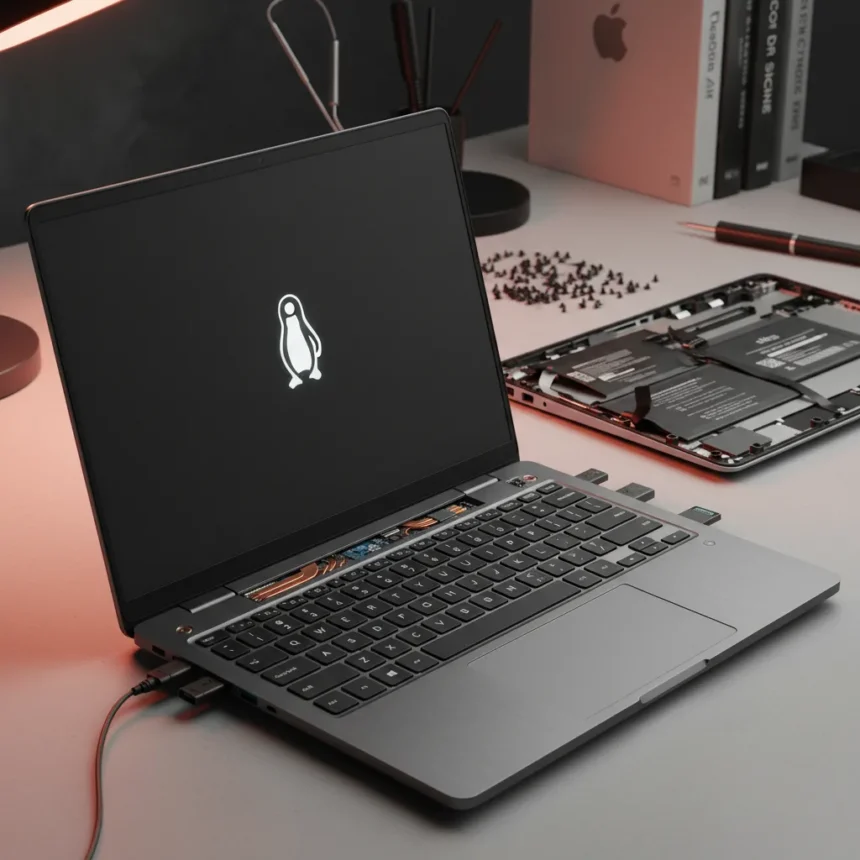
The Framework Laptop 13 Pro is a redesigned ultrabook that swaps soldered components and sealed logic boards for a modular architecture that lets users upgrade RAM, storage, and ports years after purchase. Available with Intel Core Ultra Series 3 or AMD Ryzen AI 300-series processors, it directly targets Linux professionals frustrated by Apple’s repairability stance.
Key Takeaways
- CNC-machined aluminum chassis marks the first major redesign since 2023, improving rigidity and premium feel.
- Intel Core Ultra Series 3 (Lunar Lake) delivers 40+ TOPS AI performance with up to 12+ hours claimed battery life.
- Haptic glass touchpad with force feedback and Wi-Fi 7 support enhance daily usability across Linux distributions.
- Upgradable to 96GB DDR5-5600 RAM and 8TB NVMe storage; mainboards remain interchangeable with prior generations where compatible.
- Starts at $1,099 for DIY Intel config; pre-built Ubuntu models from $1,499.
Framework Laptop 13 Pro Chassis and Design Overhaul
Framework’s first major chassis redesign introduces CNC-machined aluminum construction that improves structural rigidity while maintaining the 3.3-pound weight target. The new frame feels noticeably more premium than the previous plastic-and-magnesium hybrid, reducing flex and creaking during typing or port access. This matters because Framework’s entire value proposition rests on users swapping components repeatedly—a loose chassis would undermine that promise.
The redesigned keyboard reduces actuation force and resonance, addressing a common complaint from early adopters. The haptic glass touchpad with force feedback replaces the mechanical clickpad, delivering tactile confirmation without the acoustic snap that can feel jarring in quiet environments. These aren’t flashy upgrades, but they’re the kinds of refinements that separate a tolerable portable from one you actually enjoy using for eight hours straight.
Intel Core Ultra Series 3 Performance and Linux Optimization
The Framework Laptop 13 Pro ships with Intel Core Ultra Series 3 processors (Lunar Lake architecture), delivering 40+ TOPS of AI performance alongside traditional CPU workloads. The Core Ultra 7 258V configuration offers the balance most users need, though Framework also sells Core Ultra 5 and higher variants. For Linux developers accustomed to older Intel chips, the efficiency gains are substantial—this generation prioritizes power-per-watt in ways that extend battery life on battery-dependent workflows.


AMD Ryzen AI 300-series variants (such as the Ryzen AI 7 350 with 8-core/16-thread performance up to 5.0GHz and Radeon 860M iGPU) are available as alternatives, offering comparable 50 TOPS NPU performance. This internal competition is healthy; buyers aren’t forced into Intel’s ecosystem if AMD’s thermal profile or GPU performance suits their workload better. The inclusion of pre-loaded Ubuntu Linux removes the friction of sourcing and installing a distribution yourself, though users comfortable with manual setup can choose Windows 11 Pro and swap later.
Modularity and Upgrade Path: Where Framework Laptop 13 Pro Stands Apart
The Framework Laptop 13 Pro retains the modular Expansion Card system that defines the brand. Users configure USB-C, USB-A, HDMI, DisplayPort, and Ethernet ports without committing to a fixed layout. This flexibility matters more on a 13.5-inch screen than on a 16-inch workstation—every port slot is premium real estate, and Framework lets you reclaim unused ports for charging, storage, or networking as your needs evolve.


Upgradable components include up to 96GB DDR5-5600 RAM and up to 8TB NVMe storage, with mainboards remaining interchangeable with prior Framework generations where compatible. This means a user who bought a 2023 Framework Laptop 13 can drop a new Core Ultra mainboard into their existing chassis, preserving the aluminum build and keyboard they already know. Apple’s MacBook Pro, by contrast, locks users into their original configuration—soldered RAM, proprietary storage, and sealed thermal systems mean a 2024 MacBook cannot be meaningfully upgraded. For Linux users who value control and longevity, this architectural difference is the entire story.
Display and Battery Upgrades
Framework offers two display options: a 2256×1504 60Hz matte IPS panel or an upgraded 2880×1920 120Hz IPS screen. The higher-refresh panel is sharper for text and smoother for scrolling, though at 13.5 inches the pixel density difference is subtle unless you sit very close. Both are matte, eliminating glare—a practical choice for Linux developers who spend hours in terminal windows or documentation.
The new 61Wh battery (up from the previous 55Wh) claims over 12 hours of runtime under typical Linux workloads. Real-world performance will vary based on CPU load, display brightness, and whether you’re running power-hungry applications, but the capacity increase is a tangible improvement. For remote work or travel, longer battery life reduces the need to hunt for outlets.
Pricing and Availability
The Framework Laptop 13 Pro starts at $1,099 for a DIY configuration with Intel Core Ultra 5, 16GB RAM, and 512GB SSD. Pre-built models with Ubuntu Linux pre-installed begin at $1,499. Expansion Cards, display upgrades (such as the 120Hz panel at $199), and additional RAM or storage modules are sold separately through the Framework Marketplace. The DIY tier appeals to Linux enthusiasts comfortable with assembly; pre-built options suit buyers who want immediate productivity without opening the chassis.



Framework positions itself as available now for pre-order and shipping in the US and EU, with global expansion ongoing. Availability outside these regions may involve longer lead times or regional resellers—check Framework’s official store for your country.
Framework Laptop 13 Pro vs. MacBook Pro: The Repairability Divide
MacBook Pro remains the performance and ecosystem standard for creative professionals, with superior thermal management and OS-level optimization. But MacBook Pro achieves this through sealed, soldered designs that render the machine unrepairable after purchase. A cracked MacBook Pro display means buying a new logic board; a failed MacBook Pro battery requires an authorized service center and hundreds in labor costs. Framework Laptop 13 Pro sacrifices some thermal efficiency and polish for the ability to replace nearly every component yourself. If you value repairability, longevity, and ecosystem independence, Framework wins decisively. If you prioritize raw performance and seamless integration with iOS/iPadOS, MacBook Pro remains the safer choice.
Should You Buy the Framework Laptop 13 Pro?
Yes, if you use Linux professionally or as your primary OS and value repairability and modularity over sealed, optimized design. The Intel Core Ultra Series 3 delivers sufficient performance for development, content creation, and productivity work. The modular port system and upgradeable internals mean your investment remains relevant for years, even as your needs change. The $1,099 entry price is competitive with MacBook Air but buys you a machine you can actually fix and upgrade.
Skip it if you depend on macOS-exclusive software, prefer closed ecosystems, or need the absolute fastest thermal performance. Linux support, while strong with Ubuntu pre-installed, may require additional tweaking for niche distributions or hardware integrations.
What processors are available in the Framework Laptop 13 Pro?
Intel Core Ultra Series 3 (Core Ultra 5, 7, and higher) and AMD Ryzen AI 300-series (such as Ryzen AI 7 350) are the primary options. Both deliver comparable AI performance (40+ TOPS for Intel, 50 TOPS for AMD) and sufficient power for professional Linux workflows.
Can you upgrade the Framework Laptop 13 Pro after purchase?
Yes. You can upgrade RAM to 96GB DDR5-5600, storage to 8TB NVMe, swap the mainboard with compatible older generations, and reconfigure Expansion Cards at any time. This is the core value proposition—unlike sealed laptops, Framework machines evolve with your needs.
Does the Framework Laptop 13 Pro come with Linux pre-installed?
Pre-built models ship with Ubuntu Linux pre-loaded, eliminating installation friction. DIY configurations ship with Windows 11 Pro, allowing you to install your preferred Linux distribution. Framework officially supports Ubuntu, but users can run any distribution compatible with modern Intel or AMD hardware.
The Framework Laptop 13 Pro succeeds because it makes a simple but radical choice: prioritize repairability and modularity over the sealed optimization that dominates the ultrabook market. For Linux users tired of buying new hardware every three years because a battery died or RAM maxed out, it’s the most coherent alternative to MacBook Pro available today.
This article was written with AI assistance and editorially reviewed.
Source: Tom's Hardware