






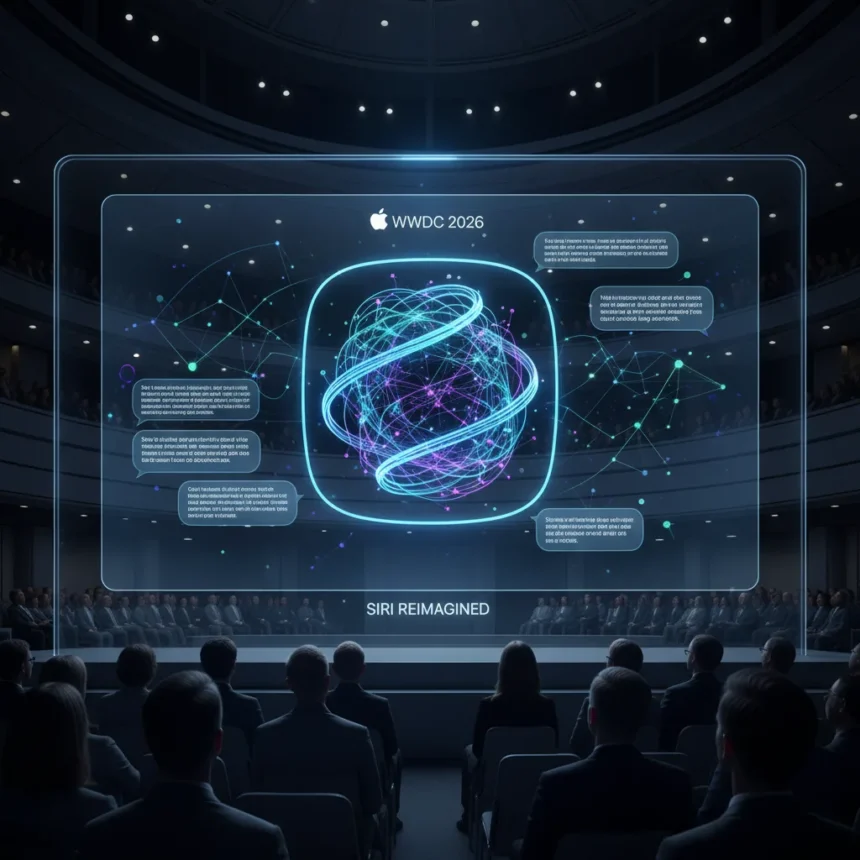
The Siri redesign WWDC 2026 represents Apple’s most significant attempt yet to transform its voice assistant from a novelty into a genuine AI powerhouse. The overhaul, coming to iOS 27 at Apple’s June 8–12 developer conference, signals that the company finally recognizes the gap between its aging assistant and conversational AI tools like ChatGPT.
Key Takeaways
- Siri redesign WWDC 2026 introduces a dedicated standalone app with full conversation history
- Dynamic Island integration shows a glowing cursor with “Search or Ask” prompt for easier access
- Multi-command processing allows Siri to handle complex requests beyond single-action queries
- Third-party AI integration support expands Siri’s capabilities beyond Apple’s own models
- Contextual AI functionality enables smarter, context-aware responses across iOS 27
What Apple Is Actually Changing With Siri Redesign WWDC 2026
Apple’s Siri redesign at WWDC 2026 moves beyond voice commands into genuine conversational territory. The new interface replaces Siri’s minimal activation design with a dedicated standalone app that stores full conversation history, mirroring how ChatGPT and Claude work. This is not a cosmetic tweak—it is an architectural shift that acknowledges users want persistent, searchable conversations with their AI assistant, not one-off queries.
The Dynamic Island, Apple’s notch replacement, gains a thin glow effect around the search bar with a “Search or Ask” prompt and glowing cursor. This makes Siri more discoverable and positions the assistant as the primary way users interact with their device, rather than a buried voice command. The visual redesign signals intent: Apple wants Siri front and center.
Multi-Command Processing and Contextual Intelligence
The Siri redesign WWDC 2026 includes multi-command processing, allowing the assistant to handle sequential or complex requests that would previously require multiple interactions. Instead of asking Siri to set a reminder, then asking it to send a message, users can now chain commands together. This capability directly addresses one of the loudest criticisms of Siri: its inability to understand nuanced, multi-step requests that ChatGPT handles routinely.



Contextual AI functionality rounds out the upgrade, enabling Siri to understand what you are doing, where you are, and what you have done recently. A smarter assistant remembers you were searching for flights earlier and can reference that context when you ask “book that trip.” These features transform Siri from a task executor into something approaching a true conversational partner.
Third-Party AI and the Competitive Landscape
Perhaps most tellingly, the Siri redesign WWDC 2026 opens the door to third-party AI solutions. Apple is not betting exclusively on its own models—it is building a platform where developers can plug in competing AI services. This is a pragmatic acknowledgment that Apple’s AI capabilities alone cannot match the sophistication of specialized models from OpenAI, Google, or Anthropic.



This move positions Apple differently than competitors. Google Assistant is deeply integrated with Google’s search and AI infrastructure. Amazon’s Alexa relies on a sprawling ecosystem of smart home integrations. Siri, historically, has been locked to Apple’s own capabilities. The redesign changes that calculus, allowing Apple to offer users choice while maintaining platform control. Whether this openness actually ships in the final release remains to be seen—Apple has promised AI features before only to scale them back.
Why This Matters Now
The timing of the Siri redesign WWDC 2026 is not coincidental. ChatGPT has over 200 million weekly active users. Google’s Gemini is embedded in Android and search. Microsoft is aggressively pushing Copilot across Windows and cloud services. Apple’s Siri, by comparison, feels stagnant—a voice assistant stuck in the 2010s while competitors operate in the age of generative AI.
For Apple, this redesign is existential. The company has built its reputation on seamless device integration and user experience. If Siri cannot compete intellectually with ChatGPT, users will increasingly reach for their browser or third-party apps instead of asking their iPhone. That fractures Apple’s ecosystem advantage.
What We Still Do Not Know
The research teaser for WWDC 2026 reveals design direction and feature set, but key questions remain unanswered. Will Siri actually outperform competitors, or will it ship with the same limitations that have plagued it for years? Will the third-party AI integration work smoothly, or will it feel bolted-on? And critically: will Apple actually ship these features, or will they be scaled back in the final release, as happened with previous AI announcements?



Apple has a history of overpromising on AI. The company delayed on-device processing for years. It has been cautious about AI features that might raise privacy concerns. The Siri redesign WWDC 2026 could represent genuine transformation—or it could be another incremental update dressed up as revolution.
Is the Siri redesign WWDC 2026 enough to catch ChatGPT?
Not on its own. Siri’s advantage is deep iOS integration and on-device processing. ChatGPT’s advantage is raw intelligence and user trust. The Siri redesign WWDC 2026 closes the interface gap but does not guarantee Siri will answer complex questions as reliably as ChatGPT. Apple would need its own large language model to compete directly—something the company has not yet demonstrated.
When will the Siri redesign WWDC 2026 be available?
Apple will announce the Siri redesign at WWDC on June 8–12, 2026. iOS 27 and the new Siri features are expected to roll out to public beta in summer 2026, with a general release likely in September 2026 alongside new iPhone models.
Can you use third-party AI with the redesigned Siri?
Yes. The Siri redesign WWDC 2026 includes support for third-party AI solutions, allowing developers to integrate competing models. This means users could potentially route requests to ChatGPT, Gemini, or Claude through Siri’s interface rather than opening separate apps.
The Siri redesign WWDC 2026 is Apple’s overdue acknowledgment that voice assistants have evolved. Whether the execution matches the ambition will determine whether users finally stop treating Siri as a joke. For now, the teaser suggests Apple is finally taking the competition seriously.
This article was written with AI assistance and editorially reviewed.
Source: TechRadar