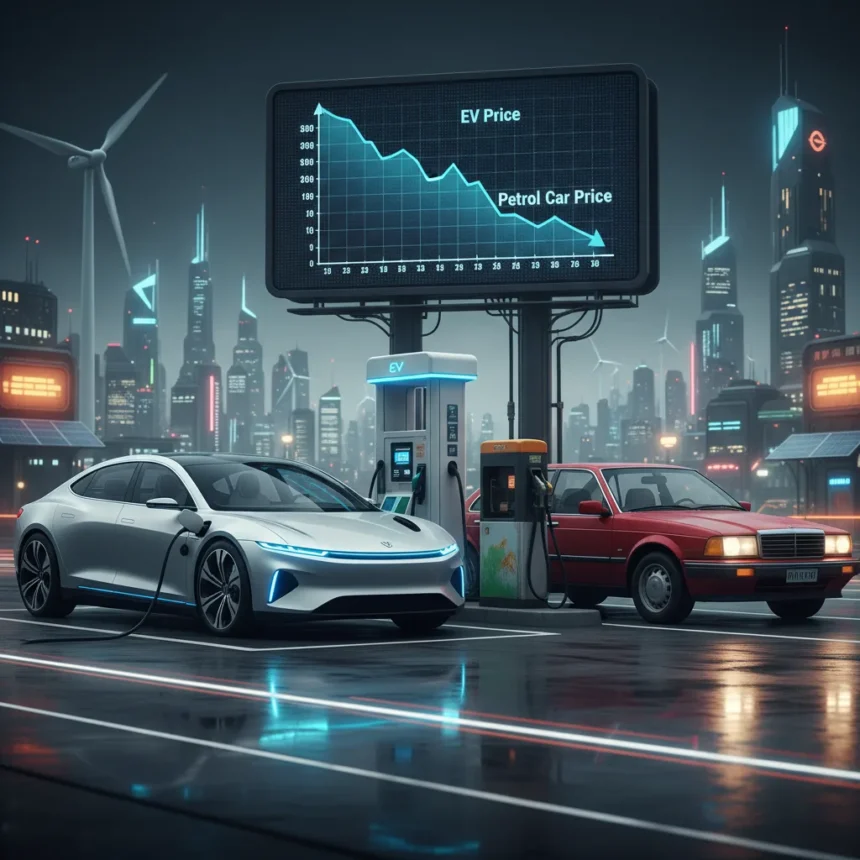
EV prices undercut petrol cars for the first time ever, according to new market data, fundamentally altering the financial argument for switching to electric. This milestone represents a watershed moment for the automotive industry—one where the average electric vehicle now costs less than the average petrol-powered alternative.
Key Takeaways
- Average EV prices have dropped below average petrol car prices for the first time in history.
- The price crossover strengthens the economic case for EV buyers globally.
- This shift marks a critical tipping point in EV adoption momentum.
- Petrol vehicles no longer hold a price advantage over electric alternatives.
- The data signals accelerating market transformation in the automotive sector.
Why EV prices undercut petrol cars matters now
For years, the primary barrier to EV adoption was cost. Buyers faced a simple calculation: pay more upfront for an electric vehicle, or stick with the cheaper petrol option. That equation has inverted. When the average price of EVs falls below petrol cars, the psychological and financial resistance to switching collapses. Buyers no longer need to justify a premium—they are choosing the cheaper option.
This reversal did not happen overnight. It reflects years of manufacturing scale, battery cost reduction, and competitive pressure from established automakers entering the EV space. The milestone is not just a number on a spreadsheet—it is the moment when electric vehicles stop being a luxury choice and become the economically rational default.
The broader market implications of this price shift
The crossover reshapes how consumers, dealers, and manufacturers think about the future. Petrol cars can no longer compete on price alone. They must now justify why a buyer should pay more for older technology, higher fuel costs, and increasing regulatory scrutiny around emissions. Dealers stocking petrol inventory face a harder sell. Manufacturers still invested primarily in petrol production face accelerating pressure to pivot toward electric.

Globally, this shift varies by market. Some regions have already seen EV adoption surge due to subsidies and charging infrastructure. Others are just beginning to feel the price pressure. But the direction is clear: when price parity arrives, adoption follows. This is not prediction—it is market gravity.
What comes next for EV buyers and the industry
With price no longer a barrier, the next phase of competition shifts to range, charging speed, interior design, and brand reputation. Buyers will demand better user experience, not just cheaper alternatives. Manufacturers that invested in software, charging networks, and customer experience will pull ahead. Those that simply dropped prices to compete will struggle.



For buyers, this moment means the financial case for going electric is now airtight. The remaining objections—charging infrastructure, range anxiety, model selection—are real but shrinking. As this price trend solidifies, expect acceleration in EV adoption, further pressure on petrol car values, and intensifying competition among EV makers to differentiate beyond cost.
How does this compare to petrol cars historically?
Petrol vehicles have dominated the market for over a century, partly because they were cheaper to manufacture and fuel than early alternatives. Electric vehicles faced the opposite trajectory—expensive to produce, expensive to buy, but cheaper to operate. The crossover point where total cost of ownership favored EVs arrived earlier than purchase price parity, but psychological resistance to higher sticker prices remained strong. Now that purchase price itself favors electric, that psychological barrier dissolves entirely.
Is EV adoption guaranteed to accelerate from here?
Price parity is necessary but not sufficient for universal adoption. Buyers in regions with poor charging infrastructure, those who drive long distances frequently, or those with limited parking will still face practical barriers. However, for urban and suburban buyers—the majority of the market—the economic case is now overwhelming. Expect adoption curves to steepen significantly in coming years.
What should petrol car buyers know about this shift?
If you are considering a petrol car purchase, understand that resale value will face headwinds as EV adoption accelerates. A new petrol vehicle bought today will depreciate faster than an equivalent EV, all else equal. The used petrol market will soften as supply increases and demand contracts. From a pure financial standpoint, the petrol option is becoming the riskier choice.



The historic moment when EV prices undercut petrol cars is not a prediction or projection—it is here. This is the inflection point that reshapes the automotive industry. Buyers, dealers, and manufacturers who recognize this shift will thrive. Those who cling to petrol-era assumptions will find themselves increasingly isolated.
Edited by the All Things Geek team.
Source: TechRadar