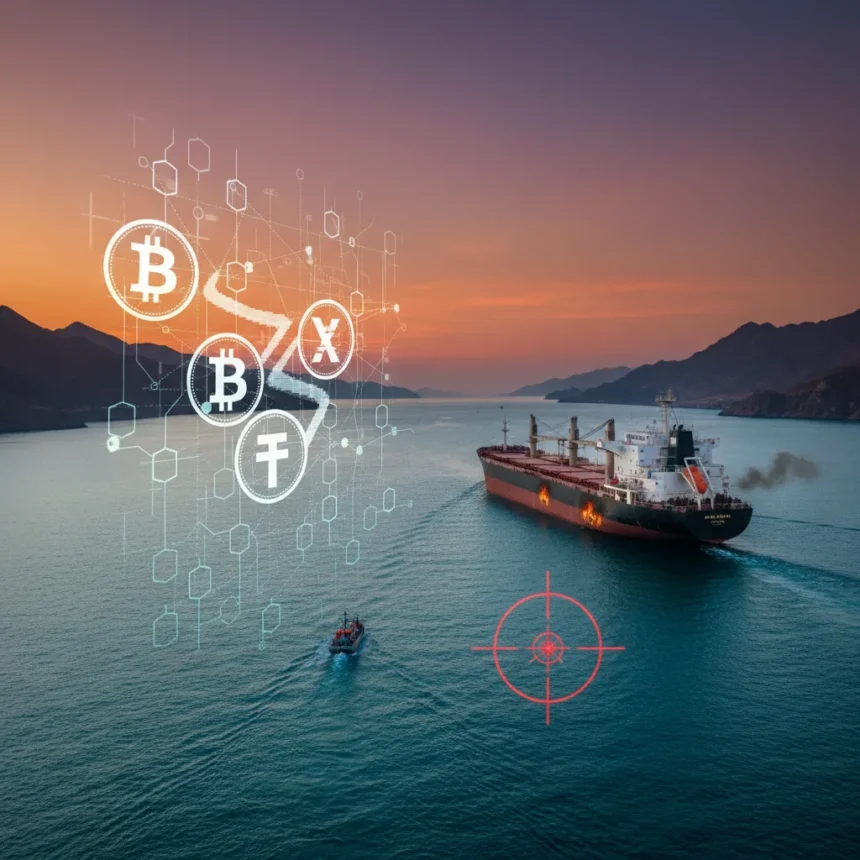
A Strait of Hormuz crypto scam is targeting hundreds of stranded ships by impersonating Iranian authorities and demanding Bitcoin or Tether payments for safe passage through one of the world’s most critical energy corridors. On April 20, 2026, Greek maritime risk management firm MARISKS issued an alert warning shipowners about fraudulent messages demanding cryptocurrency transit fees—a scheme that has already claimed at least one victim and triggered real gunfire on at least two vessels.
Key Takeaways
- MARISKS confirmed fraudulent messages demanding Bitcoin or Tether are not from Iranian authorities
- At least two ships were fired upon by Iranian boats on April 18, 2026, after attempting passage
- Approximately 400 ships and 20,000 seafarers are stranded due to overlapping US and Iranian blockades
- Scammers promise clearance after document submission and cryptocurrency payment
- The Strait of Hormuz handles roughly 20% of global oil and LNG trade
How the Strait of Hormuz crypto scam works
The Strait of Hormuz crypto scam operates through a deceptively simple procedure. Fraudsters send messages to ship operators claiming to represent Iranian Security Services, requesting vessel documentation for review. Once documents are submitted, the scammers demand payment in Bitcoin or Tether, promising the vessel can then transit the strait “unimpeded at the pre-agreed time”. The exact wording from the fraudulent messages reads: “After providing the documents and assessing your eligibility by the Iranian Security Services, we will be able to determine the fee to be paid in cryptocurrency (BTC or USDT). Only then will your vessel be able to transit the strait unimpeded at the pre-agreed time.”
What makes this scheme particularly effective is its exploitation of a genuine crisis. Approximately 400 ships and 20,000 seafarers are currently stranded in the Gulf, trapped between overlapping US blockades of Iranian ports and Iranian restrictions on the Strait of Hormuz. The desperation of vessel operators facing potential losses—combined with Iran’s brief April 18 reopening of the strait—creates ideal conditions for fraudsters to convince captains that cryptocurrency payments to “authorities” are legitimate.
Real gunfire follows scam payments in Strait of Hormuz crypto scam incidents
At least two vessels reported Iranian boats firing shots at them while attempting to exit the Strait of Hormuz on April 18, 2026, forcing them to turn back. MARISKS believes at least one vessel fell victim to the scam by following fraudulent instructions before experiencing gunfire. One tanker was widely identified as Sanmar Herald in connection with a radio distress call and gunfire incident during a passage attempt. The timing is critical: Iran briefly reopened the strait on April 18 subject to inspections, and the scam appears to have exploited this window of opportunity.


The disconnect between scam victims and actual Iranian enforcement created a dangerous situation. Ships that paid fraudsters expected safe passage based on fake “clearance” messages, only to encounter real military fire when they attempted transit. This creates a tragic irony: cryptocurrency was supposed to help the scammers evade sanctions tracing, but instead it became a tool to send desperate mariners into harm’s way.
Why the Strait of Hormuz crypto scam exploits sanctions and geopolitics
The Strait of Hormuz crypto scam succeeds because it mimics a real system. According to Hamid Hosseini of Iran’s Oil, Gas and Petrochemical Products Exporters’ Union, Iran’s actual toll collection system involves quick Bitcoin payments after document assessment, specifically designed to evade international sanctions tracing. Scammers weaponize this legitimate-sounding mechanism to convince operators that cryptocurrency payments are standard procedure.



The broader context amplifies the threat. The Strait of Hormuz historically handles roughly 20% of global oil and LNG trade, making it one of the world’s most strategically important chokepoints. When dual blockades trap 400 ships and 20,000 seafarers, and geopolitical tensions trigger real military fire, the difference between a scam message and an official directive becomes dangerously blurred. Operators under extreme pressure—facing fuel shortages, crew stress, and financial losses—are more likely to believe fraudulent demands than they would be under normal circumstances.
What MARISKS and maritime authorities are warning
MARISKS issued an explicit warning: “These specific messages are a scam” and are not from Iranian authorities. The alert explicitly stated that no legitimate Iranian authority is collecting cryptocurrency transit fees through these channels. However, the warning came after at least one vessel had already fallen victim, and the existence of the scam itself demonstrates how effective impersonation can be in a crisis.
The maritime industry faces a cascading problem. Distinguishing between legitimate Iranian communications and fraudulent ones is nearly impossible when Iran itself has suggested collecting tolls during ceasefire talks. Ship operators have no official, verified channel to confirm whether a message is genuine, and the speed of maritime operations leaves little time for extended verification.
Is the Strait of Hormuz crypto scam still active?
MARISKS issued its alert on April 20, 2026, after the April 18 gunfire incidents, indicating the scam was active at that date. No public reports confirm whether the scam continues, but the underlying conditions—stranded ships, blockades, and geopolitical tension—remain in place. Ship operators should assume the threat is ongoing unless explicitly informed otherwise by verified Iranian government channels.



How can ship operators verify legitimate Iranian transit communications?
The research brief does not specify an official verification method for legitimate Iranian communications. Ship operators should contact their flag state maritime authority, their insurance provider, and industry organizations like MARISKS before responding to any unsolicited transit demands, especially those requesting cryptocurrency.
The Strait of Hormuz crypto scam represents a convergence of three dangerous forces: geopolitical crisis, desperate maritime operators, and cryptocurrency’s role in sanctions evasion. Scammers succeeded not because they were technically sophisticated, but because they exploited a real system, real blockades, and real fear. Until the underlying blockade is resolved and verified communication channels are established, ship operators will remain vulnerable to fraudsters impersonating authorities they cannot independently verify.
Edited by the All Things Geek team.
Source: Tom's Hardware