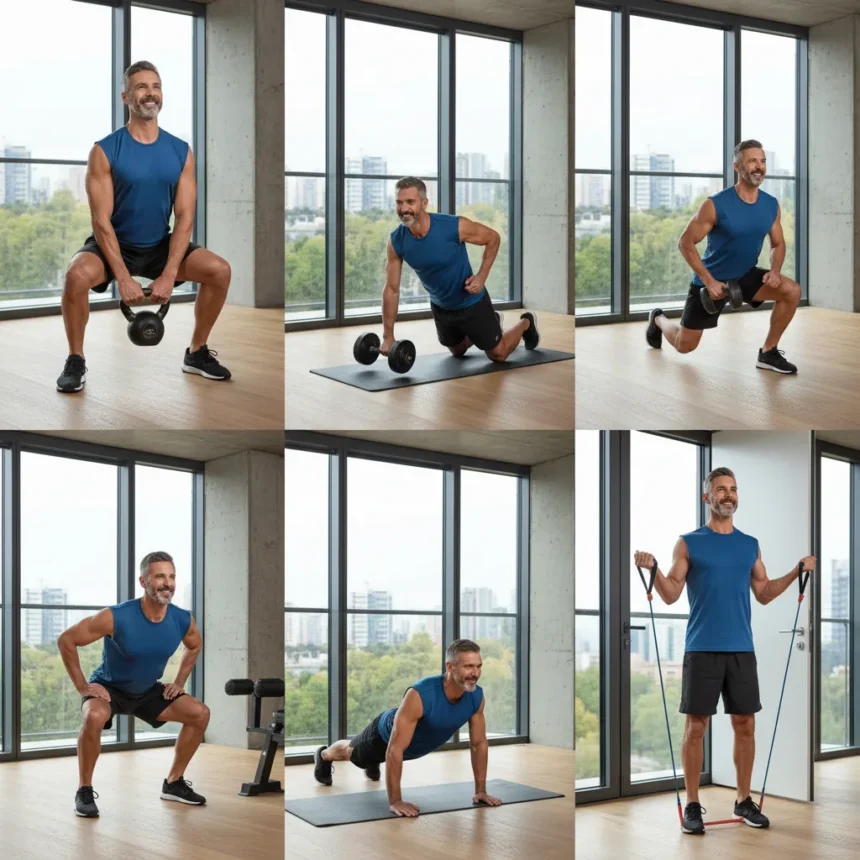
Strength exercises after 50 become non-negotiable if you want to stay independent, mobile, and injury-resistant as you age. A 43-year-old personal trainer argues that the five compound exercises he recommends should form the foundation of any post-50 fitness routine, targeting the exact functional demands most people face: rising from chairs, lifting grandchildren, and carrying groceries without pain or fatigue.
Key Takeaways
- Muscle mass loss accelerates around age 50, making strength training essential for longevity and independence.
- Balance training prevents falls and injuries, which become increasingly serious after 50.
- Strength exercises after 50 should focus on compound movements that work multiple muscle groups simultaneously.
- Perform these routines 2-3 times per week with slow, controlled form to avoid injury.
- Stop immediately if you feel sharp or stabbing pain during any movement.
Why Muscle Loss Accelerates After 50
The decade after 50 marks a critical inflection point for muscle retention. Strength training becomes the primary tool to slow this decline, but most people either skip it entirely or perform exercises with poor form that waste time and risk injury. The trainer emphasizes that functional strength—the ability to move your own bodyweight with control—matters far more than lifting heavy weights for vanity. This is where the right exercise selection becomes decisive. Compound movements that recruit multiple muscle groups simultaneously build efficiency into your routine, which is especially valuable when training 2-3 times per week.
Balance training deserves equal emphasis after 50. Falls become a serious threat to independence and longevity, yet balance work is often overlooked in favor of pure strength. The best routines integrate both, so each session addresses the full spectrum of functional fitness needs.
The Five Compound Exercises a Trainer Swears By
The personal trainer and his peers rely on five compound exercises that collectively target legs, core, upper body, and balance. These are not isolation movements or machines—they are foundational bodyweight and light-weight patterns that transfer directly to real-world tasks. The trainer’s recommendation centers on slow, controlled motion with proper core bracing throughout each rep. Momentum is the enemy; swinging your limbs to complete a rep defeats the purpose and increases injury risk.

Form quality separates effective training from wasted effort. The trainer emphasizes moving slowly and maintaining control throughout every repetition. If you feel a sharp or stabbing pain at any point, stop immediately. Mild muscle fatigue is normal; sharp pain is a signal to reassess your technique or scale back the difficulty. This distinction is critical because senior fitness injuries often stem from pushing through pain rather than respecting physical limits.
Strength Exercises After 50: A Practical Framework
One example from similar trainer routines illustrates the precision required: the seated leg lift, performed seated with core braced, involves extending both legs in front of you with hands on the floor next to your hips (or behind your head for added challenge). You lift one leg to hip height, open it to the side without twisting your upper body, pause, return to center, and lower with control before switching sides. This single movement addresses leg strength, core stability, and hip mobility—three critical areas for post-50 function. The entire motion should feel slow and deliberate, never rushed or bouncy.



Routines that combine such exercises—squats, push-ups, and pull-ups appear in related trainer recommendations—create a full-body stimulus without requiring hours in the gym. Performing these 2-3 times weekly allows adequate recovery while building consistency, the actual driver of long-term results. Most people overestimate how much training frequency matters and underestimate how much consistency matters; three solid sessions per week, performed consistently for years, outpace sporadic intense training every time.
Balancing Strength and Fall Prevention
A personal trainer working with seniors emphasizes that strength and balance training are inseparable after 50. Balance exercises prevent falls and injuries, which can permanently reduce mobility and independence. The five-exercise approach recommended by the trainer integrates balance demands into compound movements rather than treating it as a separate category. This is more time-efficient and more aligned with how your body actually functions in daily life.
Progressive overload—gradually increasing difficulty—keeps these routines effective over months and years. You might start with bodyweight squats, then add a light dumbbell, then increase the depth or speed of the movement. The principle applies to every exercise in the routine. This gradual progression prevents plateaus while respecting the recovery capacity of aging muscles and joints.
Common Mistakes to Avoid
The biggest mistake is sacrificing form for volume. Swinging your legs to complete an extra rep, using momentum to power through a push-up, or ignoring sharp pain are all liabilities. These shortcuts save no time—they only increase injury risk and reduce the stimulus to the muscles you’re trying to strengthen. The trainer’s advice is unambiguous: move slowly, brace your core, stop if pain occurs. This is not conservative; it is the fastest path to results.



A second mistake is inconsistency. Sporadic training sessions do not build the neural adaptations and muscle memory required for functional strength. Two solid sessions per week, performed consistently, beat four sporadic sessions. Consistency compounds over years, transforming your baseline fitness and injury resilience.
How often should I do strength exercises after 50?
Perform strength exercises after 50 about 2-3 times per week, allowing at least one rest day between sessions. This frequency provides sufficient stimulus for muscle retention and functional strength while allowing adequate recovery. More frequent training does not necessarily yield better results if form and recovery suffer.
What should I do if I feel pain during these exercises?
Stop immediately if you feel sharp or stabbing pain. Mild muscle fatigue and burning sensations are normal, but sharp pain signals a form issue or an exercise that is too advanced for your current fitness level. Scale back the difficulty, reassess your technique, or consult a qualified professional before continuing.
Can I do these strength exercises after 50 if I’m returning from an injury?
If you are returning from injury, pregnant, postpartum, or new to strength training, consult a qualified professional—a physical therapist, doctor, or certified trainer—before starting any routine. They can assess your specific situation and modify exercises to match your current capacity safely.
Strength exercises after 50 are not optional if you want to maintain independence, prevent falls, and stay functional in daily life. The five-exercise framework recommended by this personal trainer prioritizes compound movements, slow controlled form, and consistency over intensity. Start with bodyweight versions, progress gradually, and commit to 2-3 sessions per week. This approach builds real strength—the kind that lets you rise from a chair without thinking, lift your grandchildren without strain, and move through the world with confidence and resilience.
Edited by the All Things Geek team.
Source: Tom's Guide