




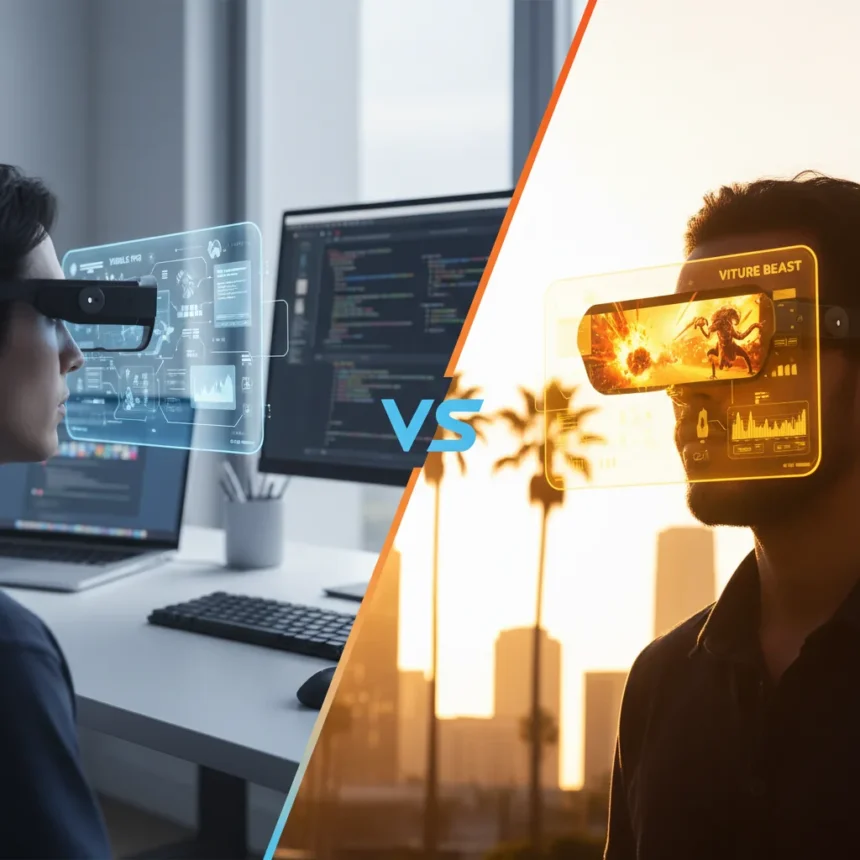
Xreal One Pro vs Viture Beast represents the clearest split in premium AR glasses today: one excels at making spreadsheets readable and text crisp, the other floods your vision with brightness and color punch. Both pack onboard spatial tracking chips, prism optics, and 120Hz refresh rates, yet they solve the AR glasses puzzle in fundamentally different ways. If you are shopping for a premium headset in the $450-$549 range, this choice matters.
Key Takeaways
- Xreal One Pro delivers superior stability and sharper text for productivity tasks like spreadsheets and coding.
- Viture Beast offers 900 nits brightness (vs 700 on Xreal One Pro) and a 20% larger apparent field of view.
- Both weigh roughly 87-88g and support prescription lenses, but tracking calibration differs between models.
- Xreal One Pro has truer colors and less chromatic aberration; Viture Beast favors oversaturated, punchy visuals.
- For entertainment and bright environments, Beast wins; for all-day productivity, One Pro takes the crown.
Xreal One Pro vs Viture Beast: Display and Brightness
Brightness is where these two glasses diverge most sharply. Xreal One Pro tops out at 700 nits, which is solid for indoor work but feels dim in direct sunlight. Viture Beast climbs to roughly 900 nits in anchor mode, noticeably brighter and more practical for outdoor AR anchoring. If you plan to use these glasses outside or in bright offices, that 200-nit gap is the difference between readable and washed-out.
Color science tips the scales differently. Xreal One Pro prioritizes true-to-life color reproduction and minimizes chromatic aberration—the color fringing that plagues cheaper AR glasses. Viture Beast leans into oversaturated, punchier colors with deeper contrast, which makes games and movies pop but can feel unnatural for productivity work. A spreadsheet on the Beast looks vivid; the same spreadsheet on the One Pro looks accurate. Which matters more depends on whether you are editing documents or watching Netflix.
Xreal One Pro vs Viture Beast: Sharpness and Field of View
Sharpness comparisons reveal a nuanced picture. Xreal One Pro delivers sharper text and cleaner edges across the entire field of view, making it the clear winner for spreadsheets, code, and document editing. Viture Beast sharpens the center image more aggressively but at the cost of softer edges, a trade-off that favors gaming and video over productivity.



Field of view is another split decision. Viture Beast claims a 58° FOV versus Xreal One Pro’s 57°, but the Beast feels roughly 20% larger in practice, creating a more immersive sense of space. That extra width matters for watching movies or playing games in a virtual cinema, but it does not translate to sharper text at the edges. For someone glued to a spreadsheet, the One Pro’s tighter, crisper display is the bigger win.
Xreal One Pro vs Viture Beast: Tracking and Stability
Both glasses use onboard spatial tracking chips for 6DoF anchoring, a major leap over older birdbath-based designs. The real difference lies in calibration and reliability. Xreal One Pro locks in spatial stability immediately, with no setup friction. Viture Beast requires roughly 10 seconds of calibration for best 3DoF stability, and some reviewers report that its implementation is not quite as reliable in real-world conditions. If you are anchoring virtual objects to your desk and moving around, the One Pro’s plug-and-play tracking is the safer bet.


Both glasses weigh nearly identical amounts—Xreal One Pro at 87 grams, Viture Beast at 88 grams—so comfort during extended use is a wash. Both support prescription lenses, a must-have feature for anyone who does not wear contacts. The difference is operational: Xreal One Pro just works, while Viture Beast asks you to calibrate and occasionally recalibrate for best results.
Xreal One Pro vs Viture Beast: Productivity vs. Entertainment
This is the core tension. Xreal One Pro is built for work. Its 1080p resolution (in a taller 16:10 aspect ratio), superior text rendering, true colors, and instant spatial tracking make it the go-to for remote work, coding, and content creation. The 2D-to-3D conversion engine also helps legacy apps feel less flat on screen.
Viture Beast is built for play. Higher brightness, wider FOV, punchier colors, and sharper center image make it the better choice for gaming, streaming, and entertainment in any lighting condition. Viture also supports full 120Hz performance (though it defaults to 60Hz and requires manual switching), which matters for fast-paced games. Firmware updates promise 1200p resolution to match the Beast’s entertainment ambitions, though the One Pro may still hold the productivity edge even after that upgrade.
How does the Xreal One Pro compare to the Viture Beast for outdoor use?
Viture Beast wins outdoors. Its 900-nit brightness handles direct sunlight far better than Xreal One Pro’s 700 nits. If you are planning to use AR glasses outside or in very bright environments, the Beast is the practical choice. The One Pro remains an indoor-first device.

Which AR glasses are better for productivity work?
Xreal One Pro takes this decisively. Sharper text, true colors, instant spatial tracking, and a taller aspect ratio designed for documents make it the clear winner for spreadsheets, code, and office work. Viture Beast’s oversaturated colors and softer edge sharpness are distractions in a productivity context.
Do both glasses support prescription lenses?
Yes, both Xreal One Pro and Viture Beast support prescription lens inserts, a critical feature for anyone who wears glasses. This eliminates the need to wear contacts or glasses underneath, making all-day wear more practical.
The verdict is straightforward: buy Xreal One Pro if you work in offices, code, or edit documents. Buy Viture Beast if you want the brightest, most immersive entertainment experience in any lighting condition. There is no single winner in Xreal One Pro vs Viture Beast because these glasses are optimized for different lives. The One Pro is the professional’s choice; the Beast is the enthusiast’s. Choose based on what you will actually do with these glasses 80% of the time, and you cannot go wrong.
Where to Buy
This article was written with AI assistance and editorially reviewed.
Source: Tom's Guide