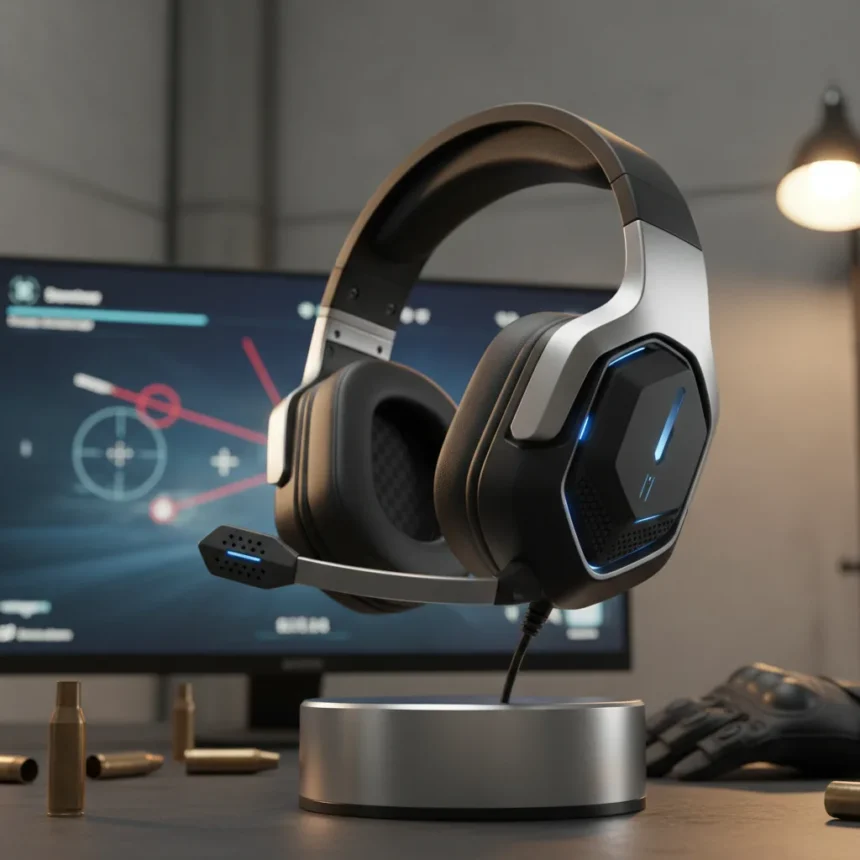
The new RIG wireless gaming headset is a competitive-play-focused peripheral from Nacon, revealed in early 2026 and positioned as a value-driven alternative to premium rivals in the increasingly crowded wireless gaming headset market. RIG is pitching it squarely at first-person shooter fans, with claims of studio-grade audio and custom tuning for the kind of directional sound that separates a good FPS session from a great one. Whether those claims hold up against the competition is the real question.
Key Takeaways
- RIG’s new wireless headset is custom-tuned for first-person shooters and marketed as delivering studio-grade audio.
- The related wired RIG R5 Spear Max HD features 40mm GrapheneQ drivers, a 20Hz–40kHz frequency range, and a USB-C DAC supporting 32-bit/384kHz.
- RIG’s lineup now includes US availability, a shift from its previously UK-exclusive distribution.
- The SteelSeries Arctis Nova Elite, a key rival, is priced at $599.99 — significantly above RIG’s positioning.
- RIG’s R-series is described as priced at roughly half the cost of comparable competition.
What Makes the RIG Wireless Gaming Headset Different?
RIG is targeting a specific frustration in the FPS gaming community: headsets that sound great for music but fail to isolate enemy footsteps, directional gunfire, and environmental cues in competitive play. Custom-tuning for shooters isn’t a new idea, but it’s rarely the headline feature at this price tier. RIG is betting that positioning matters as much as specs.
The broader R-series lineup gives a strong indication of what to expect technically. The wired RIG R5 Spear Max HD — a related model in the same family — ships with 40mm GrapheneQ audio drivers developed by Ora, covering a frequency range of 20Hz to 40kHz. That upper limit well exceeds standard human hearing, which typically tops out around 20kHz, and it signals a driver tuned for detail retrieval rather than just bass punch. The headset also includes a broadcast-grade 6mm unidirectional microphone, Dolby Atmos support, and a USB-C DAC that handles 32-bit/384kHz sample rates with power passthrough and an auxiliary port. That’s a serious spec sheet for the price bracket.
The R-series also features RIG’s Snap+Lock mod system, which allows users to swap out interchangeable parts. It’s a practical differentiator — headsets at this price point rarely offer that kind of physical customization, and it extends the useful life of the hardware considerably.


How Does the RIG Wireless Gaming Headset Compare to SteelSeries and Razer?
The wireless gaming headset market at the premium end is dominated by brands with deep pockets and established reputations. RIG’s pitch of delivering competitive audio at roughly half the price of the competition puts it in direct conflict with some well-regarded hardware.
The SteelSeries Arctis Nova Elite sits at the extreme end of the market at $599.99, making it the world’s first Hi-Res certified wireless gaming headset with 24-bit transmission over 2.4GHz or Bluetooth, 40mm carbon fiber drivers with a brass ring, and an all-metal frame. It’s exceptional hardware, but the price is genuinely prohibitive for most players. The SteelSeries Arctis Nova 5, a more accessible option, offers FPS-specific audio profiles including a dedicated ‘FPS Footsteps’ mode for isolating enemy movement sounds, with 2.4GHz dongle connectivity and simultaneous Bluetooth support. It was recently available for $104.99 on sale. Meanwhile, PC Gamer’s 2026 best gaming headset pick goes to the Razer BlackShark V3, praised for great audio, low latency, and game-specific EQ profiles.



RIG’s value argument is credible on paper. If the wireless model delivers audio quality comparable to the R5 Spear Max HD’s wired specs at a competitive price point, it could genuinely challenge the Nova 5 in the mid-range. The ‘custom-tuned for FPS’ angle also gives it a cleaner marketing story than generalist rivals. That said, promotional phrases like ‘studio-grade’ are easy to print on a box — independent verification of the audio performance will matter far more than the tagline.
Is the US Availability a Bigger Deal Than It Sounds?
RIG expanding into the US market is worth noting. Previous RIG headsets were often UK-exclusive, meaning a large portion of the global gaming audience had no direct access to the brand. Launching in the US signals that Nacon is treating the R-series as a genuine global product line rather than a regional experiment. For US-based FPS players who’ve never had a reason to consider RIG, this is effectively a brand introduction as much as a product launch.
The R5 Spear Max HD wired model is already available at Amazon US for $149.99, which establishes a pricing anchor for the lineup. If the wireless model lands close to that figure, it would represent a compelling alternative to the Nova 5 and a significant undercut of the Nova Elite’s $599.99 price point.
Is the RIG wireless gaming headset good for competitive FPS play?
RIG has designed the new wireless headset specifically with FPS and competitive play in mind, with custom audio tuning aimed at directional sound clarity. The related wired R5 Spear Max HD features 40mm GrapheneQ drivers and Dolby Atmos support, which suggests the lineup prioritizes positional audio accuracy. Independent reviews have not yet confirmed performance claims.


How does the RIG headset price compare to SteelSeries?
RIG’s R-series is positioned at roughly half the price of comparable competition. The SteelSeries Arctis Nova Elite, for context, is priced at $599.99, while the more accessible Arctis Nova 5 recently sold for $104.99 on sale. RIG appears to be targeting the mid-range gap between those two options.
What is the Snap+Lock mod system on RIG headsets?
The Snap+Lock system is RIG’s modular customization feature that allows users to swap interchangeable parts on compatible headsets. It’s a practical design choice that extends hardware longevity and lets players personalize their setup — an unusual feature at this price tier in the wireless gaming headset category.
RIG’s new wireless gaming headset arrives with the right pitch for 2026: FPS-focused audio, modular hardware, and a value-first positioning against rivals that charge two to four times as much. The specs on the R-series wired model are genuinely impressive, and if the wireless version translates that performance without major compromises, Nacon could earn a real foothold in a market currently dominated by SteelSeries and Razer. The ‘studio-grade’ claim still needs real-world validation — but the hardware foundation gives it a fighting chance.
Edited by the All Things Geek team.
Source: TechRadar