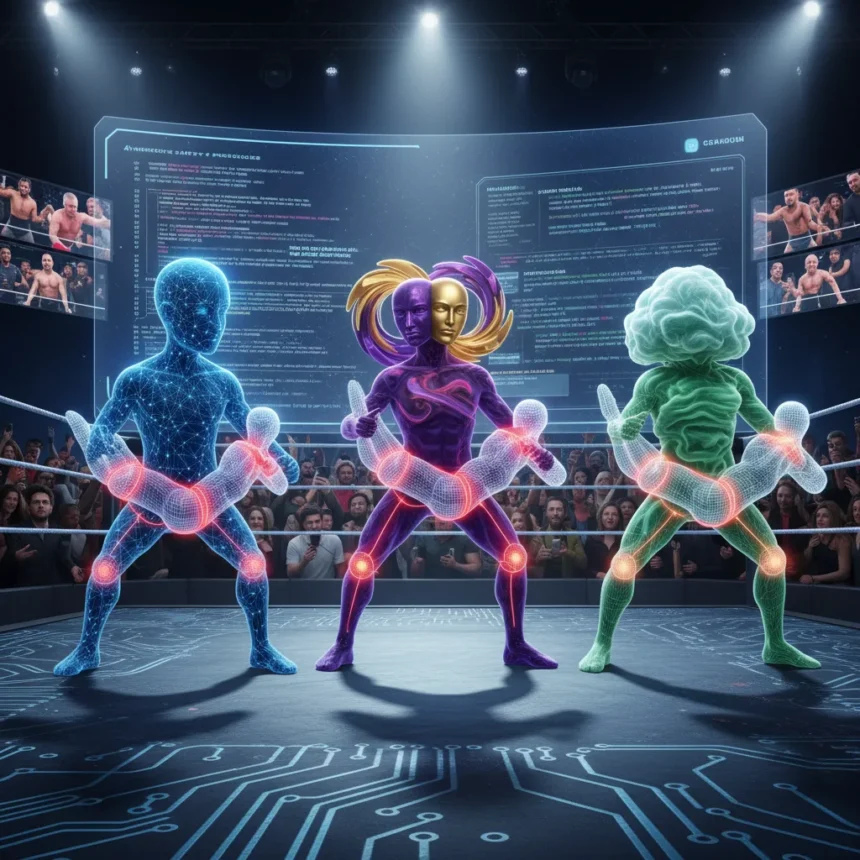
AI wrestling tutorials have become unexpectedly sophisticated. A recent test comparing ChatGPT, Gemini, and Claude on how to perform WWE wrestling finishers safely revealed something striking: all three AI models generated step-by-step instructions detailed enough to rival professional wrestling training, complete with safety cues for both the performer and recipient.
Key Takeaways
- ChatGPT, Gemini, and Claude all provided expert-level, safe wrestling move breakdowns with performer and recipient positioning cues.
- AI instructions emphasized injury prevention while maintaining the visual impact that makes finishers dramatic in WWE broadcasts.
- The precision of AI wrestling tutorials challenges perceptions about what large language models can teach on physical skills.
- WWE’s Netflix debut with Raw has renewed interest in wrestling finishers, making accessible training resources increasingly relevant.
- No single AI model emerged as a clear winner—all three delivered comparable quality and detail.
How AI Models Explained Wrestling Safety
The three AI models approached the task with unexpected precision. Each one broke down how to execute two specific finishers while keeping the recipient safe—a critical detail in professional wrestling, where moves must look devastating but prevent actual injury. The instructions included controlled impact techniques, proper body positioning, and fall-breaking mechanics that protect both performers.
What made the results striking was not just accuracy, but completeness. The AI responses treated wrestling as a choreographed skill requiring both physical knowledge and partner communication. This mirrors how WWE trainers actually teach the craft. Rather than treating wrestling moves as simple impacts, the models understood the nuance: how to position limbs, when to absorb force, how to time transitions so the recipient can protect themselves.
ChatGPT vs. Gemini vs. Claude: Which AI Handles Wrestling Best
All three models delivered high-quality wrestling tutorials without a clear hierarchy emerging. Each AI demonstrated the ability to break down complex physical movements into actionable steps. The comparison revealed that modern large language models share similar training on sports instruction and safety principles, resulting in comparable outputs across different platforms.



This contrasts with how these same models perform differently on other specialized tasks. For instance, Claude and Gemini have shown advantages over ChatGPT in certain technical domains like data migration, yet for wrestling instruction, the gap narrows significantly. The consistency suggests that physical movement instruction—when grounded in established techniques and safety protocols—is an area where AI training converges across different architectures.
Why AI Wrestling Tutorials Matter Now
The timing of this discovery coincides with WWE’s mainstream resurgence. Raw recently moved to Netflix, bringing signature finishers like the Go To Sleep and Riptide into millions of homes. Fans watching these moves want to understand how they work without risk of injury. AI wrestling tutorials fill a gap between casual curiosity and formal training, offering accessible explanations that professional wrestling academies traditionally gatekeep.



The broader implication is significant: AI can now teach physical skills with enough detail to be genuinely useful. This expands what people expect from chatbots beyond text summarization or code generation. If an AI can explain how to safely execute a wrestling finisher, it raises questions about what other hands-on skills might be teachable through language models—from basic first aid to equipment handling to athletic conditioning.
Safety Considerations for Learning from AI
While the AI responses demonstrated strong safety awareness, applying wrestling instructions requires real-world caution. These moves involve a partner and potential for injury if executed incorrectly. Anyone attempting to learn wrestling moves should work with a qualified wrestling coach or trainer who can provide in-person feedback, spotting, and progression. AI instructions are educational tools, not substitutes for supervised training.
The models themselves included safety language in their explanations—cues about controlled impacts and proper positioning. However, text-based instruction has inherent limitations. A partner cannot see whether you’re executing the move correctly through a screen, and wrestling relies on feel and communication that digital guidance cannot fully replicate. The value of AI wrestling tutorials lies in conceptual understanding and technique breakdown, not as standalone training.
What This Reveals About AI Limitations and Strengths
The wrestling tutorial experiment exposes both what AI does well and where it still falls short. Large language models excel at breaking down established techniques into logical steps. They understand safety protocols because these are well-documented in training data. They can contextualize physical movements in ways that make them comprehensible to novices.


What AI cannot do is observe, correct, and adapt in real time. A wrestling coach watches your form, sees where your weight is distributed, and adjusts your positioning mid-movement. An AI provides a template. That distinction matters. The fact that AI wrestling tutorials are surprisingly good does not mean they replace human instruction—it means they complement it by democratizing access to basic conceptual knowledge.
Is AI good enough to teach wrestling moves?
For understanding how moves work and why safety matters, yes. AI models like ChatGPT, Gemini, and Claude can explain wrestling finishers with enough precision to give viewers insight into the craft. However, learning to execute these moves safely requires in-person coaching and a trained partner. AI tutorials are educational supplements, not replacements for professional wrestling training.
Can you actually learn WWE finishers from ChatGPT?
You can learn the conceptual breakdown and safety principles behind finishers from AI. ChatGPT and similar models provide detailed step-by-step explanations comparable to professional instruction. Translating that knowledge into safe physical execution requires supervised practice with a wrestling coach or experienced training partner who can provide real-time feedback and correction.
Why is WWE on Netflix now?
WWE Raw moved to Netflix as part of the company’s streaming expansion and partnership strategy. This brought wrestling’s signature finishers and dramatic moments to Netflix’s global audience, increasing mainstream visibility and interest in how these moves are actually performed. The timing coincides with renewed curiosity about wrestling instruction and technique.
The experiment of testing ChatGPT, Gemini, and Claude on wrestling finishers reveals something important about AI in 2025: these models have moved beyond trivia and coding into genuine practical instruction. They can explain complex physical skills with precision and safety awareness. That does not make them wrestling coaches, but it does make them useful tools for anyone curious about how professional wrestling actually works. The real value lies not in replacing trainers, but in making wrestling knowledge accessible to millions of people who might never step into a wrestling academy.
Where to Buy
Apple iPhone 17 Pro Max | Apple iPhone 17 Pro Max | Apple iPhone 17 Pro Max
Edited by the All Things Geek team.
Source: Tom's Guide