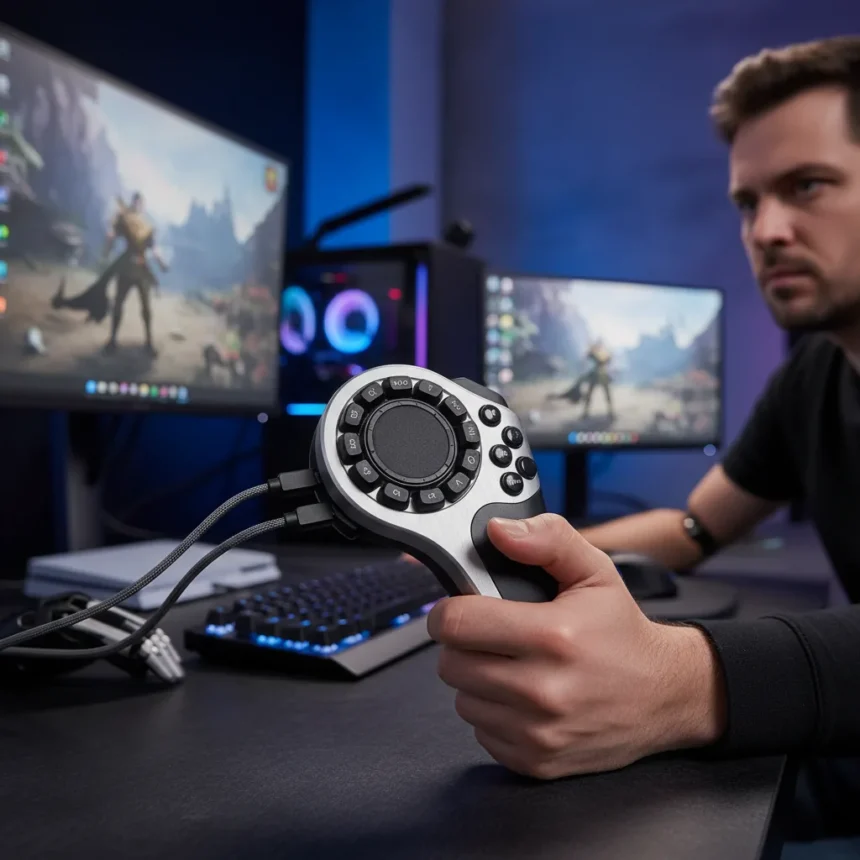
A one-handed gaming controller that merges a standard USB mouse with a custom keypad has emerged as a practical solution for disabled gamers seeking full control over PC and console titles. Built by a Reddit user who lost his right arm in an accident, the prototype demonstrates how 3D printing and Arduino microcontrollers can transform accessibility for players navigating the gaming world with one hand.
Key Takeaways
- Combines USB mouse base with Arduino-powered joystick and button array into a single device.
- Includes 3D-printed finger supports with four total buttons positioned at the controller front.
- Designed for left-hand use, enabling full keyboard and mouse control without dual USB cables.
- Enables complex gaming tasks like Minecraft speedrunning using only one hand.
- Available through moddoMOUSE at moddo.io, with prototype demonstrated on YouTube.
How the One-Handed Gaming Controller Works
The one-handed gaming controller starts with a regular-sized USB computer mouse as its foundation, then integrates a second device featuring a joystick and additional gaming keys. The original design faced a practical hurdle: managing two separate USB cables. The maker solved this by consolidating both input systems into a single USB connection using an Arduino Micro, eliminating cable clutter and simplifying setup.
The physical interface includes 3D-printed finger supports glued to the front of the controller base, each fitted with two buttons for a total of four additional inputs. This modular approach means the device can grow with user needs—adding or repositioning buttons without complete redesign. The joystick handles movement and camera control, while the mouse portion manages aim and interaction, all operated by fingers on a single hand.
One critical design feature addresses a common one-handed gaming frustration: large aim adjustments. Rather than forcing players to drag the mouse across a mousepad repeatedly, the controller allows lifting and repositioning for sweeping movements, then placing it back down for precision adjustments. This hybrid approach mimics how two-handed players naturally switch between gross motor movements and fine control.
One-Handed Gaming Controller vs. Existing Alternatives
The market already offers several one-handed solutions, each with distinct trade-offs. Evil Controllers manufactures custom Xbox and PlayStation controllers with one side outfitted with bumpers and an external thumbstick, plus fully remappable inputs including triggers and D-pad functions. These are purpose-built for console gaming but lack the keyboard functionality that PC gaming often demands.
Azeron provides a unique one-handed controller featuring multiple finger keys and a built-in thumbstick, available in various configurations and colors. The Tipy Keyboard takes a different approach entirely, integrating a one-handed keyboard with a built-in mouse, numeric keypad, and Bluetooth or USB-C connectivity. Unlike these commercial solutions, the one-handed gaming controller prototype merges the best of both worlds—mouse precision and keyboard access—in a single device designed specifically around the maker’s gaming needs.
General one-handed solutions also exist, from co-pilot setups using a second controller for thumbsticks to U-shaped joystick toppers and chin joysticks. The DIY controller’s strength lies in its customizability and unified design philosophy: everything the gamer needs sits under one hand, eliminating the mental overhead of switching between multiple input devices.
Why This Prototype Matters for Disabled Gamers
Gaming accessibility remains fragmented. Most mainstream controllers assume two hands, forcing disabled players to either adapt existing hardware or purchase expensive custom solutions. This prototype emerged from necessity—the maker wanted to resume gaming after his amputation and discovered that no single product fully met his needs.
The decision to share the build publicly amplifies its impact. By publishing a YouTube demonstration and making the design accessible, the creator signals that one-handed gaming need not be passive or limited. Speedrunning Minecraft with one hand, as the maker demonstrates, requires precision, timing, and complex input sequences—tasks that many assumed impossible for disabled gamers using standard peripherals.
The Arduino-based approach also matters. It means future iterations can be customized without manufacturer approval or expensive retooling. A gamer needing different button layouts, sensitivity curves, or hand shapes can modify the design to fit their unique anatomy and playstyle. This flexibility is nearly impossible with mass-market controllers designed for the broadest possible audience.

Can You Build Your Own One-Handed Gaming Controller?
The prototype uses readily available components: a standard USB mouse, Arduino Micro, 3D printer access, and basic electronics knowledge. The maker benefited from JLCPCB sponsorship for PCB manufacturing, which offers services at $2 for 1-8 layer PCBs on orders of five units, plus new user coupons worth $60. This suggests the project costs significantly less than commercial alternatives, though exact pricing for the finished moddoMOUSE device has not been publicly disclosed.
Building requires comfort with soldering, 3D modeling, and Arduino programming. Beginners might struggle with integration, but the modular design—starting with a mouse base and adding components incrementally—keeps complexity manageable. The YouTube demonstration provides a roadmap, though aspiring builders should expect iteration and troubleshooting.
FAQ
What makes this one-handed gaming controller different from other accessible gaming options?
Unlike commercial one-handed controllers designed primarily for consoles, this prototype integrates both mouse and keyboard functionality into a single device, enabling full PC gaming control without switching between multiple peripherals. The Arduino-based design also allows customization for individual user needs.
Is the one-handed gaming controller available for purchase?
The moddoMOUSE version is available through moddo.io, though specific pricing and shipping details have not been publicly disclosed. The prototype itself was a personal build, but the public demonstration suggests commercialization is underway.
Can the one-handed gaming controller work with consoles?
The prototype was designed for PC gaming, with console compatibility implied but not explicitly detailed in available documentation. Console support would likely depend on whether the device can emulate standard controller protocols, a technical detail not yet confirmed.
The one-handed gaming controller represents a shift in how disabled gamers can approach accessibility—not as a limitation to work around, but as a design challenge worth solving. By combining affordability, customizability, and practical performance, this prototype proves that gaming inclusion doesn’t require waiting for manufacturers to care. Sometimes it takes a determined gamer with one hand and an Arduino to show what’s actually possible.
Edited by the All Things Geek team.
Source: Tom's Hardware