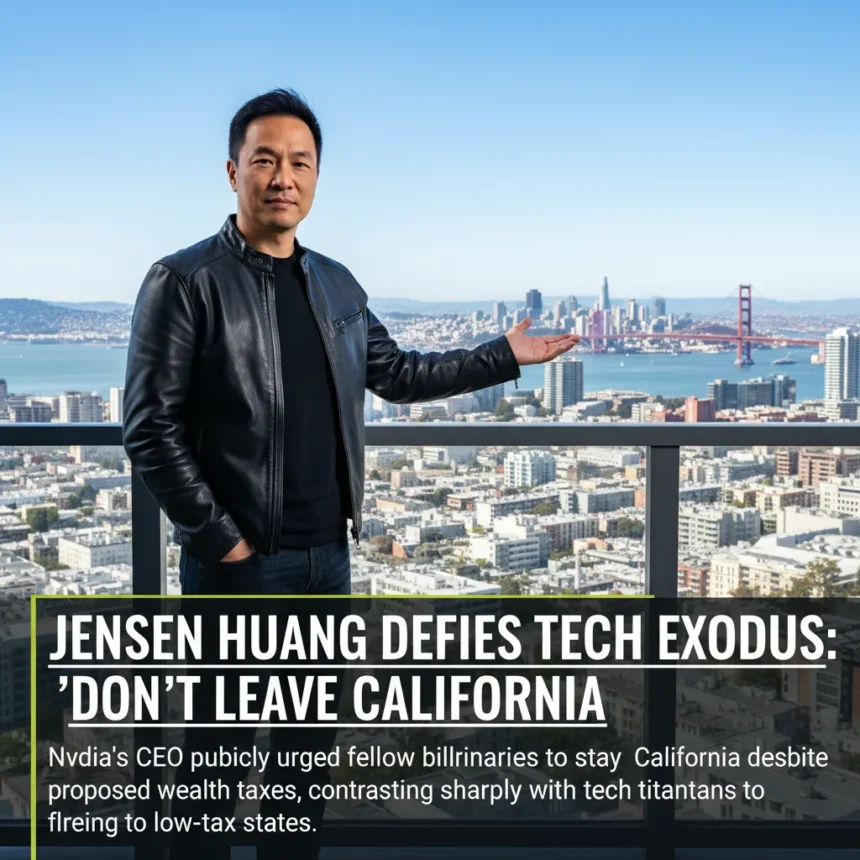
Jensen Huang, Nvidia’s co-founder and CEO with a net worth around $155.8 billion, is bucking the billionaire exodus from California. At Stanford Graduate School of Business on April 23, 2026, Huang sat down with Congressman Ro Khanna to deliver a blunt message to fellow tech titans: stay put, even if California wealth tax billionaires face unprecedented levies.
Key Takeaways
- Jensen Huang publicly endorsed California residency despite proposed 5% wealth tax that could cost him over $7 billion
- Meta’s Mark Zuckerberg, Google co-founders Larry Page and Sergey Brin are relocating to Nevada and Florida ahead of potential tax implementation
- The Make Billionaires Pay Their Fair Share Act, co-introduced by Ro Khanna in March 2026, targets approximately 1,000 U.S. billionaires
- A California ballot initiative requires 875,000 signatures by June 25, 2026, to advance the wealth tax proposal
- Huang cited Silicon Valley’s talent pool and climate as reasons Nvidia remains headquartered in California
Huang’s Defiant Stand on California Wealth Tax Billionaires
Huang’s position represents a rare display of principle amid Silicon Valley’s capital flight. When asked about California’s proposed wealth tax, Huang told Khanna: “Move to California, don’t leave. It’s the highest taxes in the world, but it’s okay”. This statement carries weight—the proposal would impose a 5% annual or one-time wealth tax on billionaires’ net worth, potentially costing Huang over $7 billion personally. Yet he framed the tax not as a threat but as a reasonable cost of doing business in the state that built his empire.
In a separate Bloomberg TV interview conducted earlier in the week, Huang doubled down on his indifference to the tax. “I’ve got to tell you, I have not even thought about it once,” he said. “I’m perfectly fine with it. Not this person. This person is trying to build the future of AI”. The comment reflects Huang’s broader philosophy: Nvidia’s mission supersedes tax optimization. He and the company have chosen to remain rooted in Silicon Valley, and whatever fiscal burden California imposes, Huang appears willing to absorb it.
The Billionaire Exodus Nvidia’s CEO Is Resisting
Huang’s stance becomes more striking when contrasted with the wave of relocations already underway. Meta CEO Mark Zuckerberg, Google co-founders Larry Page and Sergey Brin, and other prominent billionaires are moving to Nevada and Florida ahead of California’s proposed January 1 residency deadline, seeking to escape the anticipated wealth tax. These departures signal a coordinated capital flight from the state that birthed the tech industry.


The Make Billionaires Pay Their Fair Share Act, co-introduced by Congressman Ro Khanna in March 2026, would apply to roughly 1,000 U.S. billionaires and represents the federal government’s most aggressive wealth tax proposal in years. A parallel California ballot initiative is pushing for a state-level version, requiring 875,000 signatures by June 25, 2026, to reach voters. The signature deadline is fast approaching, and Huang’s public endorsement could influence whether other billionaires follow his lead or accelerate their departures.
Why Huang Chooses California Over Tax Havens
When asked why Nvidia remains in Silicon Valley despite the tax burden, Huang cited two unmovable assets: talent and climate. “We chose to live in Silicon Valley, and whatever taxes they would like to apply, so be it,” he explained. Silicon Valley’s ecosystem of engineers, researchers, and venture capitalists cannot be replicated in Nevada or Florida. The region’s decades-long concentration of AI expertise, chip design talent, and startup infrastructure gives Nvidia a competitive moat that no tax rate can erode.


This logic exposes a flaw in the billionaire exodus narrative. Relocation may preserve personal wealth, but it risks abandoning the very ecosystem that generated that wealth in the first place. Huang seems to understand that California’s tax cost is merely the price of maintaining access to the world’s most sophisticated innovation network. Moving to a low-tax state might save him billions but would hollow out the talent advantages that make Nvidia valuable.
What Happens Next With California Wealth Tax Billionaires
The signature deadline of June 25, 2026, will determine whether California voters get to decide the wealth tax’s fate. If the ballot initiative qualifies, it will face fierce opposition from departing billionaires and their allies. Huang’s public support could prove pivotal—not because it will convince every wealthy Californian to stay, but because it signals that accepting higher taxes is compatible with building world-class companies.
Research on wealth migration remains contested. Critics argue that wealth taxes are difficult to implement fairly, especially when assets are illiquid or held in complex corporate structures. Supporters counter that California‘s concentration of billionaire wealth justifies the levy. Huang’s position sidesteps the academic debate entirely: he is simply saying that for Nvidia’s mission, California is worth the cost.
Is Jensen Huang staying in California for tax reasons?
No. Huang has stated that Nvidia remains in Silicon Valley for access to talent and the region’s climate, not for tax incentives. The company’s commitment to California predates the wealth tax proposal and is rooted in competitive advantages that tax rates cannot replicate.


How much would the California wealth tax cost Jensen Huang?
The proposed 5% wealth tax on billionaires would cost Huang over $7 billion, based on his net worth of approximately $155.8 billion. Despite this substantial personal liability, Huang has stated he is “perfectly fine” with the tax.
Are other tech billionaires leaving California?
Yes. Meta CEO Mark Zuckerberg and Google co-founders Larry Page and Sergey Brin are relocating to Nevada and Florida ahead of California’s proposed residency deadline, seeking to avoid the wealth tax. Huang’s stance puts him at odds with this broader exodus.
Jensen Huang’s defiance on California wealth tax billionaires matters precisely because it is rare. In an era when billionaires routinely optimize their taxes and relocate for marginal gains, Huang is choosing to stay and pay. Whether his example influences others or remains an outlier will shape not just California’s fiscal future but also the geography of AI innovation itself.
Edited by the All Things Geek team.
Source: TechRadar