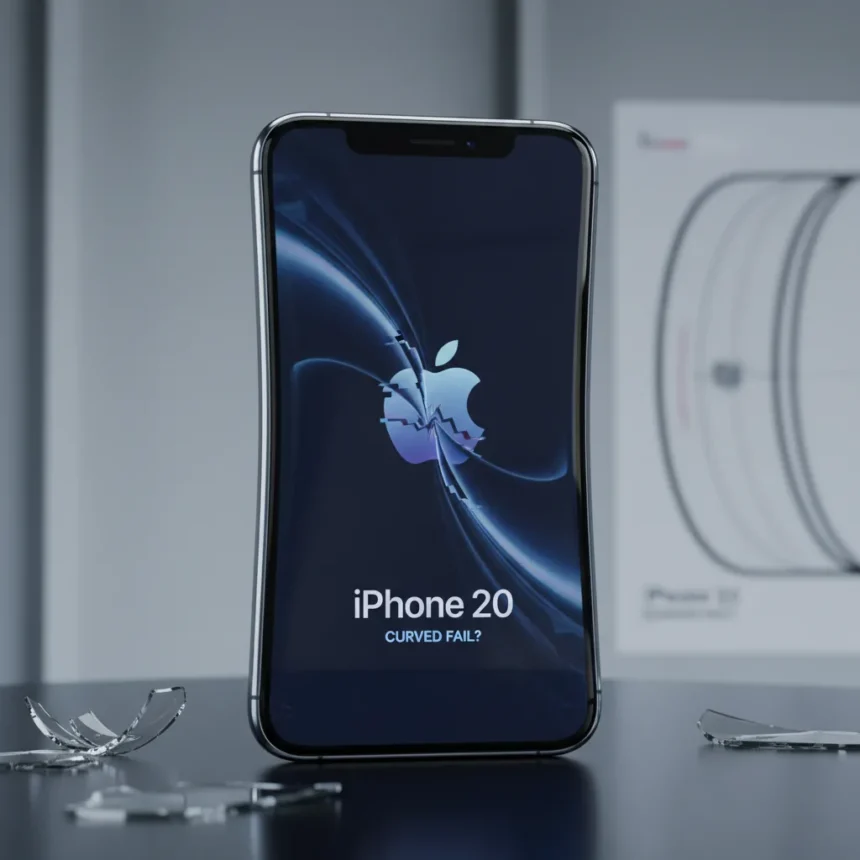
iPhone 20 curved screens are coming back, according to supply chain leaks, and that should worry anyone who remembers why Samsung abandoned aggressive curved edges in the first place. Apple is reportedly collaborating with Samsung to produce a quad-curved OLED display that curves around all four edges for the 2027 20th-anniversary iPhone model, complete with an under-display camera and a bezel-less design.
Key Takeaways
- Apple plans quad-curved OLED displays for the 2027 iPhone 20, curving all four edges.
- Samsung’s pol-less OLED technology uses Color Filter on Encapsulation for brighter, thinner panels.
- Micro-curves reduce accidental touches and distortion compared to Samsung’s aggressive waterfall edges.
- Curved screens have repeatedly failed to deliver practical benefits while introducing real usability problems.
- Leaks sourced from Weibo leaker Digital Chat Station, unconfirmed by Apple or Samsung.
The rumor mill is already spinning: Digital Chat Station, a well-known Weibo leaker, has detailed the display architecture, including a crater-shaped light diffusion layer for uniform brightness and a pol-less design using Samsung’s COE technology. But before Apple’s design team pats itself on the back for this innovation, the history of curved phone screens offers a cautionary tale that the company seems determined to ignore.
Why iPhone 20 curved screens repeat Samsung’s mistakes
Samsung’s Galaxy Edge lineup proved that curved screens sound better in concept than they work in practice. The aggressive waterfall edges that curved down the sides of those phones caused distortion at the edges, made accidental touch inputs nearly unavoidable, and turned what should have been a premium feature into a daily frustration. Users complained constantly. The industry learned the lesson and moved on. Yet here comes Apple, apparently ready to resurrect the idea.
The key difference, Apple’s suppliers claim, is subtlety. The iPhone 20 curved screens will use micro-curves—shallow curvatures rather than Samsung’s dramatic waterfall edges—designed to minimize accidental touches, reduce distortion, and improve grip comfort while enabling natural edge swipes. That sounds reasonable in theory. In practice, it is a marginal improvement on a fundamentally flawed concept. A shallower curve does not solve the problem; it just delays when users will start hating it.


The real issue with curved screens is not the angle of the curve—it is that they create an inferior interaction surface. Flat screens allow users to rest their thumb or palm naturally without triggering phantom inputs. Curved screens, no matter how shallow, introduce a zone of ambiguity where the phone cannot reliably distinguish between intentional input and accidental contact. Apple has spent years perfecting flat-edge industrial design with the iPhone 12 and later models. Abandoning that for a curve, however gentle, is a step backward disguised as innovation.
What the iPhone 20 curved screens actually offer
Apple is betting that the under-display camera and bezel-less design justify the curved edges. The pol-less OLED technology—which removes the polarizing layer entirely and uses Samsung’s Color Filter on Encapsulation process—does deliver real benefits: brighter panels, thinner construction, and better light diffusion. Those are genuine technical achievements. But none of them require curved screens. A flat OLED panel could deliver the same brightness and thinness. The under-display camera is a legitimate reason to eliminate the notch, but it does not need curves to work.



The curved edges appear to be chosen for aesthetic reasons: they look premium, they feel exclusive, and they signal that this is a special 20th-anniversary device. Those are valid marketing goals. They are not valid engineering reasons to introduce a feature that has already proven to frustrate users.
Flat screens won the design war for a reason
When Apple moved to flat edges with the iPhone 12, it was not a compromise or a cost-cutting measure—it was a deliberate design choice backed by years of user feedback. Flat edges are easier to grip, they do not distort content at the periphery, and they do not create accidental input zones. The flat-edge iPhone became the template that Samsung, Google, and others eventually copied because it simply works better. Reversing that decision for the iPhone 20 curved screens would be a failure to learn from the market’s own verdict.
The supply chain reports suggest that Apple is testing the under-display camera technology and that the curved display is still in development. There is still time to reconsider. A bezel-less flat-screen iPhone 20 with an under-display camera would be a genuine innovation without the baggage of a feature that has already failed. The curved edges feel like a designer’s indulgence rather than a user’s need.
Will the iPhone 20 curved screens actually ship?
These are unconfirmed rumors from supply chain sources, and Apple has a history of testing radical designs that never reach production. The quad-curved OLED panels may remain prototypes, abandoned before launch if user testing reveals what decades of curved-screen history already knows: they do not work as well as flat alternatives. If Apple does ship the iPhone 20 curved screens, it will be a costly reminder that premium materials and latest manufacturing do not guarantee good design.



Is the iPhone 20 definitely getting curved screens?
No. These are leaks from Weibo leaker Digital Chat Station and supply chain reports, not official announcements from Apple or Samsung. The iPhone 20 is still in development, and curved displays may be tested and abandoned before the 2027 launch. Apple frequently prototypes radical designs that never reach consumers.
What makes the iPhone 20 curved screens different from Samsung’s Galaxy Edge?
Apple’s quad-curved design uses micro-curves—shallow curvatures on all four edges—rather than Samsung’s aggressive waterfall edges. The micro-curves are designed to reduce accidental touches and distortion while maintaining a natural grip. However, this is a difference in degree, not kind; the fundamental problems of curved screens persist regardless of curve depth.
iPhone 20 curved screens represent a puzzling step backward for Apple. The company has spent over a decade proving that flat edges are superior. Reversing that decision for a 20th-anniversary phone would be a triumph of marketing over engineering—and users would pay the price every time they accidentally triggered an action on the curved edge.
Edited by the All Things Geek team.
Source: Tom's Guide