






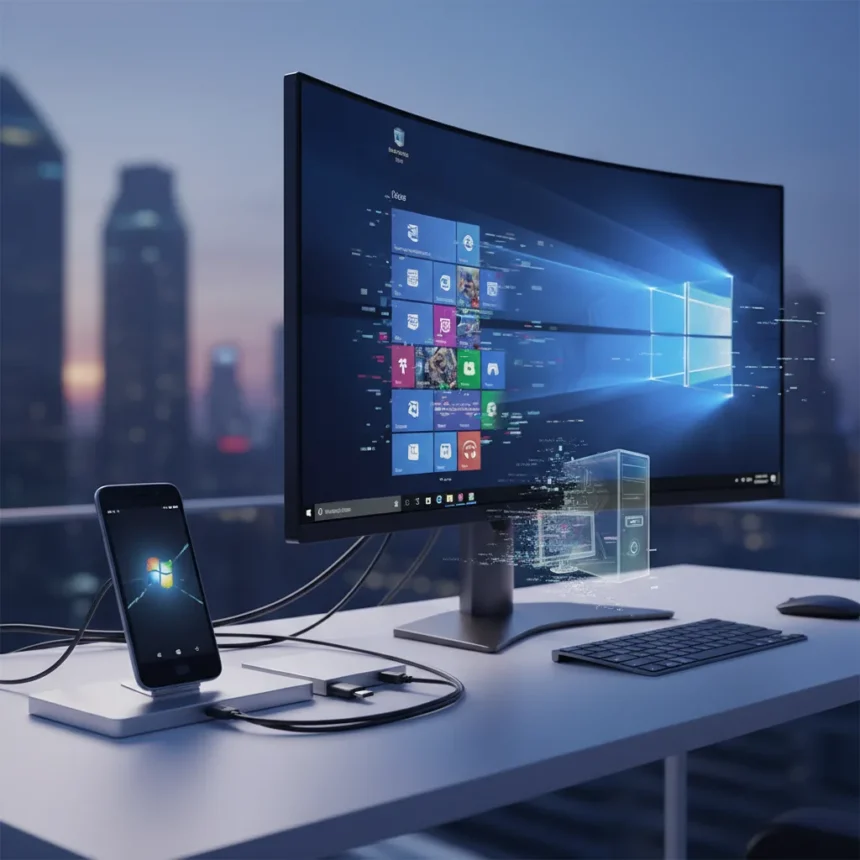
Windows 10 Mobile Continuum was Microsoft’s bold attempt to blur the line between phone and desktop, allowing users to connect their Lumia smartphones to external displays and turn them into fully functional PCs. Announced in late 2015 alongside the flagship Lumia 950 and Lumia 950 XL, the feature was engineered directly into Windows 10’s DNA rather than bolted on as an afterthought. Yet within months, Continuum faded into obscurity—described as nothing more than a ripple that disappeared almost as quickly as it arrived.
Key Takeaways
- Continuum launched with Windows 10 Mobile in late 2015, integrated at the OS level for Lumia 950 and 950 XL phones
- Users connected phones to a Microsoft Display Dock to access monitor, keyboard, and mouse setups
- The feature failed due to lack of available desktop applications for Windows 10 Mobile
- Continuum was positioned as Microsoft’s answer to Motorola’s failed Atrix, with OEM partner backing
- The concept eventually evolved into discussions of full Windows 10 on ARM devices running x86 applications
How Windows 10 Mobile Continuum Was Supposed to Work
The vision was straightforward: dock your phone, and it transforms into a desktop machine. Users connected their Lumia devices to Microsoft’s Display Dock, which provided access to a monitor, keyboard, and mouse. The phone’s processor handled everything—no separate computer needed. It was convergence taken seriously, built into the operating system itself rather than relying on third-party software. Microsoft believed this approach gave it a structural advantage over Motorola’s earlier Atrix, which had attempted the same feat years before and failed spectacularly.
The architecture was sound. Windows 10 Mobile was designed from the ground up to support this dual-mode operation, with the OS intelligently switching between phone and desktop interfaces depending on what was connected. On paper, it addressed a real problem: why carry two devices when one could do both jobs? The company had OEM partner support and a unified app platform to back the vision. Everything seemed aligned for success.
Why Windows 10 Mobile Continuum Failed in the Market
The fatal flaw was brutally simple: there were no desktop applications to run. Windows 10 Mobile lacked the software ecosystem that made traditional PCs indispensable. Users could dock their phones and see a desktop interface, but once they did, they discovered a barren landscape of available programs. The Microsoft Store had a fraction of the apps that Windows on traditional PCs offered, and critical productivity software simply did not exist for the platform. Continuum became a solution looking for a problem it could not actually solve.


This was not a hardware limitation or a design flaw—it was an ecosystem problem. Without developers building applications for Windows 10 Mobile, the feature remained a novelty. Users who connected their phones to external displays quickly realized they could accomplish far more by simply using a laptop. The hardware was capable, but the software layer that would have made Continuum genuinely useful never materialized. By the time the market realized this gap was unbridgeable, momentum had already evaporated.
Windows 10 Mobile Continuum vs. the Atrix Precedent
Motorola’s Atrix had tried the same concept years earlier and crashed spectacularly. Microsoft studied that failure and believed it had found the missing ingredients: deeper OS integration, OEM support, and a more unified platform. Yet both devices ultimately faced the same wall—the lack of software that justified the hardware investment. Continuum was not a technical failure; it was a market failure rooted in the same ecosystem weakness that had doomed its predecessor.



The difference was that Microsoft had more to lose. Motorola was a phone maker experimenting with an ancillary feature. Microsoft was betting Windows 10 Mobile’s entire future on convergence. When Continuum failed to catch fire, it signaled something darker: the entire Windows 10 Mobile strategy was increasingly irrelevant. Users were not waiting for better docking solutions—they were switching to iOS and Android, where the software ecosystem was mature and thriving.
What Happened to the Convergence Dream
The Continuum concept did not simply disappear. It evolved into discussions of full Windows 10 running on ARM-based devices, which could theoretically run x86 applications. This represented a shift in Microsoft’s thinking—rather than asking phones to become PCs, why not put actual Windows on mobile-class hardware? The company continued exploring this direction, though with diminishing returns. The dream of true convergence persisted, but Continuum itself became a historical footnote, a well-intentioned feature that arrived too early, in an ecosystem not ready to support it.
Microsoft eventually abandoned Windows 10 Mobile entirely, conceding that the smartphone market belonged to Android and iOS. Continuum’s failure was not the cause of that defeat—it was a symptom of a deeper problem: Microsoft could not build the developer momentum needed to compete in mobile. The feature worked. Users could dock their phones and see a functional desktop. But working features do not matter if nobody wants to use them.
Could Continuum Have Succeeded With Better Timing?
If Continuum had launched with a mature app ecosystem already in place, the story might have been different. The hardware was solid, the concept was sound, and the execution was technically competent. What was missing was the one thing Microsoft could not manufacture on its own: widespread third-party developer support. By 2015, the mobile market was already calcified around iOS and Android. Convincing developers to build for Windows 10 Mobile required a user base that did not exist, creating a chicken-and-egg problem with no solution.


The feature also arrived at an awkward moment in computing history. Tablets were declining, ultrabooks were becoming thinner and cheaper, and cloud services were reducing the need for local processing power. Continuum assumed users wanted a pocket-sized desktop replacement, but the market was moving in different directions entirely. Even if the software ecosystem had been robust, Continuum might have remained a niche curiosity rather than a category-defining innovation.
Was Windows 10 Mobile Continuum a waste of engineering effort?
Not entirely. The engineering that went into Continuum informed later work on Windows on ARM and mobile-class processors. The feature demonstrated what was technically possible and exposed the real constraints—ecosystem, not hardware. For Microsoft’s internal teams, Continuum was valuable research, even if the market never embraced it.
Why did developers not build apps for Windows 10 Mobile?
The platform lacked sufficient users to justify development investment. iOS and Android had billions of users; Windows 10 Mobile had millions at best. Developers chose to invest their time where the return was largest, leaving Windows 10 Mobile perpetually starved of the software it needed to compete.
Did any other company try the phone-as-PC concept?
Motorola’s Atrix was the most famous attempt, arriving before Continuum and failing for similar reasons. Samsung later explored DeX, which offered a similar docking experience for Galaxy phones, but with better success because Android already had a massive app ecosystem behind it.
Windows 10 Mobile Continuum remains a fascinating case study in how technical excellence cannot overcome ecosystem weakness. Microsoft engineered a feature that worked, backed it with hardware, and positioned it strategically—and it still failed because the foundation was not there. The lesson is harsh: in mobile computing, the software ecosystem is not just important, it is everything. Continuum proved that no amount of hardware innovation or clever design can substitute for the apps users actually want to run.
This article was written with AI assistance and editorially reviewed.
Source: Windows Central