





AI real-world applications represent the future of the technology, according to Google’s leadership, who argue that practical systems solving concrete problems will outlast the chatbot boom that defined 2024 and 2025. While OpenAI’s ChatGPT captured headlines and consumer attention, Google CEO Sundar Pichai and DeepMind CEO Demis Hassabis are pushing a different narrative: AI’s most important work happens in traffic management systems, medical imaging, and climate prediction—not in conversational interfaces.
Key Takeaways
- Google positions AI real-world applications in infrastructure, health, and climate as more impactful than consumer chatbots.
- DeepMind’s GraphCast weather model outperforms traditional forecasting in 90% of predictions.
- AlphaFold accelerates protein folding research, directly enabling faster cancer drug discovery.
- AI-optimized traffic systems and wildfire detection via satellite imagery are in pilot or research stages.
- Google frames practical AI as a regulatory advantage amid tightening rules on generative AI.
Why Google Believes AI Real-World Applications Matter More
Pichai and Hassabis reject the premise that AI’s value lies primarily in consumer-facing chatbots. Pichai stated that the real future of AI is not just chatbots—it’s in systems that save lives and make cities smarter. This shift reflects a broader realization within the tech industry: generative AI’s novelty wears off quickly, but infrastructure and health applications create lasting, measurable impact. Google’s argument is not that conversational AI lacks value, but that it represents only one slice of what AI can accomplish.
The distinction matters for investors, policymakers, and enterprises evaluating where AI actually moves the needle. A chatbot can entertain or assist with writing tasks. A cancer detection system can catch tumors earlier, potentially saving thousands of lives annually. A traffic management system can reduce urban congestion, cutting emissions and commute times. These applications operate in domains where accuracy directly translates to human welfare.
DeepMind’s Practical AI Breakthroughs in Health and Weather
Google DeepMind’s work demonstrates this philosophy in action. AlphaFold, the protein-folding AI, has already transformed cancer research by predicting protein structures in hours rather than years, according to Hassabis. This acceleration directly enables researchers to identify drug targets faster and design therapies with greater precision. The system moves beyond theoretical promise into active deployment within pharmaceutical and academic labs worldwide.


GraphCast, DeepMind’s weather prediction model, outperforms the European Centre for Medium-Range Weather Forecasts (ECMWF)—the global standard for accuracy—in 90% of predictions. Traditional weather forecasting relies on physics-based simulations run on supercomputers. GraphCast uses machine learning on historical data to achieve superior speed and accuracy. This matters for hurricane preparedness, agricultural planning, and renewable energy forecasting. When a model beats the gold standard by that margin, deployment follows quickly.
AI Real-World Applications in Traffic and Wildfire Detection
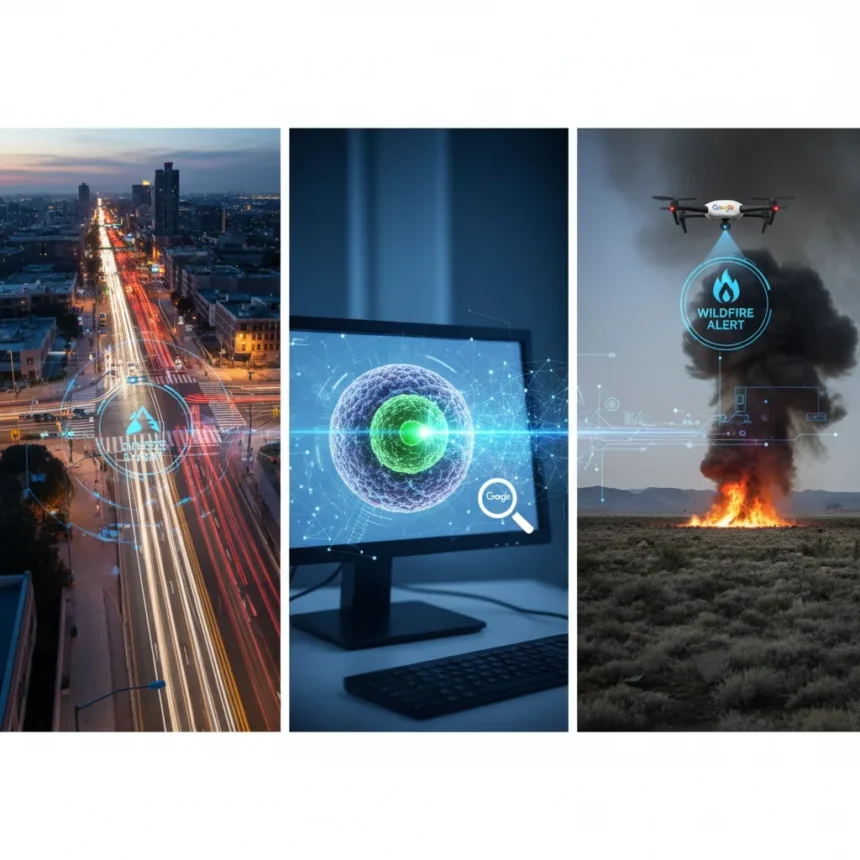
Google is also developing AI systems for urban infrastructure and disaster prevention. AI-optimized traffic lights represent a concrete use case: sensors and cameras feed real-time traffic flow data into neural networks that adjust signal timing dynamically, reducing congestion and emissions. Pichai has emphasized that AI can process satellite data to predict and alert on wildfires faster than humans alone, addressing a growing crisis as wildfire seasons intensify across North America, Australia, and Europe.



These applications remain largely in pilot or research stages, though enterprise deployment is accelerating. Google Cloud offers AI services for healthcare providers and municipalities, though specific pricing and availability vary by region and customer size. Unlike ChatGPT, which launched as a free consumer product, these systems are enterprise-focused tools integrated into existing workflows.
How Google Positions Itself Against OpenAI and Microsoft
The competitive framing is subtle but clear. OpenAI built ChatGPT as a consumer product that captured cultural attention but generates regulatory scrutiny. Microsoft invested heavily in integrating generative AI into Office and Copilot, betting on workplace productivity. Google, by contrast, is positioning itself as the company building AI for societal challenges—a narrative that aligns with regulatory pressure on generative AI and emerging public concern about AI’s environmental and ethical costs.
Microsoft has also invested in healthcare AI, including tumor detection systems, and Meta has deployed wildfire prediction models. But Google’s advantage lies in scale and brand: DeepMind’s reputation for foundational research, Google Cloud’s enterprise reach, and Pichai’s platform as a CEO allow Google to shape the narrative around what AI should prioritize. Whether this translates to market dominance depends on execution speed and regulatory environment.
Why This Matters Now
The timing of Google’s pivot is significant. Generative AI’s hype cycle is cooling. Enterprises are asking harder questions about ROI. Regulators are tightening rules on data, bias, and environmental impact. Meanwhile, real-world crises—wildfires, traffic congestion, cancer burden—are worsening. Google’s argument that AI real-world applications should take priority is not just philosophical; it’s pragmatic. A company that delivers measurable impact on climate, health, and infrastructure will face less regulatory friction and build deeper customer loyalty than one chasing consumer chatbot engagement.



The question is not whether practical AI applications are valuable—they clearly are. The question is whether Google can execute faster than competitors and whether it will actually deploy these systems at meaningful scale, or whether they remain research projects that generate headlines without transforming how cities, hospitals, and emergency services operate.
What counts as AI real-world applications?
AI real-world applications are systems deployed in production environments to solve concrete problems in healthcare, infrastructure, climate, or other domains where accuracy and speed directly impact human welfare. Traffic optimization, disease detection, and weather prediction are classic examples. Consumer chatbots, by contrast, are tools for information retrieval and writing assistance—valuable but less directly tied to life-or-death outcomes.
Is Google’s GraphCast weather model actually more accurate than traditional forecasting?
Yes. GraphCast outperforms the European Centre for Medium-Range Weather Forecasts in 90% of predictions, according to DeepMind’s benchmarks. The model processes historical weather data using machine learning rather than physics-based simulations, achieving faster computation and higher accuracy on medium-range forecasts.
When will AI traffic lights and cancer detection tools launch?
No specific launch dates are confirmed. These systems are in pilot or research stages. Google Cloud offers AI services for healthcare and enterprise clients, but deployment timelines vary by region and customer readiness. AlphaFold is already in active use by researchers and pharmaceutical companies, making it the most mature application in Google’s portfolio.
Google’s argument that AI real-world applications matter more than chatbots is compelling, but the real test lies in deployment speed and measurable impact. A traffic system that reduces congestion by 10%, a cancer detection tool that improves diagnosis accuracy by 5%, or a wildfire alert that saves even one community matters far more than a chatbot that generates a million interactions. If Google can deliver these systems at scale before competitors do, the company will have earned its claim to leading the next wave of AI.
This article was written with AI assistance and editorially reviewed.
Source: Tom's Guide