




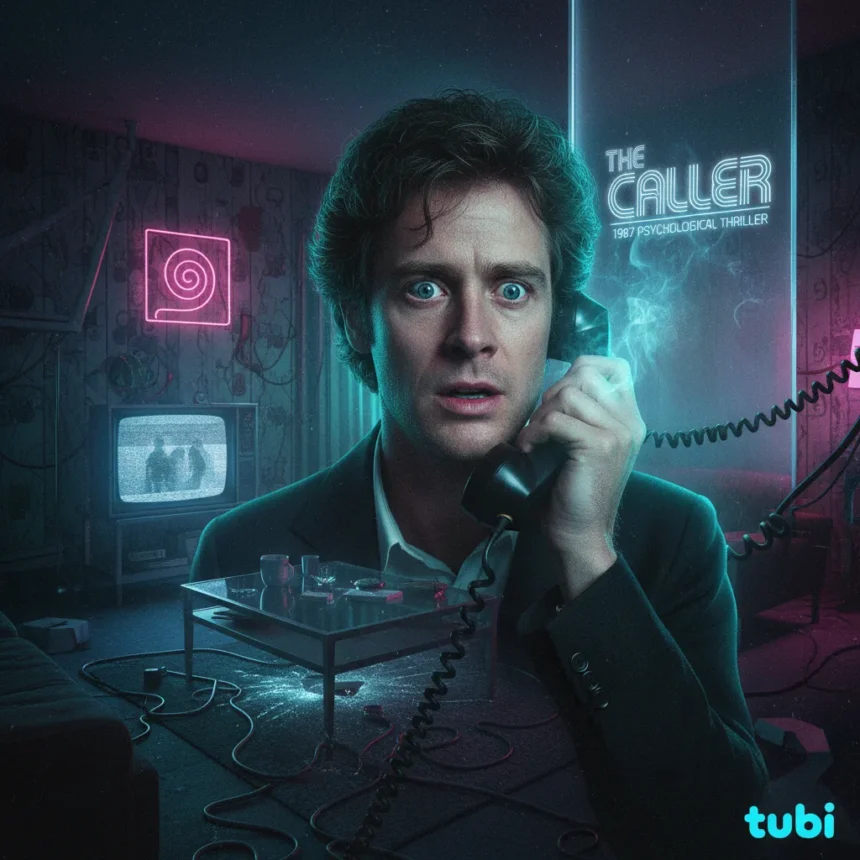
The Caller 1987 thriller is a two-character psychological standoff that should have made Malcolm McDowell a household name in horror circles but instead vanished into obscurity for nearly four decades. Released in 1987 and directed by Arthur Allan Seidelman, this 100-minute mind game strips away elaborate sets and production budgets to focus on what actually terrifies: a stranger’s presence and the slow erosion of trust. Now streaming free on Tubi, it demands immediate attention from anyone who still remembers when thrillers didn’t need jump scares to disturb you.
Key Takeaways
- The Caller 1987 thriller stars Malcolm McDowell as a polite stranger whose car supposedly breaks down at a remote cabin.
- The film runs 100 minutes with only two main actors, creating a claustrophobic dialogue-driven tension similar to Twilight Zone episodes.
- A bizarre twist ending and themes of gaslighting, mind games, and psychological terror seal its cult status.
- Written by Michael Sloan and now available free on Tubi, making it accessible to modern audiences discovering hidden gems.
- The film’s low budget and surreal tone have sparked recent cult revival interest among thriller enthusiasts.
The Caller 1987 thriller opens with deceptive simplicity. A woman called Girl (Madolyn Smith) prepares dinner in a secluded cabin, expecting a guest. A bizarre phone conversation precedes a knock at the door. A polite Englishman claims his car has broken down and asks to use her phone. She lets him in. From that moment, the film becomes a psychological chess match where every word carries weight and every gesture hides intention.
Why The Caller 1987 Thriller Builds Dread Without Gore
The Caller 1987 thriller works because it abandons the horror genre’s safety net of visual spectacle. Instead of relying on jump scares or elaborate kills, it constructs dread through dialogue, proximity, and the slow realization that something is profoundly wrong. McDowell’s stranger is not a masked killer or supernatural entity—he is a man whose motivations remain deliberately opaque, whose politeness masks something darker. The film puts viewers on edge within the first ten minutes through nothing but oddness and bizarre conversations.
The escalation is methodical. Girl’s initial suspicion hardens into certainty that her visitor has no broken car, no legitimate reason to be there. What begins as playful uneasiness transforms into bold anger and psychological terror. The film explores themes of gaslighting, mental illness, and abuse within the confined space of the cabin, creating a pressure cooker where both characters are trapped. McDowell’s performance never tips into cartoonish villainy—he remains unsettlingly composed, which makes the threat feel more plausible and more disturbing.



The Caller 1987 thriller achieves what many contemporary horror films miss: the understanding that what you don’t fully understand is scarier than what you do. The film’s surreal, hypnotic tone keeps viewers guessing about the true nature of the relationship between these two strangers. Is this a home invasion thriller? A psychological study of two damaged people? Something stranger still? The ambiguity is the point.
The Caller 1987 Thriller vs. Modern Psychological Thrillers
Modern psychological thrillers tend toward plot complexity and narrative twists that can be explained and dissected. The Caller 1987 thriller takes the opposite approach—it trusts the audience to sit with discomfort and uncertainty. There is no elaborate backstory reveal that justifies everything. There is no tidy resolution that ties up loose ends. Instead, the film ends on a note of genuine weirdness that has sparked debate among cult enthusiasts for decades. This refusal to provide easy answers is what separates hidden gems from forgotten films—and what makes The Caller 1987 thriller worth rediscovering.



The comparison to Twilight Zone episodes is apt. Like the best episodes of that series, The Caller 1987 thriller builds a closed-room scenario where the rules of reality seem to shift slightly, where the familiar becomes alien. The low budget actually strengthens this effect—there is nowhere to hide in production value, so every element must earn its place. The dialogue carries the weight that special effects would carry in a bigger film.
What Makes The Caller 1987 Thriller a Cult Mystery Worth Discovering
The Caller 1987 thriller has experienced a quiet cult revival, particularly among viewers who discovered it through retrospective reviews and streaming platforms. Its status as a hidden gem is not accidental—the film was underseen on theatrical release and overlooked during the home video era, only to be rediscovered by critics and cinephiles willing to take chances on obscure titles. Recent attention from cult film communities and platforms like Tubi has introduced it to audiences who would never have encountered it otherwise.
The film’s ending is deliberately bizarre and unsettling, refusing to conform to thriller conventions. Without spoiling it, the final moments reframe everything that came before and leave viewers genuinely uncertain about what they witnessed. This is not a flaw—it is the film’s greatest strength. In an era when most thrillers spell out their twists with on-screen text, The Caller 1987 thriller respects its audience enough to leave them disturbed and questioning.
The Caller 1987 thriller contains themes of edge play and BDSM elements woven into its psychological terror, adding layers of discomfort that extend beyond typical home invasion scenarios. The film does not exploit these themes for shock value—they emerge naturally from the power dynamics between the two characters, making the film feel more transgressive and less comfortable than standard thriller fare.



Is The Caller 1987 thriller worth watching if I don’t usually like horror films?
The Caller 1987 thriller is not a traditional horror film—it is a psychological thriller that happens to be disturbing. If you appreciate Twilight Zone episodes, slow-burn tension, and character-driven narratives, you will likely find it compelling even if gore and jump scares typically turn you away. The film’s strength lies in its dialogue and atmosphere, not in visual horror.
Why did The Caller 1987 thriller take so long to find an audience?
The film was released in 1987 but never received the critical attention or distribution support that might have made it a cult classic earlier. It existed in relative obscurity until recent years when streaming platforms and retrospective reviews introduced it to new audiences willing to explore overlooked titles. Its two-character, dialogue-heavy format may have seemed commercially risky in an era that favored more conventional thrillers.
Can I watch The Caller 1987 thriller for free right now?
Yes. The Caller 1987 thriller is currently available to stream free on Tubi, making it one of the most accessible hidden gems in the platform’s library. No subscription upgrade or rental fee is required [source article summary].
The Caller 1987 thriller deserves to be watched not because it is a forgotten masterpiece—it has real flaws, including a final ten minutes that some viewers find too weird even for a surreal narrative—but because it is a rare example of a low-budget film that trusts its audience to sit with discomfort and uncertainty. In a streaming landscape cluttered with forgettable content, discovering something genuinely unsettling and strange feels like an act of resistance. Stream it free on Tubi, turn off your phone, and let Malcolm McDowell’s polite stranger into your evening.
Where to Buy
8 Amazon customer reviews | No price information
This article was written with AI assistance and editorially reviewed.
Source: Tom's Guide