





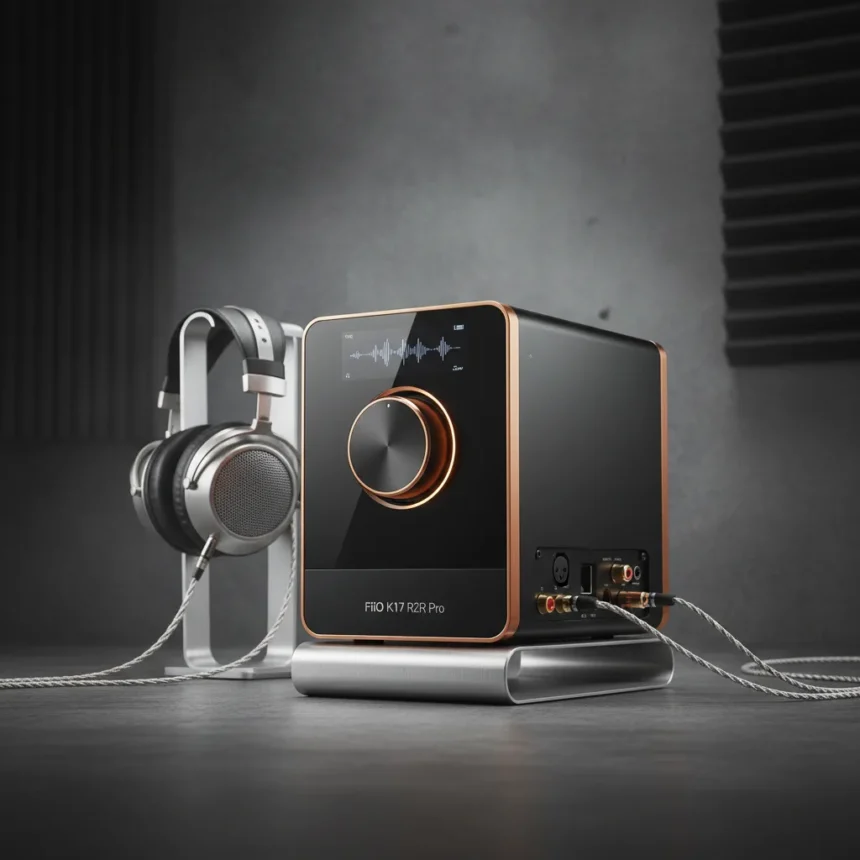
The FiiO K17 R2R Pro is a new DAC-cum-streamer from the Chinese audio manufacturer, designed to deliver what the company calls uncompromising sound quality. FiiO will showcase the K17 R2R Pro in June, signaling an imminent market entry for a device that sits at the intersection of stationary and portable hi-res audio.
Key Takeaways
- FiiO K17 R2R Pro combines DAC and streaming capabilities in a single unit
- Product will be demonstrated publicly in June
- Extends FiiO’s R2R architecture lineup beyond portable players
- Targets audiophiles seeking uncompromising sound quality
- Arrives as FiiO expands beyond portable music players into desktop audio
FiiO K17 R2R Pro: What We Know So Far
Details remain sparse ahead of the June debut, but the FiiO K17 R2R Pro represents the company’s push into desktop DAC-streaming territory. By combining digital-to-analog conversion with streaming capabilities, FiiO is positioning the device as a bridge between source material and amplification—a role traditionally filled by separate components or expensive all-in-one systems. The R2R designation signals the use of R2R (resistor-to-resistor) DAC architecture, a design philosophy FiiO has championed across its recent portable lineup.
FiiO has built momentum in hi-res audio through portable devices like the M27 flagship and the M33 R2R, both emphasizing sonic precision over convenience. The K17 R2R Pro extends this philosophy to a format designed for stationary use, suggesting FiiO believes there is unmet demand for desktop audio that does not compromise on sound engineering. The June showcase will likely reveal technical specifications, supported audio formats, connectivity options, and power output—details that currently remain undisclosed.
How FiiO K17 R2R Pro Fits the R2R Strategy
FiiO’s recent releases have coalesced around the R2R architecture as a sonic signature worth defending. The M33 R2R portable player supports 24-bit/384kHz file playback and runs Android 13 with 8GB RAM and 128GB storage, demonstrating FiiO’s commitment to hi-res formats in mobile form factors. The M27 flagship uses Qualcomm’s QCS6490 platform and competes directly with Astell & Kern in the best portable music player category, aiming for what FiiO describes as uncompromising sonic performance. By introducing the K17 R2R Pro as a DAC-streamer, FiiO signals that R2R architecture belongs not just in pocket-sized devices but in desktop setups where power and cooling constraints are less limiting.



This expansion mirrors broader industry trends where DAC manufacturers are consolidating functions—streaming, conversion, amplification—into single chassis. However, FiiO’s R2R focus distinguishes its approach from competitors like iFi, whose iDSD Diablo battery-powered portable DAC and headphone amplifier launched in 2021 as a flagship transportable solution. FiiO’s stationary DAC-streamer can prioritize audio fidelity over portability, a strategic advantage if the K17 R2R Pro delivers measurable performance gains over mobile alternatives.
Desktop Audio Market Context
The FiiO K17 R2R Pro enters a market where audiophiles increasingly expect multi-function devices. Standalone DACs have become niche products; today’s buyers want streaming integration, headphone amplification, and speaker connectivity in one box. FiiO’s move acknowledges this reality while betting that R2R architecture—a design choice more common in vintage and high-end equipment—offers sonic advantages that justify the investment. Whether the K17 R2R Pro will compete on price, performance, or both remains unknown pending the June reveal.



The timing of the announcement matters. FiiO has released multiple R2R products in rapid succession, suggesting internal confidence in the architecture and market appetite for the brand. The K17 R2R Pro represents a logical next step: taking proven sonic principles from portable devices and applying them to a form factor where thermal headroom and power delivery can be optimized without compromise.
What to Expect in June
The June showcase will answer critical questions about the FiiO K17 R2R Pro’s practical appeal. Specifications like supported audio formats, output power, connectivity (USB, S/PDIF, optical, analog RCA), and whether the device includes onboard amplification or functions as a pure DAC will determine its market positioning. Pricing and availability details are equally important—will this be an entry-level desktop DAC, a mid-range all-in-one, or a premium reference component? FiiO’s track record suggests competitive pricing relative to feature set, but the K17 R2R Pro’s actual value proposition will only crystallize once full details emerge.
Is the FiiO K17 R2R Pro worth waiting for?
If you prioritize R2R DAC architecture and trust FiiO’s sonic engineering, the K17 R2R Pro merits attention. The June debut will reveal whether the device offers genuine advantages over existing stationary DACs or serves primarily as a convenience play for FiiO ecosystem users. Audiophiles should reserve judgment until specifications and independent reviews surface.
How does the K17 R2R Pro compare to FiiO’s portable players?
The K17 R2R Pro trades portability for stationary optimization. While the M33 R2R and M27 prioritize hi-res playback in mobile form factors, the K17 R2R Pro can allocate more power and cooling to DAC circuitry. The tradeoff is obvious: you gain fidelity but lose the ability to stream music on the go. For desktop listeners, this is a sensible engineering choice.



FiiO’s expansion into desktop DAC-streaming with the K17 R2R Pro reflects confidence in R2R architecture as a sonic differentiator. The June showcase will determine whether the device justifies that confidence or represents incremental iteration. Audiophiles seeking uncompromising sound quality in a stationary form factor should mark their calendars—but reserve final judgment until full specifications and reviews arrive.
Edited by the All Things Geek team.
Source: What Hi-Fi?




