





Suunto Core 2 battery life may finally answer the question that has frustrated smartwatch owners for years: why does a watch need charging every single night? An FCC filing uncovered in recent weeks suggests that Suunto is preparing the launch of the Suunto Core 2 with a replaceable battery design that could deliver multi-month or multi-year runtime—a stark contrast to the Apple Watch’s daily charging requirement and a direct shot at Garmin Fenix’s market dominance in long-life outdoor smartwatches.
Key Takeaways
- FCC filing reveals Suunto Core 2 uses CR3032 battery, nearly double the capacity of standard smartwatch batteries.
- Original Suunto Core achieves 12-18 months average battery life with user-replaceable CR2032.
- Suunto Core 2 targets outdoor enthusiasts frustrated by Apple Watch’s nightly recharge cycle.
- Garmin Fenix remains the premium competitor, but Suunto’s replaceable battery approach offers a different philosophy.
- No official launch date or pricing confirmed; FCC filing is the only public indication of the device.
What the FCC Filing Reveals About Suunto Core 2 Battery Life
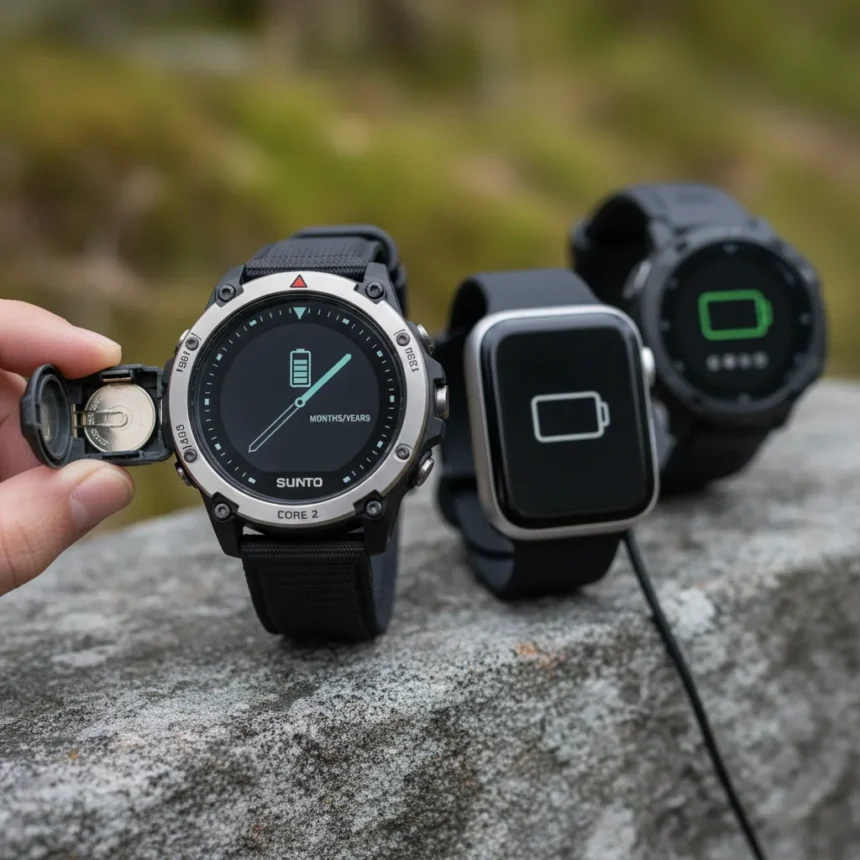
The Suunto Core 2 battery life story begins with a technical detail: the device will use a CR3032 battery with 500 mAh capacity, nearly twice the power of the standard CR2032 found in the original Suunto Core. This is not a small incremental upgrade—it is a deliberate engineering choice to extend runtime in a user-replaceable form factor. Forum speculation suggests the larger battery could sustain the watch for six months on a single charge, though Suunto has not officially confirmed this timeframe.
The original Suunto Core established the foundation for this approach. Users report battery life ranging from 12 to 18 months depending on usage patterns, with some variation based on battery brand and whether features like the compass and backlight are used frequently. The watch enters a low-battery warning state when 5 to 15 percent capacity remains, giving users clear notice before total depletion. What matters here is the design philosophy: Suunto chose a path where users swap batteries themselves rather than sending devices for service or tethering them to a charger nightly.
Suunto Core 2 vs. Apple Watch and Garmin Fenix
The contrast is immediate and brutal for Apple Watch owners. The Apple Watch requires nightly charging—a ritual that turns a wearable into a bedside accessory that demands power before you sleep. The Suunto Core 2, by contrast, aims to be a watch you wear for months without thinking about battery status. That difference defines the entire user experience.



Garmin Fenix occupies the other end of the spectrum: a premium outdoor smartwatch built for expeditions and adventure. Yet even Fenix requires periodic charging, albeit with longer intervals than Apple Watch. Suunto Core 2 battery life—if the FCC filing’s capacity hints are accurate—offers a middle ground: the durability and outdoor focus of Fenix with the user-replaceable simplicity of traditional watches. You do not wait for a charge cycle; you swap a battery and continue.
The original Suunto Core also compares favorably to Casio Pro Trek, another outdoor watch contender. The Core has a larger, easier-to-read display and allows battery swaps without special tools, while the Pro Trek demands more complex disassembly. The Pro Trek costs more than twice as much as the Core, though it offers 28-day smartwatch mode or indefinite runtime with solar charging. The Suunto approach trades solar convenience for accessibility and cost.



Battery Replacement as a Feature, Not a Flaw
Smartwatch makers have treated replaceable batteries as a relic of the past, a sign of design compromise. Suunto Core 2 battery life strategy flips this narrative. A replaceable battery is not a limitation—it is a feature that extends the watch’s lifespan and reduces electronic waste. When the CR3032 depletes after months of use, you buy a new battery for a few dollars and swap it in minutes. No recycling, no trade-in program, no subscription service required.
This approach also sidesteps the entire battery degradation problem that plagues rechargeable smartwatches. Apple Watch batteries degrade over time, losing capacity year after year until owners feel compelled to upgrade. With a replaceable battery, the watch itself never ages—only the battery does, and that is cheap to replace. For outdoor enthusiasts who expect their gear to last a decade, this is a meaningful advantage.
Why Now? The FCC Filing and Market Timing
The FCC filing appears because Suunto Core 2 is preparing for market entry, likely within the next few months. No official launch date or pricing has been announced, and Suunto has not publicly confirmed the device. However, the filing is real, the battery capacity is measurable, and the competitive pressure is undeniable. Apple Watch owners are tired of charging. Garmin Fenix users pay premium prices for multi-week battery life. Suunto is positioning the Core 2 as the practical answer: multi-month runtime, user-replaceable battery, and a price point below Fenix.
The outdoor watch market has fragmented. Smartwatches chase notifications and fitness metrics. Dedicated outdoor watches prioritize durability, navigation, and battery endurance. Suunto Core 2 battery life philosophy aligns with the latter camp, and that is where the growth opportunity lies. As consumers wake up to the absurdity of charging a watch daily, products designed to avoid that ritual will gain traction.



What About Features Beyond Battery Life?
The FCC filing tells us nothing about the Suunto Core 2’s feature set beyond battery capacity. The original Suunto Core includes altimeter, barometer, and compass (ABC) metrics, weather information, multiple watch and date functions, and a multilingual menu. It is waterproof to 30 meters, suitable for swimming and snorkeling but not diving. Whether the Core 2 retains these features, adds new ones, or strips some away remains unknown until Suunto makes an official announcement.
What is clear: Suunto Core 2 battery life is the headline feature. Everything else will be secondary to the promise of wearing a watch for months without recharging. That is the story that will drive early adoption and media coverage.
Is Suunto Core 2 confirmed to launch soon?
No official launch date has been announced. The FCC filing is the only public indication that the Suunto Core 2 exists and is preparing for market entry. Suunto has not made any statements about the device, pricing, or availability. The filing suggests it could arrive within months, but that is speculation based on typical FCC-to-launch timelines, not confirmed information.
How long will the Suunto Core 2 battery actually last?
Forum speculation suggests six months on a single CR3032 battery, but Suunto has not officially confirmed this. The original Suunto Core achieves 12 to 18 months with a smaller CR2032 battery, so the larger CR3032 capacity could plausibly extend runtime further, though actual longevity will depend on usage patterns, feature activation, and whether Bluetooth connectivity drains the battery faster than expected.
How does Suunto Core 2 compare to Garmin Fenix for outdoor use?
Both target outdoor enthusiasts, but with different philosophies. Garmin Fenix prioritizes premium features, navigation, and multi-week battery life, with a correspondingly higher price. Suunto Core 2 battery life strategy emphasizes simplicity, user replacement, and lower cost. Fenix is the choice for serious adventurers who want advanced mapping and training metrics. Core 2 is for hikers and outdoor enthusiasts who want a reliable, long-lasting watch without the premium price tag.
The Suunto Core 2 battery life story is not about revolutionary technology—it is about returning to a simpler, more practical approach to wearables. While the Apple Watch obsesses over notifications and the Garmin Fenix chases performance metrics, Suunto is betting that some users just want a watch that works for months without drama. The FCC filing suggests that bet is about to become reality.
Where to Buy
Apple Watch Ultra 3 | Samsung Galaxy Watch 8 | Google Pixel Watch 4
This article was written with AI assistance and editorially reviewed.
Source: TechRadar