





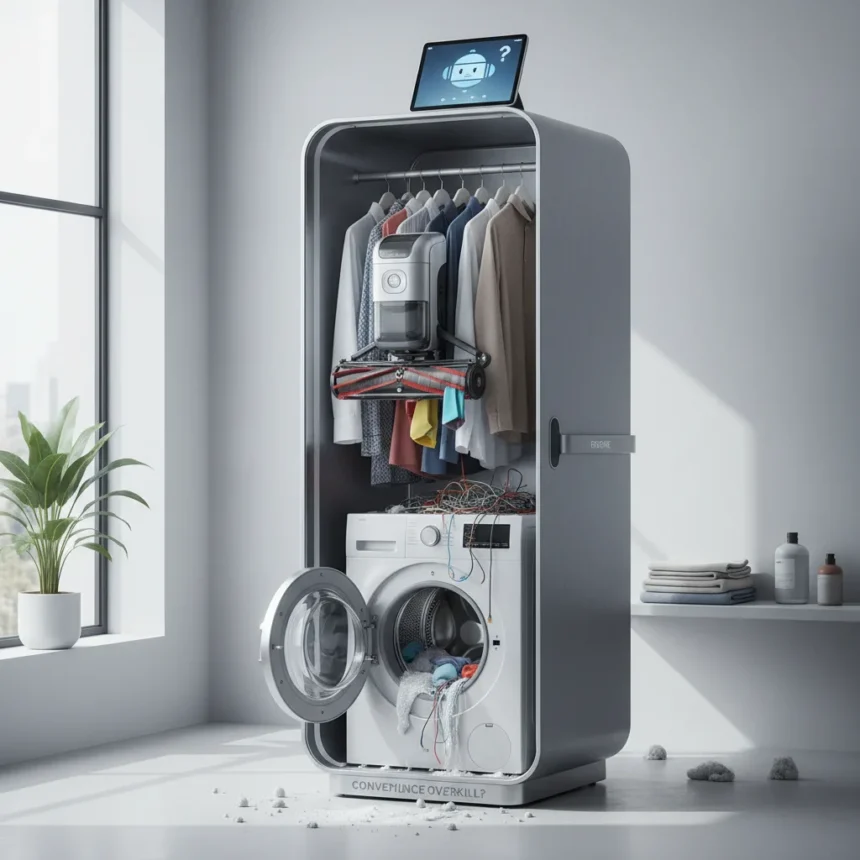
Smart home tech overreach has officially jumped the shark. At a recent product event, Dreame—the smart-home brand expanding aggressively beyond vacuums—unveiled a closet that functions simultaneously as a robot vacuum home, laundry center, and storage system, complete with four distinct washer-dryers and a robotic arm ready to assist with additional chores. The question is no longer whether smart home automation improves daily life. It’s whether we’ve lost sight of what actually needs automating.
Key Takeaways
- Dreame’s closet-vacuum-washer combo integrates a robot vacuum with four washer-dryers and a robotic arm in a single unit
- All Dreame appliances—from phones to smart rings to diamond watches—connect via a unified ecosystem requiring a Dreame ring or phone for control
- The brand now spans vacuums, cars, smartphones, wearables, smart glasses, and kitchen appliances with fingerprint scanners
- Smart home tech overreach raises questions about ecosystem lock-in and whether bundling unrelated functions actually serves users
- Competing laundry automation solutions like Foldimate take narrower, more focused approaches to specific problems
When Convenience Becomes Ecosystem Trap
Dreame’s philosophy appears to be: if it can plug in, it should connect. The closet-washing machine combo exemplifies this philosophy taken to its logical extreme. Control and updates for all Dreame appliances flow through a single Dreame smart ring or phone within the Dreame ecosystem. This centralized control sounds efficient until you realize what it means: you are locked into purchasing exclusively from Dreame if you want seamless integration. Want to swap in a superior washing machine from another brand? That breaks the ecosystem. Prefer a different smart ring manufacturer? Good luck coordinating updates across devices that were designed to work as one unified system.
This is smart home tech overreach masquerading as convenience. Yes, controlling your vacuum, washer, and closet from one app is theoretically appealing. But it comes at a cost: vendor lock-in. You cannot cherry-pick the best appliance from each manufacturer if you want everything to work together smoothly. Dreame is betting that users will accept this trade-off in exchange for integration. History suggests otherwise.
The Absurdity Expands Beyond Laundry
The closet-washer combo is not even Dreame’s most outlandish reveal. The brand has moved into smartphones, bone-conduction headphones, two smart rings, a smartwatch, diamond-encrusted watches, a TV with robotically adjusted speakers, a robot that does laundry, and a fridge equipped with a fingerprint scanner and robotic arm. There is also a rocket-powered electric car in the mix. At some point, adding more categories does not equal innovation—it is just brand sprawl. Dreame is trying to become the everything company, but you cannot be excellent at everything simultaneously.


Compare this to competitors taking narrower approaches. Foldimate, for instance, focuses on a single problem: folding laundry. The machine processes a whole load in five minutes, positioning automation as a solution to a specific pain point rather than a reason to overhaul your entire home. This is smarter product strategy than hoping users will replace their entire smart home with Dreame devices just for the sake of integration.
Smart Home Tech Overreach and the Question of Necessity
The fundamental problem with smart home tech overreach is that it conflates capability with necessity. Yes, you can embed a robot vacuum into a closet alongside four washers and dryers. But should you? Does the average household actually benefit from having their vacuum, washer, dryer, and closet storage all in one unit? Or does bundling unrelated functions simply create a single point of failure that makes your entire laundry and cleaning routine collapse if one component malfunctions?


Dreame’s approach assumes that users want maximum integration. Real-world behavior suggests the opposite. Most people want appliances that do one thing exceptionally well and integrate with other devices when it makes sense. A robot vacuum that cleans efficiently is valuable. A washing machine that cleans clothes reliably is valuable. Combining them into a closet that requires a proprietary smart ring to control everything? That is solving a problem nobody asked for.
The Ecosystem Lock-In Problem
Smart home tech overreach thrives on ecosystem lock-in. Once you have invested in a Dreame vacuum, Dreame washer, Dreame ring, and Dreame phone, switching to a competitor becomes prohibitively expensive and inconvenient. You have already paid for the integration; starting over with a different brand means losing all those connections. This is a business advantage for Dreame, but it is a consumer disadvantage. It discourages competition and innovation because users are trapped by their previous purchases.
The smarter approach is interoperability. Devices should work together through open standards, not proprietary ecosystems. A robot vacuum should pair with any smart home hub. A washing machine should integrate with any automation platform. This gives users freedom to choose the best product in each category without sacrificing integration. It is also the approach that has made smartphones and personal computers successful—they work with thousands of third-party accessories and services, not just those made by the original manufacturer.
Does smart home tech overreach actually save time?
Not necessarily. While a unified Dreame ecosystem theoretically reduces the number of apps you need, it also means you cannot use the best app for each device. You are locked into Dreame’s interface for everything. If Dreame’s vacuum app is inferior to a competitor’s, you are stuck with it. If the washing machine interface is clunky, you cannot replace it. Integration is only valuable if it does not come at the cost of individual product quality.

What makes Dreame different from other smart home brands?
Dreame’s defining characteristic is aggressive category expansion combined with aggressive ecosystem integration. While other smart home brands focus on specific areas—vacuums, security, thermostats—Dreame is attempting to become a total-home solution spanning vacuums, appliances, wearables, vehicles, and phones. This breadth is unusual and raises questions about whether the company can maintain quality across so many disparate product categories simultaneously.
Is a closet-washer-vacuum combo actually useful?
In theory, combining laundry and cleaning storage in one location saves space. In practice, it creates a complex, expensive, hard-to-repair unit that fails entirely if any single component breaks. A traditional closet, separate washer, and separate dryer are more flexible, easier to replace individually, and less likely to leave you without laundry capability if something malfunctions. Simplicity and modularity often outperform integration in real-world usage.
Smart home tech overreach is the industry’s current trajectory, and Dreame is leading the charge. But leading does not mean heading in the right direction. The future of smart homes should be about solving real problems—reducing time spent on chores, improving convenience, enhancing security—not about forcing unrelated devices into the same ecosystem simply because technology allows it. Until that philosophy changes, expect more closets that vacuum, more fridges with robotic arms, and more users frustrated by ecosystem lock-in. The question is not whether smart home tech has gone too far. It clearly has. The question is whether consumers will demand better before it is too late.
This article was written with AI assistance and editorially reviewed.
Source: TechRadar