






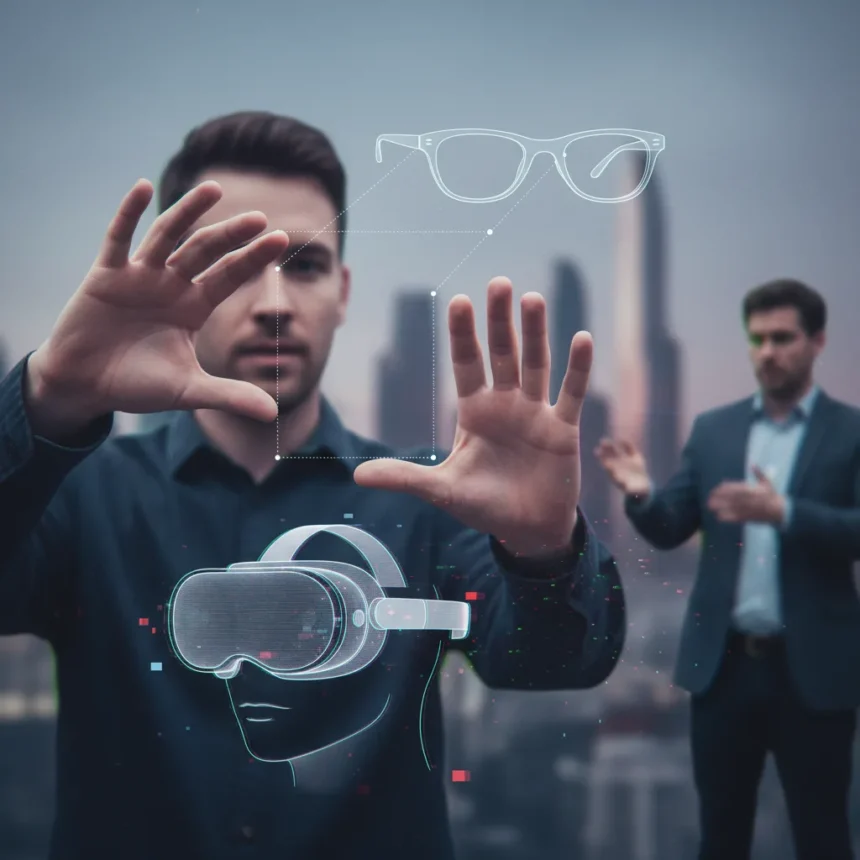
Apple Glasses hand gestures are the subject of fresh rumors claiming the upcoming smart glasses will borrow Vision Pro’s pinch-and-tap interaction model. But Mark Gurman, Bloomberg’s senior reporter covering Apple, has publicly dismissed the claim as technically implausible and suggests a simpler alternative is far more likely for the 2027 launch window.
Key Takeaways
- MacRumors cites an unnamed source claiming Apple Glasses will use dual cameras to enable Vision Pro-style hand gestures.
- Mark Gurman states the technology to recognize hand gestures with a single camera and no eye-tracking does not exist today.
- Gurman believes AirPods-style head gestures (nodding, shaking head) are more likely for the first generation.
- Vision Pro gestures require looking at content and pinching fingers together, a system that works with its full eye-tracking hardware.
- Early VR headsets relied on handheld controllers; Vision Pro eliminated them through gesture recognition.
What the Apple Glasses rumor actually claims
According to MacRumors, an inside source told the publication that Apple Glasses will ship with two cameras: a high-resolution unit for capturing shareable photos and video, plus a lower-resolution wide-angle lens designed to read hand gestures and feed visual input to Siri. The pitch is straightforward—borrow the gesture vocabulary from Vision Pro and adapt it to glasses form factor. No controllers, no additional hardware. Just hands.
The appeal is obvious. Vision Pro’s hand gesture system eliminates the need for external input devices. Users can tap their fingers together to select, pinch to zoom, swipe to scroll. It works smoothly in controlled environments where the device can track hand position reliably. Applying that same interaction model to lightweight glasses would be elegant. But elegance and technical feasibility are not the same thing.
Why Gurman thinks the rumor is sketchy
Gurman’s skepticism hinges on a single, critical fact: the technology to reliably recognize hand gestures using only a single camera, without neural band sensors or eye-tracking hardware, does not currently exist. Vision Pro succeeds because it combines eye-tracking, hand tracking, and spatial awareness into a tightly integrated system. Strip away the eye-tracking and neural sensors, and the problem becomes vastly harder. A single wide-angle camera cannot reliably determine whether you are pinching your fingers three feet away or six feet away, whether your hands are in frame or out of frame, whether you intend a gesture or simply moved your hand while thinking.

Gurman has also heard nothing from his sources inside Apple suggesting the first generation of Apple Glasses will include sophisticated gesture recognition of any kind. That silence is significant. If Apple were engineering such a system, the technical challenges would likely leak to reporters covering the company. The absence of any corroborating reporting from other sources suggests the rumor is either fabricated or based on a misunderstanding of what Apple is actually building.
Head gestures: The likely alternative for Apple Glasses
Instead of hand gestures, Gurman proposes that Apple Glasses will likely support AirPods-style head gestures—simple nods and head shakes to control the device. This is far simpler to implement. A glasses-mounted accelerometer and gyroscope can detect head motion without any camera inference. It requires no machine learning, no hand-tracking algorithm, no eye-tracking. A user could nod to confirm, shake their head to decline, or tilt their head to trigger Siri. The interaction model is limited compared to Vision Pro, but it is reliable and it exists today.
Gurman speculates the MacRumors source may have confused talk of head gestures with hand gestures—a reasonable mistake if the source was hearing secondhand information about input methods without understanding the technical distinction. It is also possible, Gurman notes, that Apple Glasses could combine simple head gestures with obvious hand gestures (like raising your hand to activate the camera), but the full Vision Pro gesture vocabulary is unlikely in the first generation.
How Vision Pro gestures actually work
Understanding why Gurman is skeptical requires understanding how Vision Pro gestures function. The system relies on looking at an interface element and performing a hand gesture in front of the device’s cameras. A tap—pressing your index finger and thumb together—selects an item you are looking at. A pinch and hold lets you grab windows or zoom. A pinch and drag moves objects or scrolls through content. A swipe or flick quickly scrolls through lists. All of these gestures are tracked in three-dimensional space and correlated with where your eyes are looking.
This works because Vision Pro has dedicated hand-tracking cameras, eye-tracking sensors, and neural processors running in parallel. The system knows not just that your fingers moved, but where your eyes are pointing, how far away you are, and what spatial context surrounds you. Remove the eye-tracking and neural hardware, and the system collapses. A camera on glasses cannot reliably infer all of that context from hand position alone, especially at varying distances and angles.
The broader context: Apple Glasses expected in 2027
Apple Glasses are expected to launch in 2027, according to reporting context from April 2026. The device will likely be positioned as a more affordable, lighter-weight alternative to Vision Pro, focused on everyday tasks like notifications, navigation, and hands-free calling rather than immersive games and spatial computing. In that context, simple head gestures and voice control via Siri make more sense than complex hand gesture recognition. The form factor and use case demand simplicity.


Why this rumor matters despite the skepticism
Even though Gurman dismisses the hand gesture claim, the rumor is worth examining because it reveals how much speculation surrounds Apple Glasses. The device has not been officially announced. No prototype has been publicly shown. All details come from supply chain leaks, analyst predictions, and unnamed sources. In that vacuum, rumors range from plausible to fantastical. A rumor claiming Apple Glasses will copy Vision Pro’s interaction model is at least coherent—it is based on technology that demonstrably works. But coherence is not the same as feasibility, and Gurman’s point stands: if the technology existed, we would likely know about it by now.
Could Apple Glasses support hand gestures in a future version?
Gurman does not rule out the possibility that future versions of Apple Glasses could eventually support hand gesture recognition. As neural processing improves and cameras become more sophisticated, the technical barriers may fall. But the first generation will almost certainly rely on simpler input methods—head gestures, voice, and possibly a companion device like AirPods or a wrist-worn controller. Expecting Vision Pro-level gesture sophistication in a glasses form factor is premature.
What does this mean for early adopters?
If you are waiting for Apple Glasses to replace your iPhone, manage your expectations. The first generation will likely be an accessory to your iPhone, not a replacement for it. Interaction will be simple and straightforward: head gestures to confirm, voice commands to request, and a touchpad or button for basic input. It will not be a spatial computing device like Vision Pro. It will be a notification display and hands-free assistant. That is not disappointing—it is realistic engineering.
FAQ
Will Apple Glasses actually have hand gesture control?
Unlikely in the first generation. Mark Gurman reports that the technology to reliably recognize hand gestures with a single camera and no eye-tracking does not exist today. Head gestures and voice control are more probable.
How do Vision Pro hand gestures work differently from what Apple Glasses might do?
Vision Pro uses eye-tracking, hand-tracking cameras, and neural processors to correlate hand position with where you are looking. Glasses lack the hardware to replicate this system, making simplified input methods more practical.
When is Apple Glasses expected to launch?
Apple Glasses are rumored to arrive in 2027, though no official announcement has been made. The exact feature set remains speculative.
The Apple Glasses rumor highlights a common pattern in tech reporting: plausible ideas get mistaken for confirmed plans, and technical limitations get overlooked in favor of aspirational design. Gurman’s skepticism is not cynicism—it is a reminder that not every feature that sounds good actually works, and that sometimes the simpler solution is the right one. Apple Glasses will likely be good at what they are designed to do, but they probably will not be Vision Pro on your face.
This article was written with AI assistance and editorially reviewed.
Source: Tom's Guide