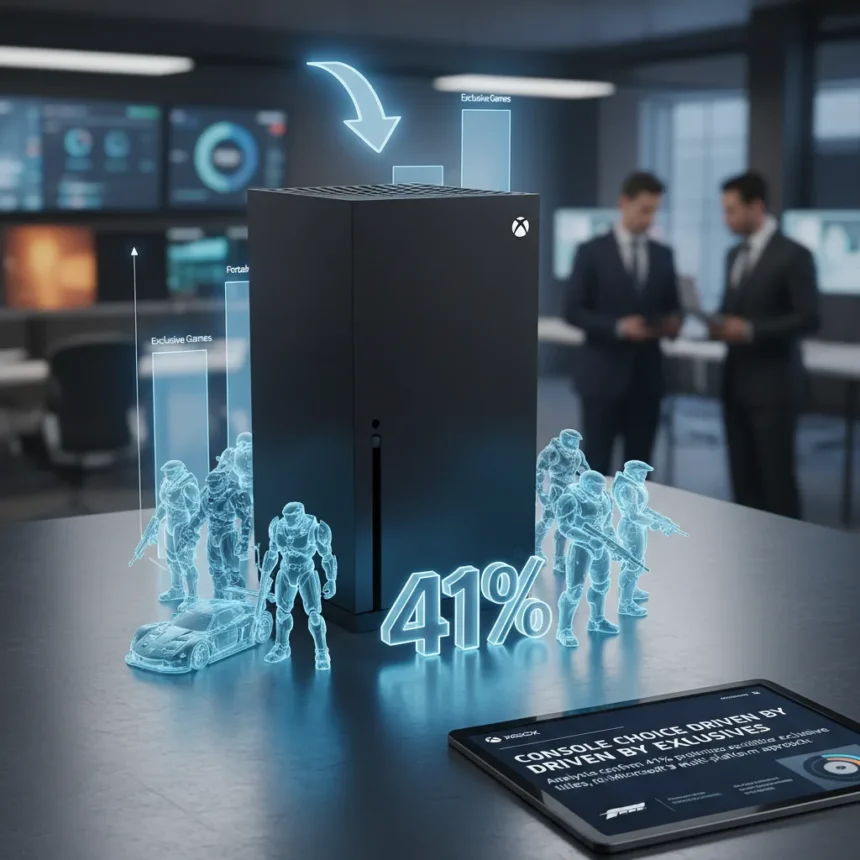
Xbox exclusive games are the number one reason players choose consoles, according to analyst data showing that 41% of respondents cited exclusives as the primary factor driving console adoption. This finding arrives as Xbox fans intensify pressure on Microsoft to abandon its “Xbox everywhere” strategy and return to platform-exclusive titles like Halo, Forza, Gears, and Fable. The tension between fan demand and Microsoft’s current multi-platform approach has become impossible to ignore, especially with new Xbox CEO Asha Sharma publicly acknowledging the backlash on February 21, 2026.
Key Takeaways
- Exclusive games cited by 41% of respondents as the number one reason players use consoles
- Xbox fans pushing Microsoft to restore exclusivity for flagship franchises like Halo and Forza
- New CEO Asha Sharma responded to fan pressure with “we hear you” on social media
- PlayStation 5 outsells Xbox Series X|S at a 3:1 ratio, partly due to stronger exclusives
- Microsoft’s next-gen Xbox planned for 2027 with Windows 11 integration and multi-device play
Why Xbox exclusive games matter more than ever
Exclusive games have always been the bedrock of console loyalty. When players commit to a platform, they are betting that the best experiences will only be available there. For decades, this strategy worked: PlayStation built its empire on franchises like God of War and Final Fantasy, while Xbox established its identity through Halo and Gears of War. The data confirms what fans have been saying for years—exclusivity is not a nice-to-have feature, it is the primary reason people buy hardware. Microsoft’s decision to release Xbox games on PC and eventually on other platforms has fractured this advantage, leaving the company vulnerable as PlayStation continues to dominate with a 3:1 sales lead.
The irony is sharp. Microsoft spent billions acquiring studios like Bethesda and Obsidian, yet these acquisitions have not translated into console sales because the games are not exclusive to Xbox. Players can buy Starfield or The Outer Worlds on PC, PlayStation, or Nintendo, removing the hardware lock-in that drives console adoption. This strategy may have made sense when Game Pass was growing explosively, but the numbers suggest it has backfired. Exclusive games remain the primary driver of console choice, and Xbox has voluntarily surrendered that advantage.
The fan revolt and Microsoft’s measured response
Xbox fans have not been silent about their frustration. On social media, players have directly appealed to new CEO Asha Sharma, arguing that games like Halo, Forza, Gears, and Fable created Xbox’s identity and must return to console exclusivity. One fan tweet captured the sentiment: “Hi @asha_shar, as the new Xbox CEO I hope that you understand how important exclusive games are and how games like Halo, Forza, Gears, Fable… Created an identity for Xbox and its players becoming a key point for Xbox’s success. Xbox games must be only on Xbox”. Sharma’s response—”we hear you”—signals acknowledgment but stops short of committing to a strategic reversal.

This measured tone reflects the complexity of Microsoft’s position. The company has already committed to multi-platform releases for titles in development, and reversing course would require public admissions of strategic error. Yet the data and fan pressure are undeniable. Microsoft maintains low Xbox Series X|S stock levels and targets sales primarily to existing Xbox One users through digital ecosystem lock-in, a far cry from the aggressive hardware expansion that PlayStation has achieved. Without exclusive games to drive new hardware sales, Xbox is essentially relying on its existing installed base rather than growing it.
What Microsoft’s 2027 strategy could mean for Xbox exclusive games
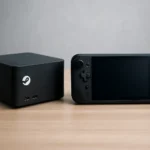
Microsoft is planning a next-generation Xbox for 2027, designed as a streamlined Windows 11 gaming PC with a TV-first interface. This hardware will be capable of running Xbox titles, legacy games, PC software like Steam, and enabling multi-device play through cloud gaming. The architecture suggests Microsoft is doubling down on the “Xbox everywhere” philosophy rather than reversing it—a next-gen console that also runs Steam is the opposite of exclusivity.
However, there is a counterargument worth considering. Some players cite Xbox Play Anywhere, which enables cross-buy and cross-play between Xbox and PC, as a stronger retention factor than exclusives. If the next-gen Xbox can offer a seamless gaming experience that bridges console and PC without sacrificing performance, it might carve out a unique position. But this is a harder sell than “this game is only on Xbox.” Exclusive games are simple, powerful, and proven. Everything else is a compromise.
How PlayStation’s exclusivity strategy exposed Xbox’s weakness
PlayStation’s dominance is not accidental. The company has consistently invested in exclusive franchises that define the platform—God of War, Spider-Man, Horizon, The Last of Us. These games drive hardware sales because they cannot be played anywhere else. PlayStation ties users to its console ecosystem through account-locked games and saves, creating friction that makes switching platforms costly. This strategy has paid off with a commanding 3:1 sales advantage over Xbox Series X|S.
Microsoft’s multi-platform approach was meant to be more consumer-friendly and expand Game Pass reach. But it has created the worst of both worlds: players do not need to buy an Xbox to play Xbox games, so hardware sales suffer, yet the company has not achieved the cross-platform dominance of a true ecosystem player like Apple or Google. It is caught between strategies, satisfying neither console loyalists nor PC gamers who see no reason to buy dedicated hardware.
Can Microsoft pivot without admitting failure?
The question facing Asha Sharma and Microsoft is whether they can restore Xbox exclusive games without publicly dismantling the “Xbox everywhere” narrative. Announcing that select future titles will be Xbox-exclusive again might be framed as a response to fan feedback rather than a reversal. The 2027 next-gen console could be positioned as the ultimate expression of that exclusivity—a hardware platform so compelling that certain games simply belong there.

The data is clear: exclusive games are the number one reason players choose consoles. Microsoft has the studios, the franchises, and the resources to compete on this front. What remains unclear is whether the company has the will to abandon a strategy that sounded good on paper but has failed in the market. For Xbox fans, the answer cannot come soon enough.
What does “Xbox exclusive games” mean in 2026?
Xbox exclusive games traditionally refer to titles available only on Xbox hardware and not on PlayStation, Nintendo, or other competing platforms. However, Microsoft has blurred this definition by releasing Xbox games on PC, cloud services, and potentially other platforms. The term now creates confusion about whether exclusivity means Xbox hardware only, or Xbox ecosystem (hardware plus PC plus cloud).
Will the next-gen Xbox in 2027 have exclusive games?
Microsoft has not confirmed that the 2027 next-gen Xbox will feature exclusive games. The current design emphasizes Windows 11 integration and multi-device play, suggesting continued multi-platform support. However, fan pressure and new CEO acknowledgment of the exclusives issue suggest this could change—though no official commitment has been made.
Why does PlayStation outsell Xbox despite Microsoft’s Game Pass advantage?
PlayStation’s 3:1 sales lead over Xbox Series X|S is largely attributed to stronger exclusive games and a deeper library of franchises that drive hardware adoption. While Game Pass offers value, exclusive games remain the primary reason players choose consoles, and PlayStation’s exclusive portfolio is significantly stronger than Xbox’s current offering.
The data is unambiguous: players choose consoles for exclusive games, and Microsoft has systematically dismantled this advantage. Whether the company can rebuild it without admitting strategic failure will define Xbox’s future. For now, fans are waiting for more than “we hear you.”
Where to Buy
Edited by the All Things Geek team.
Source: Windows Central