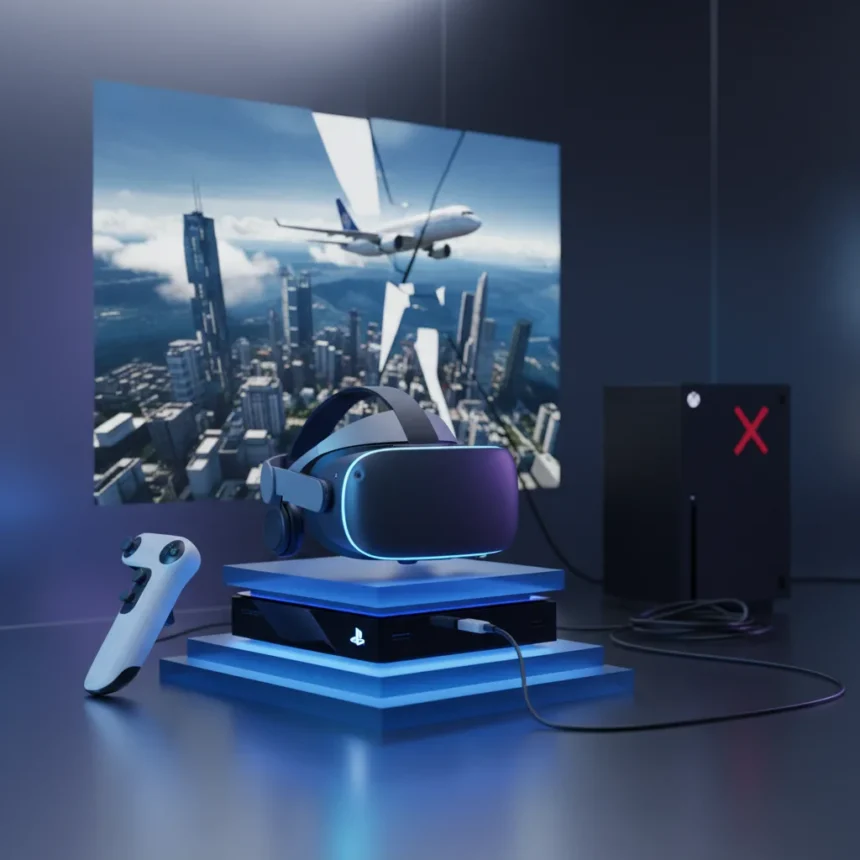
Microsoft Flight Simulator 2024 PS VR2 support just arrived on PlayStation 5, and it exposes something uncomfortable for Xbox: a $550 headset on a competing console now delivers a better experience than the game’s native platform. Sim Update 5, released in April 2026, brought full virtual reality to PS5 and PS5 Pro owners at no extra cost, while Xbox Series X and Series S players remain locked out of VR entirely.
Key Takeaways
- PS VR2 support launched free for all Microsoft Flight Simulator 2024 owners on PS5 and PS5 Pro in April 2026
- Xbox platforms have no VR support for the game, highlighting Microsoft’s absence from the VR market
- PS5 version achieves impressive visual fidelity despite hardware constraints compared to PC
- Frame duplication technology enables 60fps native rendering upscaled to 120fps via reprojection
- PC has offered full VR support since late 2024, but PS5 VR implementation rivals high-end setups
How PS VR2 Changed the Game for Flight Simulator 2024
The PS VR2 update transforms Microsoft Flight Simulator 2024 from a flat-screen experience into something immersive. According to Jorg from Asobo Studio, the development team behind the game, the VR implementation captures the muscle memory and body awareness that real pilots develop. Looking over your shoulder for the runway, scanning side windows for orientation—these subtle movements feel natural in VR in ways no controller input can replicate. This is why PlayStation 5 players now have access to a dimension of the game that Xbox owners simply cannot experience.
The technical implementation relies on frame duplication, where the render thread iterates twice per main thread frame, updating camera position between iterations to hit the required framerates. PS VR2 demands a minimum of 60fps native rendering with reprojection pushing the image to 120fps for Sony certification. On paper, this sounds like a stretch for PS5 hardware, yet reviewers found the console version punches above its weight. Giuseppe Nelva, writing for Simulation Daily, noted surprise at seeing spectacle comparable to a $4000 PC setup running on PS5, especially on the more powerful PS5 Pro.
Xbox’s VR Problem Just Became Impossible to Ignore
Microsoft owns Xbox, Game Pass, and Flight Simulator 2024—yet PlayStation 5 owners can now access VR features Xbox players cannot. This is not a minor feature gap; it is a strategic failure. Xbox Series X and Series S have no VR headset ecosystem, no VR games, and no clear roadmap to change that. Meanwhile, PlayStation 5 players benefit from PS VR2’s Move controller integration, baked directly into the SDK, giving them tactile control over the virtual cockpit that mouse-and-keyboard setups lack.


The PC version has offered full VR support since late 2024, but that requires a gaming PC capable of running Flight Simulator 2024 at high fidelity—a much higher barrier to entry than a PS5. For console players, PlayStation is now the only option. Xbox Game Pass subscribers on console cannot play this game in VR at all, a reality that undercuts one of Game Pass’s core selling points: choice and value.
PS5 VR Performance: Impressive, But Not Perfect
Early impressions of Microsoft Flight Simulator 2024 on PS VR2 paint a mixed picture. The PS5 Pro version delivers decent visuals and maintains high frame rates, but some users reported blurry moments during flight, particularly when scanning the horizon. This is not a dealbreaker—VR flight simulation is inherently demanding—but it signals that even on latest console hardware, compromises exist. The PS5 standard model performs adequately, though PS5 Pro owners get the cleaner experience.

What matters is that PS5 owners can now choose to play Microsoft Flight Simulator 2024 in VR. Xbox owners cannot make that choice at all. For a game that benefits enormously from immersion—where looking around the cockpit and feeling the aircraft’s movement matter—this is a significant disadvantage.
What This Means for Xbox’s Future
Microsoft has invested billions into gaming, yet it has ceded the VR space to competitors. PlayStation 5 has PS VR2. Meta Quest dominates standalone VR. PC has dozens of VR headset options. Xbox has nothing. The Flight Simulator 2024 PS VR2 launch is not the cause of this problem—it is the symptom. A first-party Microsoft game running better on PlayStation VR than on any Xbox platform is a public relations disaster that no amount of spin can fix.
The question now is whether Microsoft will ever commit to VR on Xbox. Until it does, moments like this will keep happening: PlayStation and PC players enjoying experiences that Xbox Game Pass cannot deliver, no matter how powerful the hardware underneath.
Can I access the PS VR2 update if I already own Flight Simulator 2024?
Yes. The Sim Update 5 patch is free for all Microsoft Flight Simulator 2024 owners on PS5 and PS5 Pro. You do not need to purchase the game again or pay for additional content. Simply download the update and you gain access to the full VR experience.


Is there a way to play Microsoft Flight Simulator 2024 in VR on Xbox?
No. Xbox Series X and Series S have no VR support for Flight Simulator 2024, and Microsoft has not announced any plans to add it. If you want to experience the game in VR, your only console option is PlayStation 5 or PS5 Pro with a PS VR2 headset.
How does the PS5 version compare to the PC VR version?
The PC version has offered full VR support since late 2024, but the PS5 version achieves comparable visual fidelity despite significant hardware differences. PS5 Pro owners report decent visuals and high frame rates, though some blurry moments occur during gameplay. The PC version requires a much more expensive gaming rig to achieve similar performance, making PS5 VR the more accessible option for console players.
Microsoft Flight Simulator 2024 PS VR2 represents a turning point: the moment when an Xbox-exclusive game became more compelling on a PlayStation console than on Xbox hardware. That is not a bug in the update. It is a feature of Microsoft’s broader absence from VR, and it is a problem that will only grow louder as VR adoption accelerates.
Edited by the All Things Geek team.
Source: Windows Central