






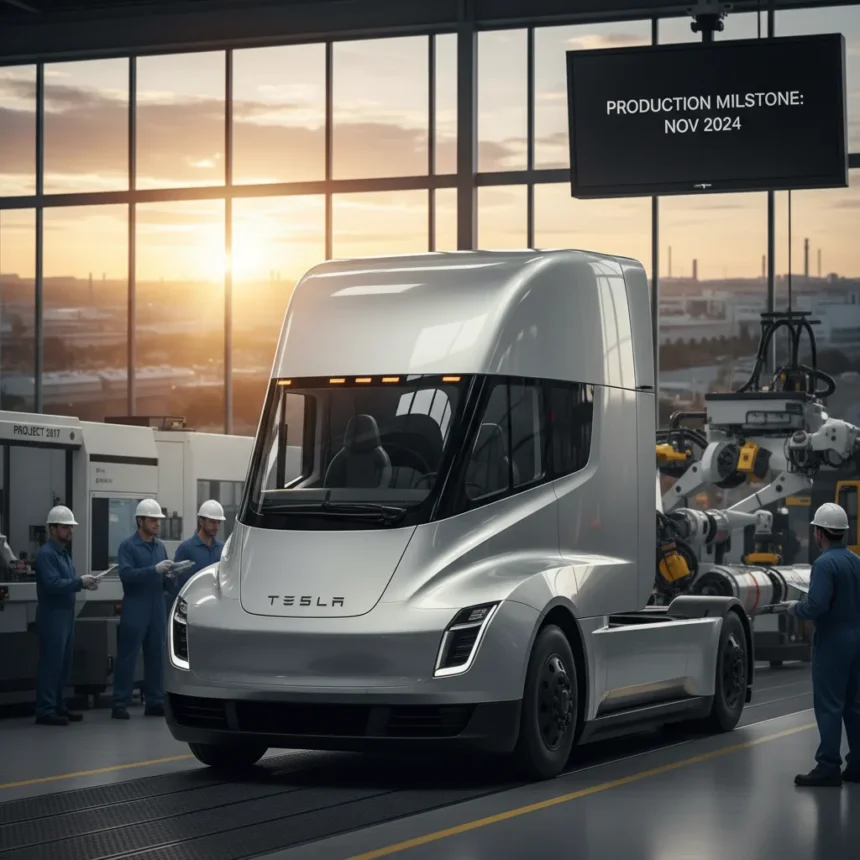
Tesla Semi mass production has finally begun, marking the end of a seven-year wait since Elon Musk first unveiled the long-haul electric truck platform in 2017. The first unit rolling off the production line represents a critical turning point for Tesla’s ambitions in the commercial vehicle sector, though the extended timeline raises questions about what took so long and whether the truck can compete in a market that has moved on.
Key Takeaways
- Tesla Semi enters mass production after 7 years, finally delivering on 2017 announcement
- Extended delay highlights challenges in scaling commercial EV manufacturing
- Production milestone signals Tesla’s commitment to long-haul electric trucking despite setbacks
- Market landscape has shifted significantly since original 2017 unveiling
- Competitors have advanced their own electric truck programs during the wait
The Long Road to Tesla Semi Mass Production
When Musk first showed the Tesla Semi in 2017, the electric truck industry barely existed. Traditional manufacturers were skeptical, startups were scrambling for funding, and the infrastructure to support heavy-duty EVs was virtually nonexistent. Seven years later, that landscape has transformed entirely. The delay was not inevitable—it reflects genuine engineering challenges in building a production-ready long-haul truck, but it also demonstrates how quickly the competitive window can close in emerging vehicle categories.
The gap between concept and manufacturing reality proved far wider than Tesla anticipated. Developing a truck that can handle the demands of long-haul trucking—extended range, heavy payload capacity, durability under constant use—requires solving problems that differ fundamentally from passenger vehicle engineering. Battery technology had to advance, supply chains had to be established, and manufacturing processes had to be refined. Yet competitors did not sit idle during this seven-year window. Other manufacturers launched their own electric truck programs, refined their designs, and began securing early customer orders.
What Tesla Semi Mass Production Means Now
The first Tesla Semi rolling off the production line is symbolically important but commercially complex. The truck enters a market where expectations have been reset multiple times, where customers have grown cautious about timelines, and where competing platforms have already demonstrated real-world capabilities. Tesla must now prove that its long-delayed truck offers genuine advantages—superior range, faster charging, lower operating costs—that justify the wait and justify fleet operators’ willingness to bet on Tesla’s service and support infrastructure.



Mass production at scale will determine whether Tesla Semi becomes a transformative force in trucking or remains a niche player. The company must ramp manufacturing quickly, establish reliable supply chains for batteries and components, and build the charging network that long-haul trucking demands. Each of these challenges has proven harder than originally envisioned in 2017, and the competitive pressure is far more intense now than it was then.
The Competitive Context
Tesla Semi’s entry into mass production occurs in a market that has evolved dramatically. Traditional truck manufacturers have accelerated their own electric vehicle programs, and dedicated EV truck startups have gained traction with customers who were willing to wait or who preferred alternatives to Tesla. The company’s seven-year delay means it is not entering a market with a clear first-mover advantage—it is entering a crowded space where other players have already built relationships, demonstrated capabilities, and earned customer trust.



This competitive reality makes Tesla Semi’s success less about being first and more about being better. The truck must deliver on range, reliability, and total cost of ownership promises that have been refined and tested by competitors over the past seven years. Customers who waited for Tesla Semi have also watched other manufacturers deliver results, and that context will shape purchasing decisions going forward.
What Delayed Tesla Semi for Seven Years?
The research available does not detail the specific engineering or manufacturing obstacles that extended Tesla Semi’s timeline from 2017 to 2024-2025 mass production. What is clear is that the gap reflects real challenges in scaling commercial EV technology at the level required for long-haul trucking. Battery production, thermal management, weight optimization, and manufacturing process development all require more time and iteration than initial timelines suggested.
The delay also reflects broader industry dynamics. Supply chain disruptions, semiconductor shortages, and the massive capital investments required to build manufacturing capacity all contributed to extended timelines across the EV sector. Tesla was not alone in missing early targets, but the seven-year gap for Tesla Semi is longer than many competitors faced, suggesting either more ambitious original specifications or more complex engineering challenges than anticipated.
Will Tesla Semi Succeed in a Changed Market?
Tesla Semi’s path forward depends on execution at scale. The company must prove that its design choices—battery technology, motor architecture, charging approach—deliver meaningful advantages in real-world trucking operations. Fleet operators care about uptime, range per charge, charging speed, and total cost of ownership. Hype and brand recognition matter less in commercial trucking than in consumer vehicles, where emotional appeal and design language influence purchase decisions.



The first units rolling off the production line are just the beginning. Mass production success requires consistent quality, reliable supply chains, and rapid scaling to volumes that matter in the trucking market. Tesla must also build the charging infrastructure and service network that commercial customers demand. These challenges are not insurmountable, but they are substantial, and the seven-year delay means the company is playing catch-up in a market that has moved faster than expected.
Is Tesla Semi finally here?
Yes, Tesla Semi has entered mass production after a seven-year delay since its 2017 unveiling. The first units are rolling off the production line, though ramping to meaningful commercial volumes will take additional time and execution.
Why did Tesla Semi take so long to reach production?
The research brief does not specify the exact engineering or manufacturing obstacles that extended the timeline. The delay reflects the genuine complexity of scaling commercial EV technology for long-haul trucking, including battery production, thermal management, and manufacturing process development.
How does Tesla Semi compete with other electric trucks?
Tesla Semi enters a market where competitors have already launched or advanced their own electric truck programs during the seven-year wait. Success depends on whether Tesla’s design delivers superior range, charging speed, reliability, and total cost of ownership compared to alternatives available to fleet operators.
The Tesla Semi’s arrival marks a turning point, but not necessarily a triumph. Seven years is a long time in automotive development, and the market has moved on. What matters now is whether Tesla can execute at scale and deliver a truck that justifies the wait. The first unit off the production line is a milestone, but the real test lies ahead.
This article was written with AI assistance and editorially reviewed.
Source: TechRadar