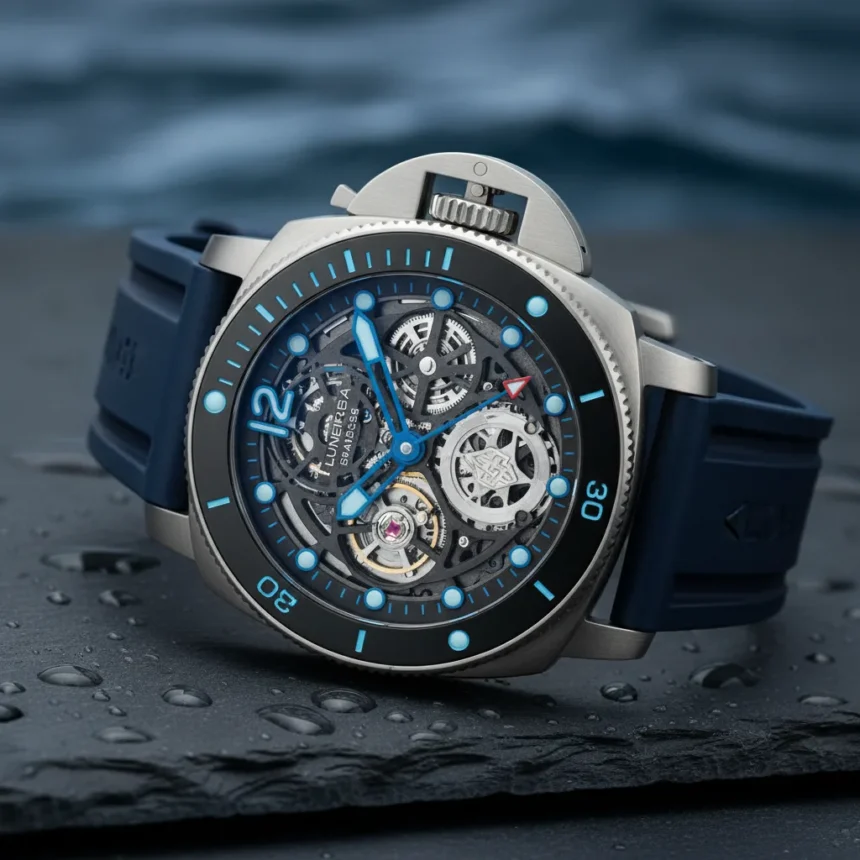
Panerai’s skeletonised GMT dive watch represents a bold departure from the brand’s traditional design language, marrying exposed mechanical complexity with the functional demands of professional diving. The watch combines a skeleton movement—where the movement’s bridges and components are machined away to reveal the inner workings—with a GMT complication and water resistance that pushes beyond what most luxury brands attempt in this category.
Key Takeaways
- Panerai’s skeletonised GMT dive watch features an exposed movement visible through the dial and caseback
- The watch delivers professional-grade water resistance suitable for serious diving applications
- GMT complication allows tracking of two time zones simultaneously for international travel
- Panerai tests all watches to 25% beyond stated water resistance ratings for safety margin
- Design challenges conventional wisdom that skeleton watches belong only in dress collections
Why Panerai chose skeleton design for a dive instrument
Skeleton watches traditionally occupy the dress watch category—formal pieces meant for evening wear where mechanical artistry matters more than ruggedness. Panerai’s decision to apply skeleton finishing to a dive watch is unconventional. The exposed movement sacrifices some structural simplicity for visual drama, yet the brand engineered the watch to maintain the durability expected of professional diving instruments. This is not a cosmetic choice but a calculated design statement that luxury and function need not be mutually exclusive.
The skeleton approach allows the wearer to observe the GMT mechanism in action, watching the second hour hand track a second timezone as the main hands mark local time. For travelers and professionals who work across multiple regions, this visual feedback transforms the complication from abstract functionality into tangible mechanical theater. Each glance at the wrist becomes a reminder of the engineering beneath the dial.
Water resistance that justifies the skeleton investment
The water resistance specification is where Panerai’s engineering credibility emerges. A skeletonised case exposes more surface area and creates additional potential failure points compared to a solid case, yet Panerai has engineered this watch to handle serious underwater work. The brand’s testing protocol—pushing watches to 25% beyond stated water resistance ratings—provides a safety margin that separates professional instruments from casual wear.

This approach to water resistance testing is uncommon in the luxury watch industry. Most brands rate their watches at maximum tested depth, leaving no buffer. Panerai’s 25% safety margin means a watch rated for 500 meters has actually been tested to 625 meters, a distinction that matters when depth becomes life-critical. For divers and maritime professionals, this transparency builds confidence that the watch will perform when it matters most.
How the skeletonised GMT compares to traditional dive watches
Traditional dive watches from brands like Rolex or Omega prioritize solid cases and closed movements—design choices that maximize durability and minimize maintenance. Panerai’s skeleton approach trades some of that bulletproof simplicity for visual complexity and mechanical engagement. A traditional dive watch tells you the time and depth rating; Panerai’s skeletonised GMT also tells you how it works.



The GMT complication adds another layer of distinction. Most professional dive watches focus on a single timezone, assuming divers operate within a local region. A GMT function acknowledges that modern diving—whether commercial, military, or adventure-focused—often crosses continents. The ability to track home time while reading local time without resetting the watch is practical for coordinating operations across time zones.
Movement finishing and case construction
Skeleton finishing demands precision manufacturing. The bridges and plates must be strong enough to support the movement’s components while being thin enough to reveal the gears and escapement beneath. Panerai’s execution here determines whether the watch feels like a refined instrument or a gimmick with exposed parts. The caseback likely features a sapphire crystal, allowing full view of the movement’s reverse side—a feature that justifies the skeleton investment by making the movement a complete visual experience from both sides.
The case itself must balance the skeleton movement’s visual requirements with the structural integrity demanded by deep-water diving. Panerai typically uses stainless steel or precious metals for dive watches, materials that resist corrosion and maintain dimensional stability under pressure. The case diameter and thickness will determine wearability—professional dive watches often run 42-47mm, sizes that accommodate the robust cases needed for serious water resistance while remaining practical for daily wear.
Is a skeletonised GMT dive watch practical?
Practicality depends on use case. For a collector who occasionally dives or travels internationally, the skeleton design adds visual interest that justifies the premium over a traditional GMT dive watch. For a commercial diver or military professional who operates in extreme conditions daily, the exposed movement presents maintenance concerns. Saltwater exposure, sediment, and pressure changes can accelerate wear on exposed components compared to a sealed movement. Panerai’s engineering addresses these concerns, but real-world durability will depend on maintenance discipline and operating conditions.



The watch is not a compromise product—it is a deliberate design choice that prioritizes mechanical engagement and visual storytelling over maximum durability. Panerai owners who understand this distinction will appreciate the watch; those seeking a pure tool watch might prefer a traditional closed-case design.
FAQ
What makes a skeletonised movement different from a standard watch movement?
A skeletonised movement has material removed from the bridges and plates to expose the gears, escapement, and other components. This reveals the mechanical workings but requires stronger engineering to maintain structural integrity, making it more complex and expensive to manufacture than a standard movement.
Can you dive deep with a skeletonised watch?
Yes, if engineered properly. Panerai’s skeletonised GMT dive watch is tested to professional diving depths, with a safety margin built into the rating. The exposed movement does not compromise water resistance if the case and crystal are properly sealed and the movement is protected from direct water contact.
Why would anyone want a skeleton watch for diving?
Skeleton watches appeal to owners who value mechanical artistry and want to see their watch work. For divers and travelers, a skeleton GMT adds visual engagement to a functional tool—the watch becomes both instrument and conversation piece, tracking two timezones while displaying the mechanical complexity that makes it possible.
Panerai’s skeletonised GMT dive watch succeeds because it refuses to choose between form and function. It is not the most durable dive watch Panerai makes, nor is it the most affordable. It is, however, the most honest—a watch that shows you exactly what it is doing and trusts that you will appreciate the engineering behind the show.
Where to Buy
Edited by the All Things Geek team.
Source: T3