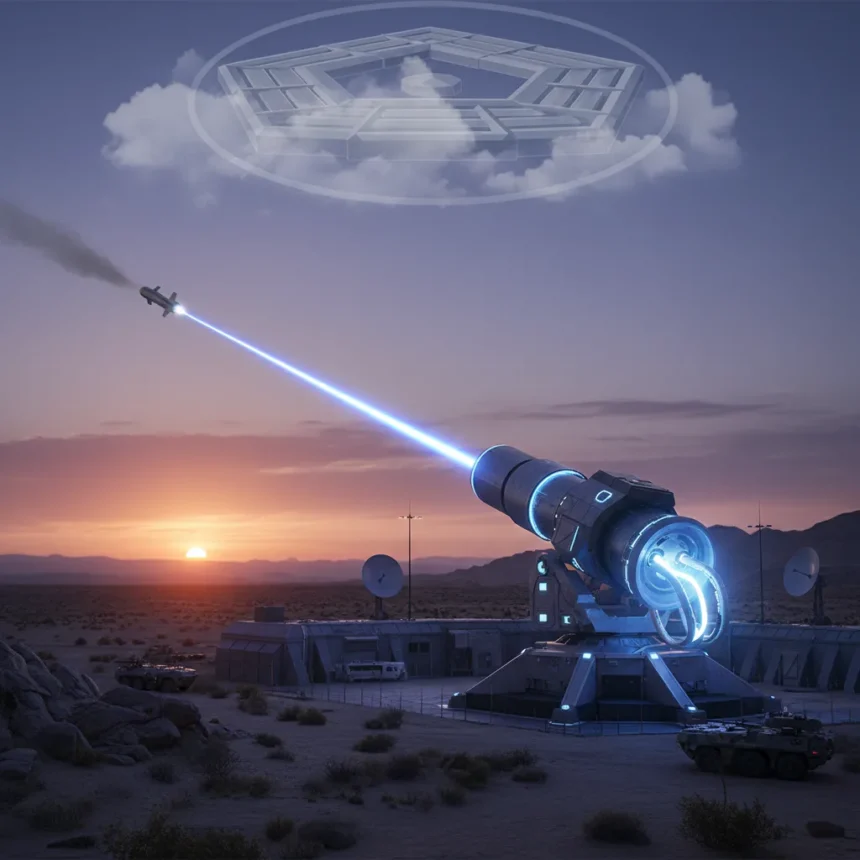
The Pentagon’s Joint Laser Weapon System represents an ambitious attempt to deploy directed-energy weapons against cruise missile threats as part of a broader air and missile defense infrastructure called Golden Dome for America. The system, a collaboration between the U.S. Army and U.S. Navy first reported in June 2025, starts with a containerized 150-kilowatt laser but includes a Joint Beam Control System capable of supporting 300-500kW output power.
Key Takeaways
- JLWS begins with 150kW containerized laser, scalable to 300kW or higher
- Pentagon requested $17.9 billion for Golden Dome in fiscal 2027, with $185 billion planned through 2035
- $452 million allocated for laser R&D related to Golden Dome development
- No existing system has demonstrated reliable effectiveness against realistic cruise missile threats
- Previous 300kW IFPC-HEL program was cancelled due to performance challenges
Why the Pentagon is betting on directed-energy weapons now
The shift toward laser-based air defense reflects a strategic pivot within the Trump administration’s missile shield strategy. The U.S. military faces evolving threats from cruise missiles like Russia’s Kh-101 and Kalibr variants, which move faster and have stronger bodies than the drones that laser systems have previously targeted. Traditional kinetic defenses are expensive and limited in magazine capacity. Directed-energy weapons offer the theoretical advantage of unlimited magazine depth—as long as power generation holds up, lasers can fire continuously.
The Joint Laser Weapon System’s scaled-down approach differs markedly from earlier attempts. The previous IFPC-HEL (Indirect Fire Protection Capability-High Energy Laser) program pursued a full 300kW system but closed in March 2026 after struggling to achieve performance targets and effectiveness against realistic threats. By starting at 150kW and building upward, the Pentagon is hedging its bets—a pragmatic retreat from an overambitious predecessor.
Technical obstacles that could derail the Joint Laser Weapon System
Atmospheric interference remains the fundamental problem. Moisture, dust, and thermal distortion scatter or absorb beam energy before it reaches the target, reducing effective range and lethality. Cruise missiles move at high speed and present hardened surfaces that require sustained, precise beam contact to damage—a far more demanding task than defeating slower, lighter-skinned drones.

No known system has yet demonstrated the beam control and aim-point precision needed against realistic cruise missile threats, even at 300kW power levels. This gap between theoretical capability and demonstrated performance haunts the program. The Pentagon allocated $452 million for laser research and development related to Golden Dome, with funding ramping sharply: approximately $94 million in 2027, $216 million in 2028, and nearly $676 million by 2031. That escalation signals confidence, but also reflects uncertainty whether the concept will survive practical use.
How the Joint Laser Weapon System fits into broader air defense plans
JLWS does not operate in isolation. It will leverage lessons learned from HELIOS, a 60kW system already installed on USS Preble, an Arleigh Burke-class guided missile destroyer. The Navy’s HELCAP (High Energy Laser Counter Anti-Ship Cruise Missile Project) testbed will receive upgrades to support JLWS testing. Meanwhile, the Pentagon is pursuing the HELSI initiative—a separate program targeting megawatt-class lasers for cruise, ballistic, and hypersonic threats, with nLight awarded a contract in 2023 to demonstrate a system by 2026.



This layered approach suggests the Pentagon does not expect any single laser system to solve all air defense problems. JLWS targets cruise missiles in the near term, while HELSI chases longer-range, higher-power solutions for future threats. An FAA-Pentagon safety agreement established at White Sands Missile Range in March 2026 formally recognized laser weapons as viable air defense tools, clearing regulatory hurdles for testing.
Is the Joint Laser Weapon System realistic, or another expensive experiment?
The record $185 billion planned for Golden Dome creation through 2035 is staggering, but the Pentagon’s willingness to fund JLWS after IFPC-HEL’s failure suggests institutional commitment. That said, the program’s success hinges on solving problems that have resisted solution for decades. Atmospheric compensation, rapid beam steering, and maintaining lethal energy on a moving target remain unsolved engineering challenges.
The shift from 300kW to 150kW is pragmatic but also cautionary. It acknowledges that the previous approach was too ambitious. Whether 150kW, scaled to 300kW or beyond, will prove sufficient against hardened cruise missiles remains an open question. The Pentagon is betting it will—but the history of directed-energy weapons suggests skepticism is warranted.
What is the difference between JLWS and HELIOS?
HELIOS is a 60kW system already deployed on Navy destroyers, proven in limited testing against drones and small vessels. JLWS is a containerized system starting at 150kW and scalable to 300-500kW, specifically designed to defeat cruise missiles rather than lower-threat targets. JLWS incorporates lessons from HELIOS but targets a fundamentally harder problem.



Why did the IFPC-HEL program close?
The IFPC-HEL program closed in March 2026 because it could not achieve the performance and effectiveness targets needed against realistic cruise missile threats. The 300kW system proved too complex to deliver reliable beam control and aim-point precision. The prototype is transitioning to support JLWS development, but the original program’s failure underscores the technical hurdles ahead.
When will the Joint Laser Weapon System be operational?
JLWS funding ramps significantly between 2027 and 2031, with nearly $676 million allocated by 2031, suggesting operational deployment could occur in the early 2030s. However, no official operational date has been announced. Given the technical challenges and the IFPC-HEL precedent, actual deployment timelines may slip substantially.
The Pentagon’s Joint Laser Weapon System is a calculated gamble: smaller than its failed predecessor, but still ambitious enough to address genuine cruise missile threats. Whether it succeeds depends on breakthroughs in atmospheric compensation and beam control that have eluded the defense industry for years. The $17.9 billion investment signals determination, but not certainty.
Edited by the All Things Geek team.
Source: Tom's Hardware