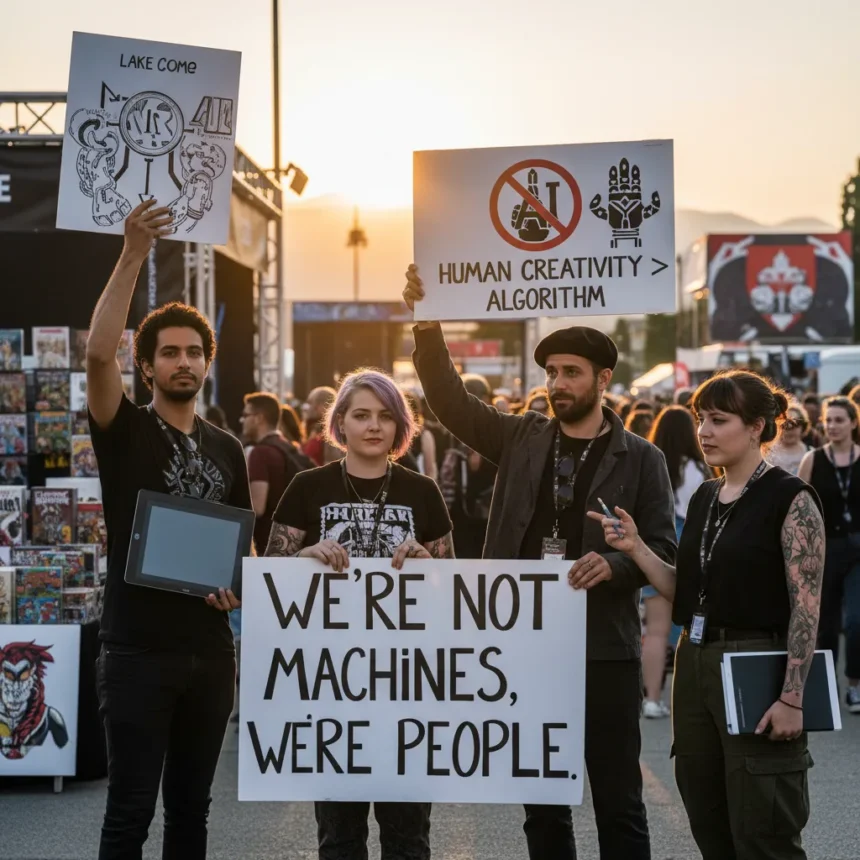
Comic artists reject AI with increasing urgency, turning the Lake Como Comic Art Festival into a flashpoint for the broader creative industry’s resistance to machine-generated imagery. The rallying cry—”We’re not machines, we’re people”—captures a fundamental divide: human artists insist that creativity is a human endeavor, not an algorithmic output.
Key Takeaways
- Comic artists at Lake Como Comic Art Festival assert human creativity cannot be replaced by AI aggregation.
- Stanley ‘Artgerm’ Lau rejects AI art entirely, stating it lacks dreams, feelings, and genuine creativity.
- DC Comics president Jim Lee declared AI “doesn’t dream… doesn’t feel… doesn’t make art. It aggregates it”.
- Dragon Con and Galaxy Con banned AI-generated art sold as original, protecting human artists’ market.
- Video game concept artists report AI makes their work harder, requiring fixes to flawed outputs.
Why Comic Artists Are Drawing a Line Against AI
The resistance from comic artists is not nostalgic hand-wringing—it is a defense of the creative process itself. Stanley ‘Artgerm’ Lau, a prominent comic illustrator who has worked for Marvel, DC Comics, Capcom, and Square Enix, articulates the core objection: “I do not concur that AI-generated images constitute art. Art is solely a human endeavor”. His argument cuts deeper than aesthetic preference. “The most captivating aspect of art is the process—solving issues, forging something from nothing—so why would you delegate the most enjoyable part of the creative journey to a machine?” Lau frames the struggle itself as the value. “Art is not simple. You must experience joy through struggle”.
This philosophy directly contradicts the efficiency promise that AI proponents make. If the goal were merely output, machines would win. But comic artists argue the goal is the human experience embedded in creation—the decision-making, the problem-solving, the emotional investment. When you outsource that to an algorithm, you lose the thing that makes art meaningful.
Major Publishers and Conventions Are Taking Sides
Comic artists reject AI not in isolation but with institutional backing. DC Comics president Jim Lee took an explicit anti-AI stance at New York Comic Con, stating: “People have an instinctive reaction to what feels authentic… We recoil from what feels fake. That’s why human creativity matters. AI doesn’t dream. It doesn’t feel. It doesn’t make art. It aggregates it”. This is not a subtle position. A major publisher is using its platform to reject AI as a creative tool entirely.



Physical conventions are enforcing the rejection through policy. Dragon Con and Galaxy Con banned AI-generated art sold as original work, with Dragon Con taking the enforcement seriously enough to have police escort a vendor off the premises. These are not fringe events—they are major gatherings where human artists have traditionally sold work and built careers. By banning AI fakes, convention organizers are protecting the market for authentic human art and signaling that audiences value authenticity.
AI’s Impact on Creative Professionals Extends Beyond Comics
Comic artists reject AI, but the problem extends into adjacent creative fields. Video game concept artists report that AI has made their work harder, not easier. The issue is not theoretical—it is practical. When studios use AI references, concept artists must fix flawed, standalone AI outputs that lack multi-angle coherence or collaboration potential. Instead of accelerating the creative process, AI introduces a new bottleneck: cleanup work that did not exist before.



This pattern suggests a broader truth about AI in creative work. The technology does not eliminate the need for human judgment; it adds a layer of remedial labor before real creation can begin. A concept artist cannot simply accept AI output and move forward. They must interrogate it, correct it, and rebuild it—a process that consumes time and frustration.
Is There a Pro-AI Perspective in the Creative Community?
Not all artists oppose AI entirely. Niceaunties, an AI artist working on a surreal “Auntieverse” project that blends Asian culture, describes AI as enabling natural language prompting—”like talking to another person”. This perspective frames AI as a creative tool that expands accessibility rather than replaces human creativity. However, this viewpoint remains a minority position within the comic and visual art communities, where the consensus increasingly favors human authenticity over machine efficiency.
The divide reflects different values. Comic artists and major publishers prioritize the human process, the struggle, and the authentic connection between creator and audience. Pro-AI artists emphasize accessibility and new possibilities. These positions are not easily reconciled, and comic artists reject AI not because they deny its technical capability but because they reject the premise that capability equals art.
What Does This Mean for the Future of Comic Art?
Comic artists reject AI at a moment when the technology is becoming ubiquitous. The Lake Como Comic Art Festival, Dragon Con, Galaxy Con, and DC Comics’ stance suggest a tide turning within the professional creative community. If major publishers and convention organizers continue to reject AI and protect human artists’ market position, the comic industry may become a holdout against AI-generated content—a space where human creativity remains the standard.


Whether this resistance can persist depends on economics and audience preference. If readers and collectors continue to value authentic human art, comic artists have a fighting chance. If AI-generated content becomes cheap and acceptable, the pressure to adopt it will intensify. For now, comic artists are drawing a line: creativity is human, struggle is essential, and machines are not artists. The question is whether the rest of the creative economy will follow.
Can AI ever create authentic art?
Comic artists and industry leaders argue no. Jim Lee’s statement that AI “aggregates” rather than creates reflects a philosophical position: authentic art requires dreams, feelings, and human perspective. AI can process patterns and generate images, but it cannot experience the world or make intentional creative choices rooted in human consciousness.
Why do comic conventions ban AI-generated art?
Dragon Con and Galaxy Con ban AI art to protect human artists’ market and maintain community standards around authenticity. When AI fakes are sold alongside human work, it undercuts the value of genuine art and deceives buyers about authorship.
Does AI make creative work easier or harder?
For concept artists in video games, AI has made work harder. Studios use AI references, but the outputs are flawed and require significant fixes before they can be used, adding an extra layer of labor rather than eliminating it.
Comic artists reject AI because they see it as a threat to the creative process, the market for human work, and the values that define authentic art. Whether that rejection holds depends on whether audiences, publishers, and convention organizers continue to prioritize human creativity over machine efficiency. For now, the line is drawn.
Edited by the All Things Geek team.
Source: Creativebloq