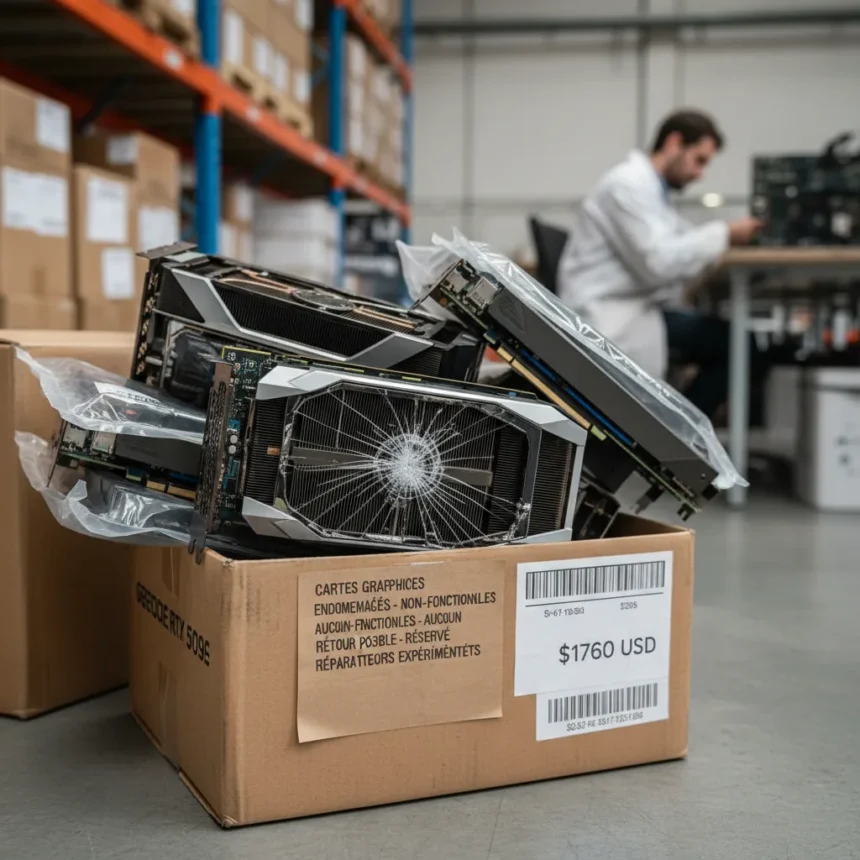
Defective RTX 5090 GPUs are now available for purchase at a French retailer for as low as $1,760, roughly half the standard market price of $4,000. LDLC, a major European computer retailer, is openly selling transport-damaged units with all PCB components intact but no returns, refunds, or warranties accepted. The move is unusual: a legitimate outlet transparently selling broken high-end hardware in an era plagued by component-stripping scams.
Key Takeaways
- LDLC selling defective RTX 5090 GPUs at €1,499 (~$1,760), about 50% off new pricing
- All PCB components present—unlike scams involving stripped GPU dies or memory modules
- Transport damage confirmed; units random variants based on stock availability
- Targeted exclusively at professionals or repair-skilled individuals; no consumer protections
- Contrasts sharply with eBay/Amazon scams where buyers received partially stripped cards
Why This Deal Exists (And Why It’s Risky)
NVIDIA’s RTX 5090 remains scarce and expensive. New units cost roughly $4,000 in the US market, with local French pricing around €3,000. When supply is tight and demand is high, damaged inventory becomes a business problem—and an opportunity for the right buyer. LDLC’s solution is blunt: sell the broken cards cheap to whoever can fix or recycle them.
The retailer’s product description makes the risk crystal clear: “This product is aimed exclusively at professionals or private individuals who have the necessary knowledge to repair the card or recycle its components. Since the product’s malfunction is known and clearly stated, no returns or refunds will be accepted.” This is not a grey-market gray box. It is transparent liquidation of defective inventory.
The defective RTX 5090 GPUs differ fundamentally from the scams flooding eBay and Amazon. In one documented case, a buyer received a Zotac Gaming GeForce RTX 5090 Solid OC that had been stripped of its GPU dies and memory modules before being returned to the seller. Another MSI unit arrived with removed chips and stripped PCIe gold fingers. LDLC’s units, by contrast, include all components on the PCB—they are broken, not gutted.


What You’re Actually Getting
LDLC offers random defective RTX 5090 variants based on current stock. Pricing starts at €1,499 (approximately $1,760 USD) for an unspecified model, with options like the MSI Ventus 3X OC listed at around €1,849 (~$2,000 USD) [original summary]. The damage is transport-related—fractures, impact damage, or component failure from shipping. The PCB is intact. The GPU die is present. The memory is there. What is broken is the card’s ability to function reliably, if at all.
The seller explicitly warns that buyers may receive “electronic waste”. This is not hyperbole. A card might be repairable by someone with soldering skills and a microscope. It might be salvageable for component recycling. It might be completely dead. LDLC will not tell you which until you open the box.



Defective RTX 5090 GPUs vs. New Cards: The Real Risk
The $2,240 savings (comparing the €1,499 unit to a €3,000 new card) looks seductive until you factor in repair costs and failure rates. YouTube case studies of damaged high-end RTX cards reveal the true cost: professional repair of a similarly damaged unit can run $5,000 to $10,000 in labor and parts, depending on the extent of the damage. If the card cannot be repaired, you have paid $1,760 for scrap metal and silicon.
New RTX 5090s, by contrast, come with manufacturer warranty and the certainty that the card will power on and run. You pay more upfront, but you know what you are getting. With LDLC’s defective RTX 5090 GPUs, you are gambling on your own repair expertise or accepting the possibility of total loss.
Who Should Actually Buy This?
LDLC’s target customer is narrow and specific: professionals with repair infrastructure, component recyclers, or GPU enthusiasts with advanced soldering and diagnostic skills. If you have a micro-soldering station, oscilloscope, and experience with GPU-level board repair, the defective RTX 5090 GPUs might make sense as a parts source or a repair challenge. If you are hoping to fix it yourself with a soldering iron and YouTube tutorials, you are likely to destroy what remains and lose your $1,760.
For everyone else—gamers, content creators, professionals who need a working GPU—the new card at full price is the only rational choice. There are no shortcuts here.



Is This Ethical?
LDLC is being more honest than many retailers. The company clearly labels the units as defective, explicitly states no returns are accepted, and targets the sale at people with repair knowledge. This is the opposite of the eBay and Amazon scams where sellers misrepresent stripped cards as functional or hide damage in listings. Transparency does not eliminate risk, but it does eliminate deception. If you choose to buy, you are making an informed decision to accept the risk.
FAQ
What exactly is wrong with the defective RTX 5090 GPUs?
LDLC lists transport-related damage as the cause, which typically means physical fractures, component failure, or impact damage from shipping. The retailer does not specify the exact failure mode for each unit—that is part of the gamble.
Can you return a defective RTX 5090 if it does not work?
No. LDLC explicitly states no returns, refunds, or guarantees are accepted. Once purchased, the card is yours, regardless of whether it powers on or is completely dead.
How does this compare to buying a used RTX 5090?
A used RTX 5090 that actually works is worth far more than $1,760 and may come with some seller recourse. LDLC’s defective units are guaranteed broken and have zero recourse. Only buy if you can repair it yourself.
LDLC’s defective RTX 5090 GPUs are a legitimate option—but only for a very specific buyer. If you have the skills to diagnose and repair GPU-level board damage, the price is worth the risk. If you do not, save your money and buy a working card. There are no bargains in broken hardware, only expensive lessons.
Edited by the All Things Geek team.
Source: Tom's Hardware