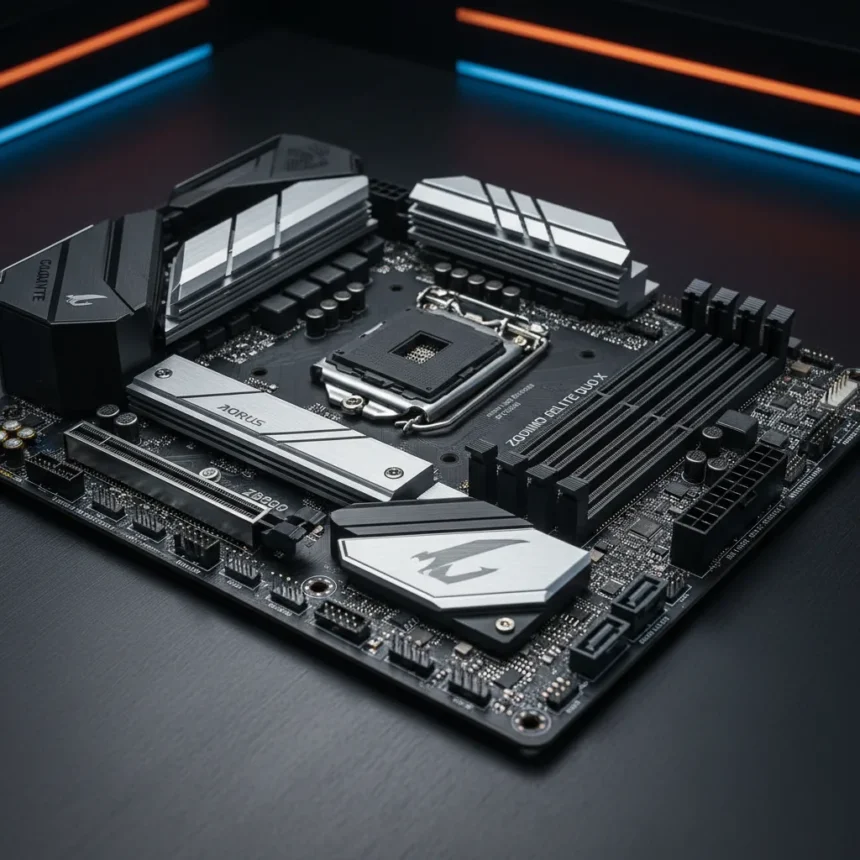
The Gigabyte Z890 Aorus Elite Duo X is a mid-range Z890 motherboard that flips conventional slot design on its head by embracing CQDIMM memory modules instead of chasing maximum connectivity. Positioned at under $280, it targets memory enthusiasts and workstation builders who need high-capacity, high-speed DDR5 rather than mainstream gamers hunting for the most features.
Key Takeaways
- Supports 256GB capacity using just two DDR5 slots via 128GB CQDIMM modules
- Native Arrow Lake Refresh CPU support with five M.2 sockets for storage expansion
- Targets memory speeds up to DDR5-10266 with improved signal integrity
- Reduced slot count prioritizes extreme overclocking behavior over slot count
- Mid-range pricing under $280 appeals to high-end builders, not casual upgraders
Gigabyte Z890 Aorus Elite Duo X Design Philosophy
The Gigabyte Z890 Aorus Elite Duo X abandons the race for slot count in favor of signal integrity. Two DDR5 slots supporting up to 256GB capacity via 128GB CQDIMM modules means fewer electrical pathways competing for clean signal transmission at extreme memory frequencies. This architectural choice reflects a deliberate trade-off: sacrifice accessibility for performance at the bleeding edge. Mainstream users upgrading from a five-year-old system will find the limited slot count frustrating. Overclockers targeting DDR5-10266 speeds will appreciate the engineering discipline.
Arrow Lake Refresh CPU support arrives natively on this board, eliminating the BIOS update roulette that plagued early Z890 adopters. The platform refresh cycle matters less to buyers who simply want to plug in a new chip and boot. The five M.2 sockets deliver ample NVMe expansion without forcing users into PCIe lane juggling that plagues some competitors.
Where the Gigabyte Z890 Aorus Elite Duo X Fits in the Z890 Lineup
The Gigabyte Z890 Aorus Elite Duo X occupies a narrow but meaningful segment. It costs significantly less than the Z890 Godlike flagship at $1,329, yet avoids the feature-bloat that makes high-end boards irrelevant for focused builders. The Asus ROG Strix Z890-A Gaming WiFi, a competing upper-midrange option, offers solid AI and DIY features with more conservative DDR5-8000/8200 plug-and-play support and VRM temperatures under 45°C at 210W CPU load. That board appeals to builders wanting reliability and moderate overclocking. The Gigabyte board appeals to builders who view memory speed as the primary performance lever.


Comparing against Gigabyte’s own Z790 Aorus Extreme reveals how the Z890 refresh cycle shifted priorities. The Z790 offered best-value flagship status with fewer M.2 sockets but comprehensive features at $200-400 less than competitors. The Z890 Aorus Elite Duo X takes a different angle: it does not try to be everything. It specializes. That focus is either liberating or limiting depending on your build goals.
CQDIMM Memory: Why Two Slots Beat Four
CQDIMM technology enables 128GB per module, making two slots functionally equivalent to eight traditional DDR5 slots in terms of capacity. The Gigabyte Z890 Aorus Elite Duo X leverages this to support up to 256GB with minimal electrical complexity. Fewer slots mean fewer signal reflections at the memory interface, a critical advantage when pushing DDR5-10266 speeds. This is not a limitation—it is a feature for anyone serious about extreme memory overclocking.



The trade-off hits buyers who want flexibility. You cannot start with two 32GB modules and upgrade incrementally. You commit to the capacity ceiling upfront. For workstation builders and content creators who know they need 128GB or 256GB, this is a non-issue. For gamers who upgrade in stages, it is a deal-breaker. Gigabyte is not targeting the latter audience.
Connectivity and Expansion Capabilities
Five M.2 sockets provide abundant NVMe storage expansion without the PCIe lane management headaches that plague some Z890 boards. The motherboard delivers ample connectivity for its price tier, avoiding the false economy of stripping features just to hit a price point. Arrow Lake Refresh native support means no BIOS gymnastics before your new CPU boots. That alone saves frustration for builders upgrading within the same platform generation.
Should You Buy the Gigabyte Z890 Aorus Elite Duo X?
Buy it if you are building a high-end workstation or memory-focused enthusiast system and need 256GB capacity without spending on unnecessary features. Skip it if you game primarily and want room to upgrade RAM incrementally over time. The Gigabyte Z890 Aorus Elite Duo X is purpose-built for a specific audience—and it executes that purpose well at under $280.
What makes CQDIMM memory different from standard DDR5?
CQDIMM modules support up to 128GB per stick, compared to 48GB maximums for standard DDR5 DIMMs. This allows two slots to deliver 256GB capacity while reducing electrical noise at extreme frequencies.



Does the Gigabyte Z890 Aorus Elite Duo X work with Arrow Lake CPUs?
Yes, it supports Arrow Lake Refresh processors natively without requiring a BIOS update. Older Arrow Lake chips may need a BIOS flash depending on the board’s firmware version at manufacture.
Is two M.2 slots enough for most builds?
The Gigabyte Z890 Aorus Elite Duo X includes five M.2 sockets, providing ample NVMe expansion for OS drives, game libraries, and working storage without PCIe lane conflicts.
The Gigabyte Z890 Aorus Elite Duo X succeeds because it knows what it is: a specialized board for memory enthusiasts and workstation builders who prioritize capacity and speed over slot count and universal appeal. At under $280, it delivers genuine value for that niche. Mainstream users will find better options elsewhere, and that is exactly how it should be.
Where to Buy
Edited by the All Things Geek team.
Source: Tom's Hardware