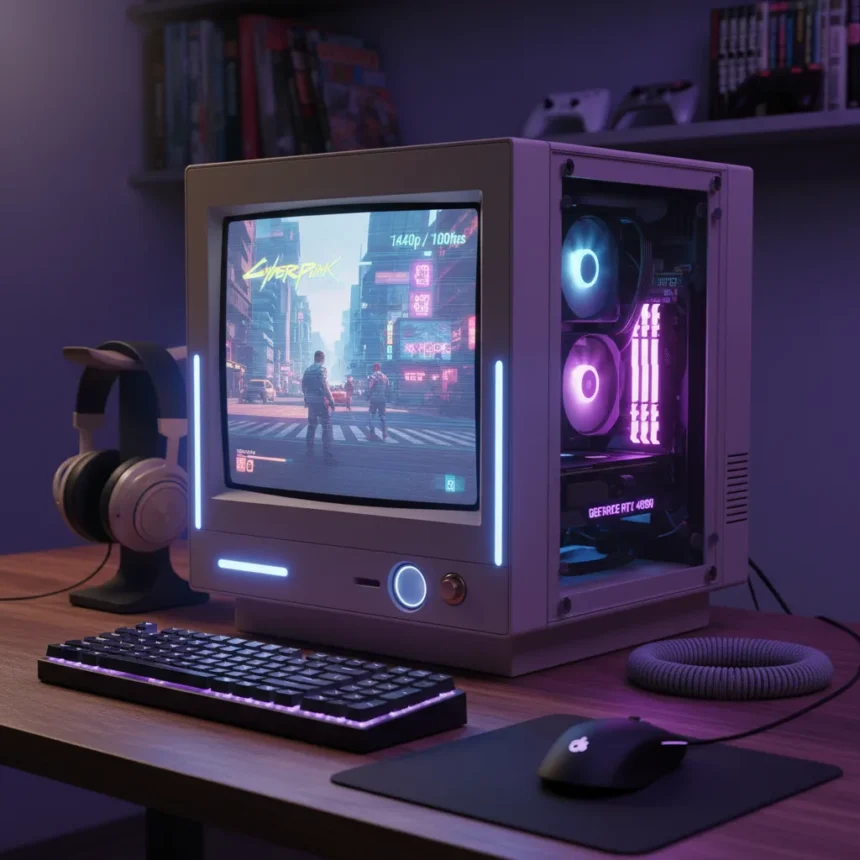
CRT PC builds are experiencing a surprising resurgence as enthusiasts hollow out vintage monitors and stuff them with high-end components, creating machines that look like 1990s iMacs but deliver contemporary framerates. A recent Redditor’s project demonstrates the appeal: a burnt-out CRT monitor repurposed as a case now runs Cyberpunk 2077 at 100fps in 1440p, marrying nostalgia with performance that most modern builds struggle to match.
Key Takeaways
- CRT PC builds use vintage monitors as cases, creating retro aesthetics with modern gaming hardware inside.
- Redditor’s CRT build achieves 100fps at 1440p running Cyberpunk 2077, proving performance viability.
- CRTs display modern games with superior color reproduction and reduced aliasing compared to LCD monitors.
- CRT gaming setups are gaining traction in 2025-2026 as gamers rediscover advantages of older display technology.
- Modern CRT alternatives like the Checkmate 19″ IPS monitor offer retro compatibility without hunting vintage hardware.
Why CRT PC builds are suddenly relevant again
The appeal of CRT PC builds extends beyond novelty. Enthusiasts are discovering that cathode ray tube monitors handle modern games in ways LCD displays cannot. CRTs smooth out jagged pixels in older games, making low-resolution details appear as intentional design rather than technical limitations. When playing a game like Cyberpunk 2077 on a CRT, iridescent colors—electric blues, greens, and magentas—pop with intensity that LCD screens struggle to reproduce, prompting some players to restart games entirely just to experience them on vintage hardware. This visual advantage, combined with the retro aesthetic of a CRT case, transforms a PC build from functional appliance into conversation piece.
The timing matters. Gaming in 2025-2026 is seeing renewed interest in CRT setups as players tire of the homogeneous slab-monitor aesthetic that has dominated desks for two decades. A CRT PC build—especially one that performs as well as the Redditor’s 1440p Cyberpunk machine—offers something modern gaming rigs cannot: character. The burnt-out monitor becomes a functional art piece, a statement that performance and personality are not mutually exclusive.
CRT monitors versus modern displays for gaming
CRT PC builds win on visual fidelity for specific game types. Unlike modern 4K TVs and LCD panels, CRTs excel at smoothing pixels in older, unoptimized games, making titles like Darktide and Cyberpunk appear more polished than they do on contemporary displays. For retro gaming, the advantage is even more pronounced—CRTs outperform modern 4K TVs at displaying games designed for their technology. However, this comes with practical trade-offs. CRTs are heavy, consume more power, generate heat, and occupy desk space that a slim monitor would not. They also require specific refresh rates and resolutions to function properly, limiting flexibility compared to modern displays that handle any input signal.


For players unwilling to hunt for vintage hardware, modern alternatives exist. The Checkmate 19″ IPS Retro Gaming Monitor supports both 15kHz and 31kHz refresh rates, accommodating PAL and NTSC standards alongside modern inputs like SCART, component, S-video, and RGBI. This bridges the gap between authentic CRT technology and contemporary convenience. Meanwhile, CRT simulator shaders for OLED and LCD screens attempt to mimic CRT visual effects digitally, though enthusiasts report that a 240Hz OLED display offers the closest approximation.
The performance question: can CRTs actually handle modern gaming?
The Redditor’s build answers this directly—yes, but with caveats. Running Cyberpunk 2077 at 100fps in 1440p is not a CRT limitation; it is a testament to the GPU and CPU powering the machine. The CRT case itself is neutral to performance, functioning purely as a display and chassis. What matters is what is inside: high-end components capable of pushing that kind of framerate to any monitor, CRT or LCD. The build’s success lies in proving that retro aesthetics do not require sacrificing modern performance.



This distinction is critical for potential builders. A CRT PC build is not inherently faster or slower than a conventional build. The visual benefits of CRT displays—superior color reproduction, pixel smoothing, reduced aliasing—are real and measurable for specific game genres, but they do not affect frame generation. What a CRT case offers is differentiation: a build that looks like it belongs in a museum but benchmarks like a contemporary gaming rig.
Is a CRT PC build practical for your setup?
CRT PC builds appeal to a niche audience: modders who value aesthetics and nostalgia, retro gaming enthusiasts, and players who have experienced CRT gaming and prefer its visual character. For mainstream gamers, the practical barriers remain significant. Sourcing a working or burnt-out CRT monitor requires hunting secondhand markets or electronics recyclers. The weight and size of a CRT case demand sturdy desk support and adequate ventilation. Cooling components inside a CRT enclosure requires careful planning to avoid heat damage to the vintage monitor shell.
That said, the trend reflects a broader shift in PC gaming culture. As gaming hardware becomes commodified and aesthetically uniform, CRT PC builds represent a rebellion against the sterile RGB-lit tower aesthetic that has dominated for years. They prove that high performance and visual personality can coexist, and they do so using hardware that would otherwise end up in landfills.
Are CRT PC builds more expensive than conventional builds?
CRT PC builds typically cost no more than conventional builds with equivalent internals. The CRT case itself is salvaged hardware, often free or cheap. The expense lies entirely in the components inside—GPU, CPU, RAM, storage—which are identical to any other high-performance build. If anything, a CRT case eliminates the cost of a modern chassis, offsetting the potential premium of sourcing and preparing vintage hardware.



Can you actually game on a CRT in 2025?
Yes. High-end CRTs like certain Sony and Dell models have been tested with modern GPUs like the RTX 5090, confirming that contemporary gaming hardware interfaces with vintage displays without issue. The real question is whether you want to. CRTs lack the refresh rate flexibility and resolution ceiling of modern displays, and they require specific signal types. But for players willing to adapt, CRTs deliver a gaming experience that LCD monitors, despite their technical superiority in resolution and brightness, simply cannot replicate in terms of visual character and color depth.
The Redditor’s CRT PC build is not a practical recommendation for most gamers, but it is a compelling argument for why retro hardware deserves a second look. In an era where gaming aesthetics have become as important as performance, a machine that delivers both while honoring the hardware that started it all has undeniable appeal. Whether you are a modding enthusiast or simply tired of another black tower with RGB fans, CRT PC builds prove that nostalgia and latest framerates can occupy the same desk.
Edited by the All Things Geek team.
Source: TechRadar