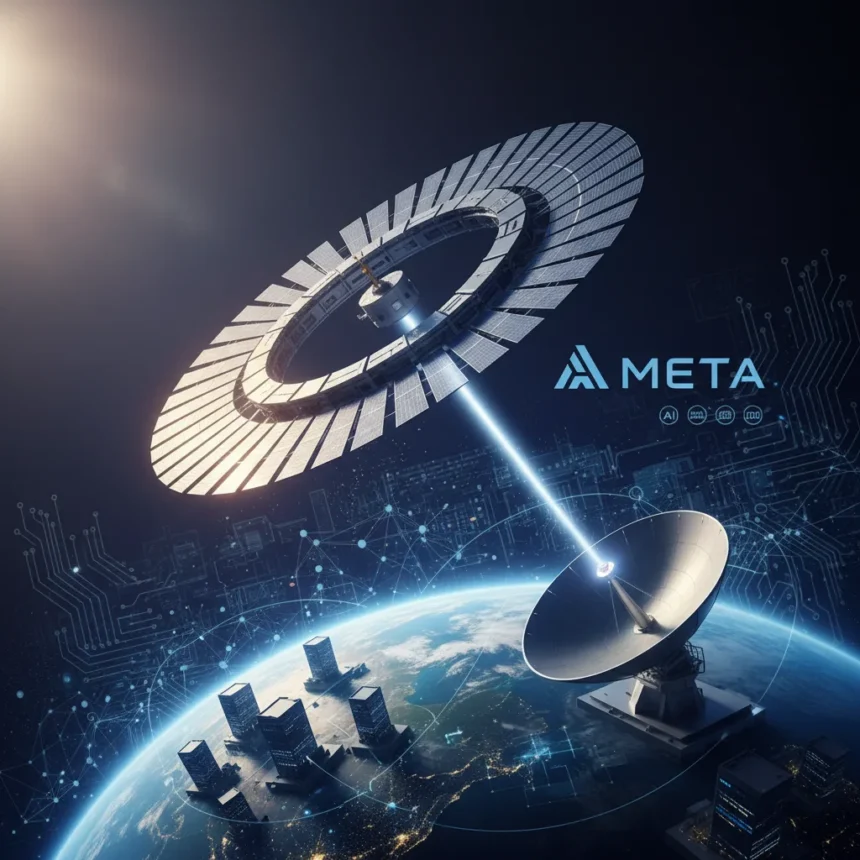
Meta’s capacity reservation agreement with Overview Energy for up to 1 GW of space-based solar power represents something unprecedented: the first major commercial commitment to a technology that barely existed outside research labs two years ago. This is not venture-stage speculation. This is a hyperscaler betting real infrastructure dollars on beaming solar energy from orbit because terrestrial alternatives cannot keep pace with artificial intelligence’s relentless appetite for electricity.
Key Takeaways
- Meta signed a 1 GW capacity reservation with Overview Energy, a 2022 startup planning geosynchronous orbit satellites
- Space-based solar delivers 24/7 power by beaming low-intensity infrared light to existing ground solar facilities
- Commercial delivery expected 2030, with orbital demonstration in January 2028
- Meta’s data centers consumed over 18,000 GWh in 2024—equivalent to powering 1.7 million U.S. homes
- Power demand expected to double or triple by 2028, straining grids and traditional renewable capacity
Why Meta Abandoned Conventional Solar for Orbital Systems
Meta’s data center electricity consumption in 2024 exceeded 18,000 GWh, a figure that grows more staggering when you realize it already matches Ireland’s entire national electricity demand from 2023. The company committed to 30 GW of renewable power, but here is the critical problem: traditional terrestrial solar cannot scale fast enough. Grid interconnection queues are clogged. Land availability is finite. Storage solutions like batteries are prohibitively expensive and land-intensive at data-center scale.
Space-based solar power bypasses these constraints entirely. Overview Energy’s satellite constellation in geosynchronous orbit collects continuous sunlight and beams low-intensity near-infrared light to existing ground solar facilities, which then convert it to electricity. The beamed light is invisible to the human eye, less intense than natural sunlight, and passively safe for humans, animals, and aircraft. This matters because it means you do not need new ground infrastructure—you retrofit existing solar plants to receive and convert beamed power, dramatically increasing their output even during night hours.
The power gains are substantial. Orbital arrays offer approximately 30% more power output than terrestrial systems due to the absence of atmospheric attenuation, and roughly 5x greater energy yield because there is no day-night cycle interrupting collection. For a company facing data center demand that could double or triple by 2028, that efficiency difference translates directly to feasibility.


The Timeline: Demonstration to Deployment
Overview Energy, founded in 2022, demonstrated power-beaming technology from a Cessna aircraft at 16,500 feet in November, proving the core physics works at altitude. The company plans an orbital demonstration in low Earth orbit in January 2028, with commercial delivery from geosynchronous orbit satellites beginning in 2030. Meta’s agreement is structured cautiously, with milestone-based access rather than immediate full capacity.
That 2030 timeline matters because it aligns with when Meta’s power crisis becomes acute. The company has already secured up to 6.6 GW of nuclear capacity by 2035 through January deals, but nuclear is slow—regulatory approval and construction timelines stretch years. Space-based solar offers a faster path to supplementary capacity, assuming Overview executes flawlessly on orbital deployment and in-orbit operations.



The Competitive Pressure Behind This Bet
Meta is not alone in facing this crunch. The entire hyperscaler industry—Amazon, Google, Microsoft, and others—is scrambling for uninterrupted renewable energy. Most are turning to behind-the-meter solutions: integrated solar and storage parks designed to avoid grid volatility. But these still depend on land availability, regulatory approval, and the physics of batteries. Space-based solar removes the land constraint entirely, which is why Elon Musk has publicly argued that solar is fundamental to space-based artificial intelligence.
The agreement with Overview Energy signals that Meta views this as worth the execution risk. No financial terms were disclosed, and the technology remains unproven at commercial scale. Economic viability, launch costs, and in-orbit maintenance remain open questions. Yet by committing to a 1 GW reservation, Meta is essentially saying: the alternative—waiting for terrestrial solar and batteries to catch up—is riskier than betting on orbital infrastructure.
What Could Go Wrong
Overview Energy must execute a flawless orbital deployment, maintain power-beaming accuracy over years of operation, and scale from demonstration to gigawatt-level capacity. Any of these could slip. The company is pre-revenue and has never operated satellites in geosynchronous orbit. Regulatory approval for power-beaming in U.S. airspace is not guaranteed, though the technology’s low-intensity, passive-safety profile should help.
Meta is hedging by structuring the agreement with milestone-based access, meaning the company does not pay full capacity costs until Overview proves each phase. That is smart risk management, but it also means Meta is not fully committed—if the technology falters, the company can walk away and rely on its nuclear deals and terrestrial solar expansion.



Is space-based solar actually viable at commercial scale?
Overview Energy has demonstrated power-beaming from aircraft and plans orbital trials in January 2028. Viability depends on successfully operating satellites in geosynchronous orbit, maintaining beam accuracy, and achieving cost parity with terrestrial alternatives. The technology is real, but commercial-scale operation is untested.
Why doesn’t Meta just build more terrestrial solar farms?
Terrestrial solar faces grid interconnection bottlenecks, land scarcity, intermittency challenges, and expensive battery storage at data-center scale. Space-based solar eliminates the day-night cycle and atmospheric losses, delivering 24/7 power to existing infrastructure without requiring new land or grid upgrades.
When will this power actually reach Meta’s data centers?
Overview Energy targets commercial delivery from geosynchronous orbit in 2030. Meta’s agreement includes an orbital demonstration in January 2028, with milestone-based access to capacity post-demonstration. Full deployment will likely take years beyond 2030.
Meta’s bet on space-based solar is not a vote of confidence in a mature technology—it is a desperate gamble that orbital infrastructure can scale faster than terrestrial alternatives. The company faces an AI power crisis that conventional renewables cannot solve in time. Whether Overview Energy delivers or collapses under execution pressure, this deal confirms that the data center industry has exhausted its earthbound options. The next frontier for AI infrastructure is literally above our heads.
Edited by the All Things Geek team.
Source: TechRadar