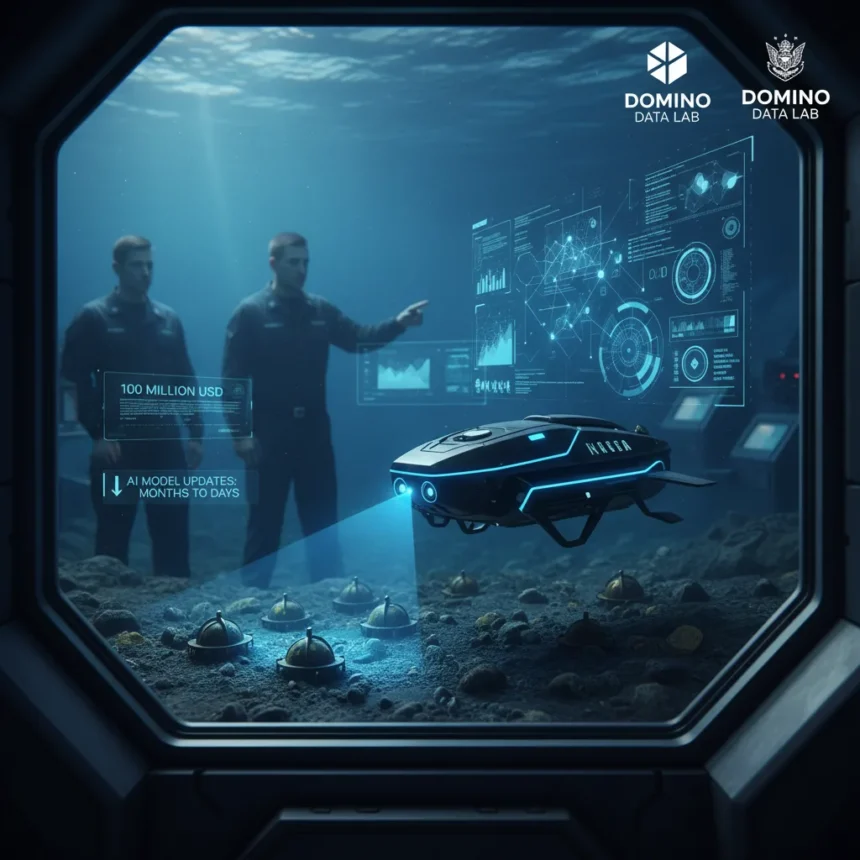
AI mine detection just became a strategic advantage for the US Navy. The service has awarded Domino Data Lab, a San Francisco-based AI company, a contract worth up to $99.7 million to accelerate underwater mine-hunting operations in the Strait of Hormuz, compressing the timeline for updating detection algorithms from months to days.
Key Takeaways
- US Navy awards $99.7 million contract to Domino Data Lab for AI mine detection systems.
- Project AMMO reduces detection algorithm updates from 6-12 months to days via MLOps automation.
- Unmanned underwater vehicles integrate side-scan sonar, visual imaging, and other sensors for real-time threat recognition.
- Strait of Hormuz mine-clearing operation demonstrates first major scaling of commercial AI for Navy undersea warfare.
- Defense Innovation Unit partnership enabled Fall 2023 demonstration of rapid sensor data collection and model deployment.
How AI mine detection reshapes naval operations
The contract expands Domino’s role as the AI backbone for Project AMMO (Accelerated Machine Learning for Maritime Operations), a Navy initiative focused on deploying unmanned underwater vehicles (UUVs) for mine countermeasures. The partnership decouples hardware from software updates, allowing detection models to evolve without waiting for physical equipment refreshes. Thomas Robinson, Domino’s Chief Operating Officer, captured the shift bluntly: “Mine-hunting used to be a job for ships. It’s becoming a job for AI.”
The Strait of Hormuz is a proving ground for this transition. As one of the world’s most critical shipping lanes, the waterway faces persistent mine threats that traditional ship-based sweeping cannot address quickly or efficiently. The new system integrates data from multiple sensors—side-scan sonar, visual imaging, and other systems—to train automatic target recognition (ATR) models that identify mines and other threats from raw sensor data.
The speed advantage: from months to days
Prior to this contract, the Navy’s mine detection algorithms operated on a glacial timeline. Model updates took six to twelve months, during which new threat variants emerged unchecked. The Domino platform inverts this dynamic through MLOps automation—a toolset that monitors deployed models, identifies performance failures, and pushes corrected detection algorithms back into the field without requiring hardware swaps or port visits.



The Fall 2023 Integrated Battle Problem demonstrated the compressed cycle in action. Navy teams collected sensor data, trained new models against expanded threat environments, and deployed updated detection models through the AMMO ecosystem within days. A Navy official involved in the project emphasized the operational impact: “The partnership between the U.S. Navy and DIU has opened the pathways to commercial innovation and has produced a MLOps toolset that ensures our solutions adapt and evolve at the speed of tactical relevance, placing an enduring capability in the hands of the warfighter.”
Why this matters beyond the Strait of Hormuz
The contract signals a broader shift in how the military approaches undersea warfare. Rather than building proprietary systems, the Navy is integrating commercial AI infrastructure—Domino’s platform knits together four other commercial technologies into a unified “factory” for model development and deployment. This approach accelerates innovation cycles and reduces dependence on lengthy government procurement timelines.



The implications extend beyond mine detection. Any naval operation requiring rapid AI adaptation—from sonar classification to threat prediction—could leverage the same MLOps infrastructure. The Defense Innovation Unit’s involvement underscores the Pentagon’s commitment to closing the gap between commercial AI velocity and military operational needs.
What separates this from traditional military AI
Military AI systems historically suffered from a fundamental mismatch: threats evolved faster than algorithms could update. Ship-based mine-hunting relied on human operators and pre-programmed detection rules, both of which degraded against novel threats. The Domino contract solves this by automating the retraining loop. When a UUV encounters a mine variant its model has never seen, operators can collect that data, retrain the model, and push corrections to the entire fleet in days rather than waiting for a new software release cycle measured in quarters.
This decoupling of hardware and software also means the Navy avoids the classic military trap of locking into obsolete systems. UUVs deployed today can run detection models from 2026 or 2027 without physical upgrades, provided Domino’s platform continues to evolve.
Operational readiness in contested waters
The Strait of Hormuz remains one of the world’s most strategically sensitive chokepoints. Roughly 21 percent of global petroleum passes through its waters annually, making mine threats not just a military concern but a global economic one. The ability to detect and clear mines in days rather than months directly translates to reduced disruption to international commerce and safer passage for merchant vessels.


The contract also reflects broader geopolitical currents. President Trump has publicly emphasized Navy mine-clearing efforts in the region, framing mine countermeasures as a priority. The AI acceleration enabled by Domino’s platform gives the Navy a tool to respond faster to emerging threats without requiring additional ships or personnel.
Is this the start of broader military AI automation?
The Domino contract suggests the Navy sees commercial MLOps platforms as foundational infrastructure, not niche tools. If the mine detection deployment succeeds at scale, expect similar contracts across other military AI applications—submarine detection, surface threat classification, electronic warfare signal recognition. The pattern is clear: automate the retraining loop, compress the update cycle, and let operators focus on tactical decisions rather than waiting for algorithm patches.
The $99.7 million investment is substantial but modest compared to traditional naval procurement. A single destroyer costs billions. The ability to accelerate AI model updates across dozens of UUVs for under $100 million represents remarkable value, assuming the platform delivers the promised speed and reliability.
What happens if AI mine detection fails?
The risk is real. Autonomous systems misidentifying debris as mines or vice versa could trigger costly false alarms or, worse, leave actual threats undetected. The Domino platform includes monitoring and failure detection, but the Navy will need robust human oversight and validation protocols before fully trusting AI recommendations in high-stakes mine-clearing operations. The Fall 2023 demonstration was controlled; real-world deployment in contested waters adds complexity.
Could other nations replicate this approach?
China and Russia maintain substantial undersea capabilities and face similar mine-detection challenges. The architecture Domino has built—integrating commercial sensors with cloud-based model retraining—is not classified technology. However, the Navy’s advantage lies in scale, integration maturity, and the Defense Innovation Unit’s ability to rapidly iterate with commercial partners. Replicating that ecosystem takes time and institutional flexibility that traditional military procurement rarely achieves.
FAQ
How much faster are AI mine detection updates with Domino’s platform?
The platform compresses detection algorithm updates from six to twelve months down to days. This acceleration enables the Navy to respond to new mine variants or threat patterns without waiting for traditional software release cycles, allowing corrections and improvements to deploy directly to unmanned underwater vehicles in the field.
What sensors does the AI mine detection system use?
The system integrates data from multiple sources including side-scan sonar, visual imaging, and other sensor systems. These inputs feed into automatic target recognition (ATR) models that identify mines and threats from raw sensor data collected by unmanned underwater vehicles.
Why is the Strait of Hormuz critical for this AI mine detection contract?
The Strait of Hormuz is one of the world’s most strategically important shipping lanes and faces persistent mine threats. Rapid AI-driven mine detection and clearance directly reduces disruption to global commerce and improves safety for merchant vessels transiting the waterway.
The Domino contract represents a turning point in how the military approaches AI deployment. Speed matters in warfare, and the ability to update detection algorithms in days rather than months gives the Navy a genuine tactical edge. Whether this model scales to other military AI applications will determine whether commercial MLOps platforms become standard military infrastructure or remain a one-off innovation.
Edited by the All Things Geek team.
Source: Tom's Hardware