







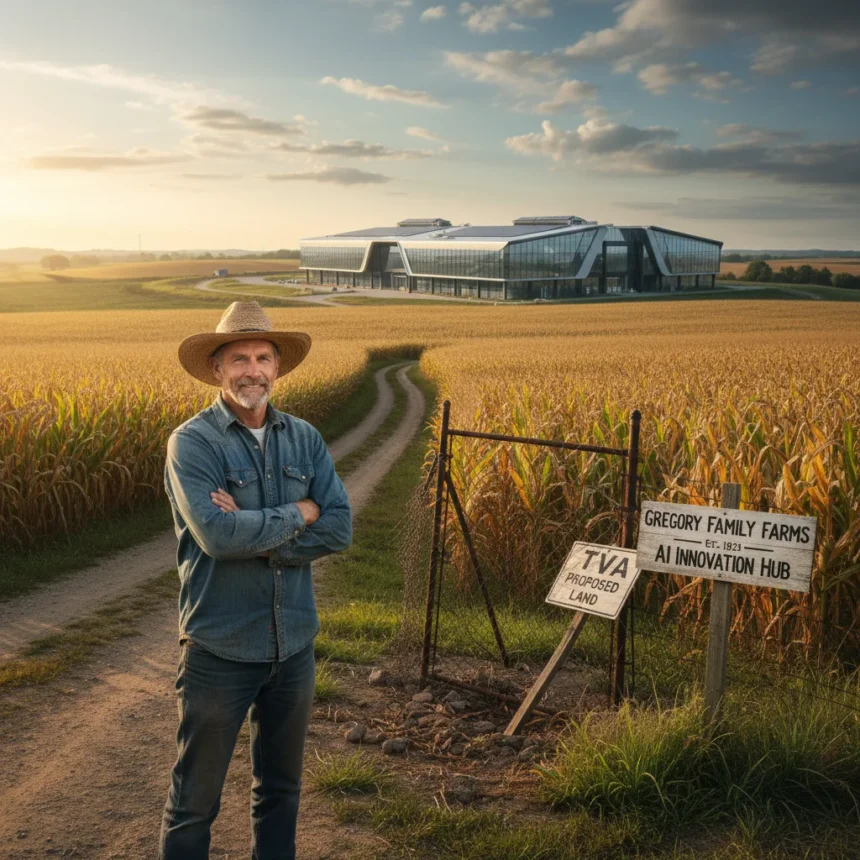
The Tennessee Valley Authority, a federal power giant established by President Franklin D. Roosevelt, met its match in a rural property rights battle when farmer John Gregory refused to surrender land for TVA AI data center infrastructure. Gregory’s defiant stance—”We’re not selling and we’re not giving way”—became a rallying cry for communities nationwide as the TVA scrambles to expand power capacity for Google and Elon Musk’s xAI facilities.
Key Takeaways
- Farmer John Gregory defeated the TVA in a property rights battle over Revolutionary War era farmland in Tennessee.
- TVA sought the land to build power infrastructure supporting AI data centers from Google and xAI amid surging electricity demand.
- Country star John Rich amplified the fight through social media, YouTube, and a protest song titled “The Devil & the TVA.”
- Local communities in Cheatham County unanimously opposed the TVA’s methane power generation plant in agricultural areas.
- Trump administration intervention via Agriculture Secretary Brooke Rollins provided the decisive push that forced TVA to back down.
Why TVA AI data center land grabs are colliding with rural America
The TVA’s push to acquire farmland for power infrastructure reflects a fundamental tension: AI data centers consume staggering amounts of electricity, and utilities are scrambling to meet that demand. Google and xAI are building massive facilities that require dedicated power generation capacity. Rather than waiting for legislative approval or negotiating with communities, the TVA—an agency that answers only to the president and bypasses senators, congressmen, governors, and the public—moved aggressively to seize land. In Cheatham County, Tennessee, near Nashville, the agency proposed a methane power generation plant in the heart of agricultural and residential neighborhoods, directly threatening family farms that had operated for generations.
What the TVA didn’t anticipate was organized resistance. George and Jean Wade, who operate a small family farm in the county, became focal points for community opposition. The Cheatham County mayor offered to buy the land back from TVA. More significantly, five local jurisdictions—Cheatham County, Ashland City, Pegram, Kingston Springs, and Pleasant View—unanimously adopted resolutions against the plant, signaling that this was not a lone farmer’s complaint but a coordinated community rejection.
How celebrity activism and social media defeated a federal agency
Country star John Rich transformed a local land dispute into a national conversation about federal overreach and property rights. Rich used social media, YouTube interviews, and a protest song titled “The Devil & the TVA” to expose the TVA’s tactics. He highlighted a particularly troubling claim: that TVA task forces enter private land without consent, allegedly violating Fourth Amendment rights. “They tell homeowners, ‘Hey, we’re coming on your land whether you like it or not,’ which steps all over the Fourth Amendment and a lot of other rights that Americans have,” Rich stated.



The TVA’s aggressive posture became harder to defend once the scale of its actions came into public view. According to Rich’s advocacy, the agency had sued over 100 families in a low-income county where only half could afford attorneys. The optics of a federal agency targeting vulnerable rural communities to feed the electricity demands of tech billionaires proved politically toxic. What started as a property dispute escalated into a symbol of corporate capture of government power.
Trump administration intervention: the turning point for TVA AI data center expansion
The decisive moment came when John Rich escalated the fight to the federal level, alerting Agriculture Secretary Brooke Rollins to TVA’s plans to tear up 6,000 acres of farmland across one Tennessee county. Rich credited this intervention as the catalyst: “That’s when we actually had a fighting chance to push TVA out.” The Trump administration’s willingness to challenge the TVA—an agency nominally independent but ultimately accountable to the president—provided the political cover rural communities needed.



This intervention exposed a critical vulnerability in the TVA’s expansion strategy. While the agency operates with remarkable autonomy, it cannot withstand coordinated pressure from the White House, local elected officials, celebrity advocates, and organized communities. The victory in Tennessee suggests that future TVA attempts to acquire farmland for AI infrastructure will face similar resistance, particularly if communities can mobilize early and secure high-profile support.
What the TVA’s defeat means for AI infrastructure expansion
The TVA’s retreat in Tennessee does not solve the underlying problem: AI data centers genuinely do require massive amounts of power, and utilities must expand capacity to meet that demand. The question is how that expansion happens. Will it proceed through community engagement, fair compensation, and transparent processes? Or will utilities and tech companies continue attempting to steamroll rural landowners?
A parallel case illustrates the stakes. In Kentucky, Dale Silbert’s family rejected a $26 million offer from a data center operator to keep their farmland. That family valued their land and way of life more than a nine-figure buyout. The TVA’s approach—using federal authority to bypass negotiation—treated property owners as obstacles to be removed rather than stakeholders to be respected.
Gregory’s victory and the broader resistance in Cheatham County suggest a shift in the power dynamic. Rural communities are learning that they can fight back, that federal agencies are not invulnerable, and that public pressure—amplified through social media and celebrity support—can force recalculation. The slow state legislature that enabled the TVA’s initial overreach now faces pressure to pass stronger property protection laws.



Can other farmers replicate this victory?
The Tennessee case succeeded because it combined multiple elements: a sympathetic defendant (a family on Revolutionary War era land), organized community opposition, celebrity amplification, and timely federal intervention. Not every farmer will have access to a country music star or a receptive Agriculture Secretary. The victory is therefore both inspiring and cautionary—it shows resistance is possible but also highlights how much depends on factors beyond the typical landowner’s control.
What remains clear is that the age of utilities quietly acquiring rural land for AI infrastructure is ending. Communities are watching. Advocacy networks are forming. And federal agencies, even powerful ones like the TVA, are learning that they cannot ignore organized opposition indefinitely. The next utility that attempts a similar land grab will face the same grassroots resistance, social media scrutiny, and potential political backlash that forced the TVA to retreat.
What exactly did the TVA want the land for?
The TVA sought land to build a methane power generation plant in Cheatham County, designed to provide electricity to AI data centers operated by Google and xAI. The facility would have been located in an agricultural and residential area, directly threatening family farms and residential neighborhoods.
Did the TVA actually sue over 100 families?
According to country star John Rich’s advocacy, the TVA sued over 100 families in Cheatham County, a low-income area where only half of residents could afford attorneys. While Rich made this claim prominently in his campaign against the agency, the statement should be understood as part of his broader critique of TVA’s aggressive legal tactics rather than an independently verified count.
How did John Rich help defeat the TVA?
John Rich used social media, YouTube interviews, and a protest song titled “The Devil & the TVA” to publicize the farmers’ fight. He escalated the issue to the federal level by alerting Agriculture Secretary Brooke Rollins to the TVA’s plans to acquire 6,000 acres of farmland, which prompted Trump administration intervention that ultimately forced the TVA to back down.
The Tennessee farmer’s victory over the TVA signals a fundamental shift in how rural communities respond to federal land grabs justified by corporate infrastructure needs. As AI data centers continue to proliferate and electricity demand surges, this battle will likely become a template for resistance—one where property rights, community voice, and political pressure can still prevail against even the most entrenched federal agencies.
This article was written with AI assistance and editorially reviewed.
Source: TechRadar




