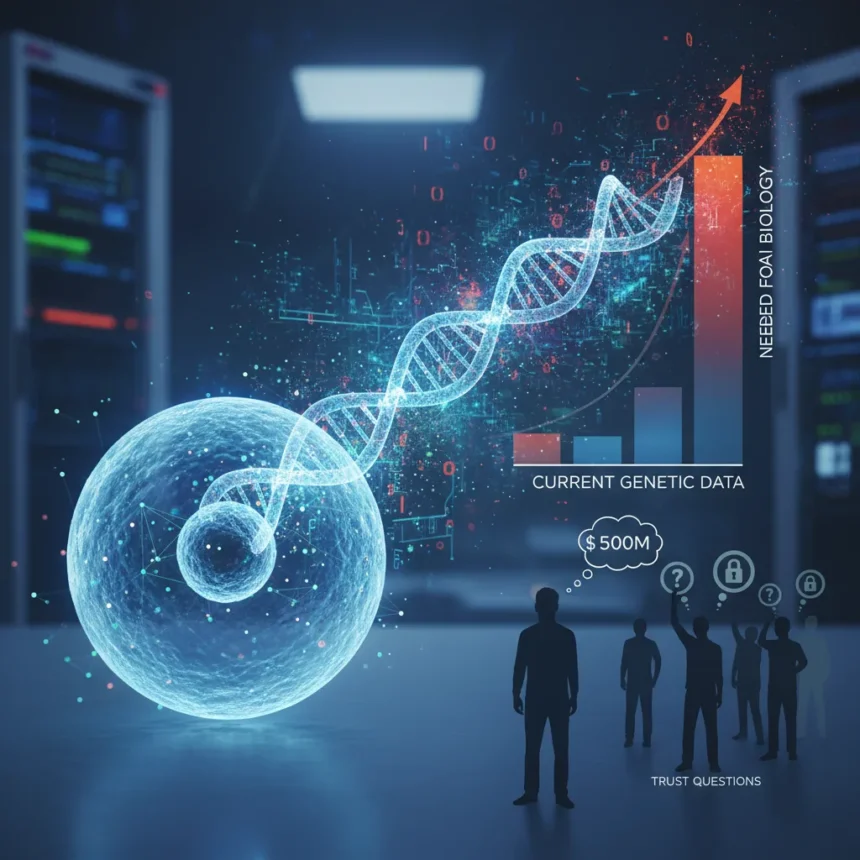
AI biology genetic data is about to become the most valuable commodity in medicine. Mark Zuckerberg and the Chan Zuckerberg Biohub announced a landmark $500 million commitment on April 29, 2026, to build artificial intelligence models that can accurately simulate human cells at the molecular level, with the stated goal of eventually curing all diseases. The ambition is staggering. The bottleneck is real. And the privacy questions loom larger than the science itself.
Key Takeaways
- Chan Zuckerberg Biohub announced $500 million over five years to build predictive AI models of human cells and tissues
- Current datasets contain around 1 billion cells; researchers need 10x more data for accurate predictive models
- $400 million funds Biohub’s own projects; $100 million available to external research labs worldwide
- Partners include Nvidia, Allen Institute, and global efforts like the Human Cell Atlas and Billion Cells Project
- Success depends on access to genetic data at unprecedented scale, raising questions about privacy and consent
The Data Bottleneck in AI Biology Genetic Data
Here is the hard truth: AI models cannot predict what they have not seen. Biohub leader Alex Rives stated plainly that predictive accuracy of AI models improves significantly as the data volume increases, and the team aspires to expand datasets by an order of magnitude or more. Currently, the largest datasets contain around 1 billion cells. For AI to reliably simulate the behavior of human cells under different conditions—to understand why a cell becomes cancerous, how it responds to drugs, what triggers disease—researchers need roughly 10 times that volume. That is not a minor engineering challenge. It is a fundamental constraint on whether this entire vision works.
The Virtual Biology Initiative allocates $400 million to Biohub’s own infrastructure: data generation at scale, imaging technology, engineering and data infrastructure, and core technologies to measure and observe cellular biology. Another $100 million goes to external research labs and institutions to nucleate worldwide data-generation efforts. The goal is to build open, global, multi-modal datasets and predictive AI models that can simulate biology, understand disease at the cellular, molecular, and tissue levels, and theoretically enable reprogramming to cure diseases. This is not just drug discovery. This is biology as code.
Why This Moment, Why This Much Money
Google DeepMind’s Demis Hassabis predicted years ago that AI could end disease, aligning with Biohub’s bet. But the announcement comes as a coordinated global push, not a single lab’s speculation. The Billion Cells Project, launched in 2025, coordinates 17 research projects across MIT, Stanford, UC San Francisco, Columbia, University of Washington, ETH Zurich, and the Genome Institute of Singapore, with partners including 10x Genomics and Ultima Genomics. Zuckerberg’s $500 million is fuel for an already-moving engine. It signals that the bottleneck has shifted from computing power to raw biological information. You cannot build a digital twin of human cells without the data to train it.



Rives acknowledged the long arc of this work, noting that progress in protein biology is the result of decades of funding. The $500 million commitment is five years. Curing all diseases is not a five-year problem. But starting with cells, tissues, and molecular-level simulation is a foundation that could accelerate everything downstream.
The Genetic Data Trust Question
Here is where the announcement gets uncomfortable. Building AI models of human cells at scale requires genetic data—lots of it. That means DNA sequences, cellular profiles, tissue samples, health records linked to biological information. Zuckerberg and Priscilla Chan have positioned themselves as philanthropists, not profit-seekers, through the Chan Zuckerberg Initiative. But the source article’s headline asks directly: will you trust him with yours? That skepticism is not paranoia. It is reasonable caution about who controls the data that defines our biology.



The research brief does not detail specific privacy safeguards, data-sharing agreements, or governance structures for how genetic information will be collected, stored, and used. The initiative emphasizes open datasets and global collaboration, which is necessary for the science to work. But openness and privacy are in tension. Genetic data is not like other data. It reveals not just your own biology but your family’s. It can be re-identified from supposedly anonymized samples. It carries implications for insurance, employment, and discrimination that regulators are only beginning to address. The ambition to cure all diseases is real. So is the risk of building unprecedented surveillance infrastructure in the name of medicine.
Can AI Biology Models Actually Deliver?
The science is promising but unproven at scale. Rives stated that he believes there is a route to developing precise predictive models of the cell. That is not a guarantee. It is a hypothesis backed by a $500 million bet. The team needs 10 times more data than currently exists. They need that data to be diverse—different cell types, different genetic backgrounds, different disease states. They need imaging technology accurate enough to measure molecular interactions inside cells. They need AI models sophisticated enough to find patterns humans cannot see, and then validate those patterns experimentally.
The comparison to prior breakthroughs in biology is instructive. The Human Genome Project took 13 years and billions of dollars. The Human Cell Atlas and Human Protein Atlas are ongoing, global efforts that have taken years to accumulate their current datasets. Biohub’s Virtual Biology Initiative is not starting from zero, but it is attempting to compress decades of incremental discovery into five years through coordinated funding and infrastructure. That is ambitious. Whether it is realistic depends on whether the data bottleneck can actually be solved, and whether AI models can generalize from that data to predict biology in ways that translate to curing disease.
What Happens Next
The announcement is a signal, not a finish line. Biohub is seeking additional investors beyond the initial $500 million. The Billion Cells Project partners will contribute their own resources. Nvidia, the Allen Institute, Arc, and other collaborators will integrate their tools and expertise. The datasets will be released openly, allowing researchers worldwide to build their own models and validate the approach. If it works, the payoff is enormous: a computational model of human biology that lets researchers test millions of interventions in silico before moving to cells, animals, or humans. If it does not work, the field will have learned something valuable about the limits of AI and the irreducibility of biology.


The genetic data question will not disappear. As biological information becomes the next frontier in AI, questions of consent, privacy, and control will only intensify. Zuckerberg and Priscilla Chan have positioned themselves as stewards of this data through philanthropy. Whether that trust is warranted depends on what comes next: how the data is governed, who has access, what safeguards exist, and whether individuals whose biological information fuels these models have any say in how it is used. The science is compelling. The governance is the real test.
Will the $500 million be enough to cure all diseases?
No. Five years and $500 million will accelerate cellular-level research and build foundational AI models, but curing all diseases requires decades more funding, validation, regulatory approval, and clinical translation. This is a landmark commitment, not the final answer.
How much genetic data do researchers need for accurate AI models?
Current datasets contain around 1 billion cells. Researchers need approximately 10 times that volume—an order of magnitude more—for AI biology models to make reliable predictions about cellular behavior and disease.
Who is funding the Virtual Biology Initiative?
The Chan Zuckerberg Biohub, backed by Mark Zuckerberg and Priscilla Chan, is committing $500 million over five years, with $400 million for internal projects and $100 million available to external research institutions. Additional investors are being sought.
The future of medicine might be written in code, not pills. Zuckerberg’s $500 million bet on AI biology is a serious attempt to make that future real. But the genetic data needed to power it raises questions that no amount of funding can answer alone. Trust in science requires transparency, and transparency requires answering hard questions about who controls the biological information that defines us. The Virtual Biology Initiative has announced its ambition. Now comes the harder part: earning the trust to deliver it.
Edited by the All Things Geek team.
Source: TechRadar