






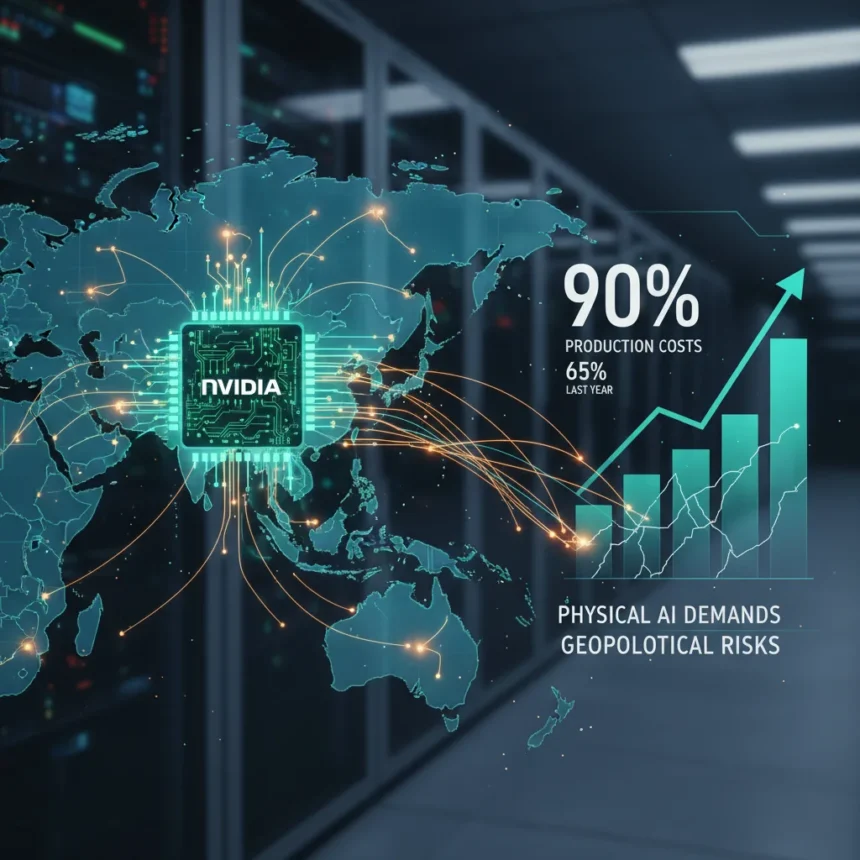
Nvidia’s Asian supply chain exposure has reached a critical threshold that exposes the company to unprecedented geopolitical and operational risk. According to Bloomberg data, Asian suppliers now account for approximately 90% of Nvidia’s production costs, a dramatic increase from roughly 65% just one year earlier. This concentration is not accidental—it reflects Nvidia’s aggressive pivot into Physical AI, the convergence of software intelligence with robotics and real-world automation, which demands even greater reliance on Asia’s semiconductor and component manufacturing ecosystem.
Key Takeaways
- Asian suppliers now represent 90% of Nvidia’s production costs, up from 65% a year ago
- TSMC and SK Hynix are the most critical global partners for Nvidia’s AI hardware production
- Physical AI expansion is driving deeper dependence on Asian supply chains
- Geopolitical tensions pose the primary risk to this concentrated supply structure
- The shift has triggered a rally across Asian supplier stocks and markets
Why Nvidia’s Asian Supply Chain Exposure Matters Now
Nvidia’s Asian supply chain exposure has become the defining vulnerability of the AI era. The company cannot build advanced AI chips without TSMC’s foundry services or memory components from SK Hynix and Samsung. These are not interchangeable suppliers—they are monopolistic chokepoints. When 90% of your production costs flow through a single region facing U.S. decoupling pressures, tariff threats, and geopolitical tensions, you are not running a resilient supply chain. You are gambling on stability that no government can guarantee.
The speed of this shift matters. Moving from 65% to 90% in twelve months signals that Nvidia has consciously accelerated its Asian dependency rather than diversified away from it. This is a deliberate choice, not an accident of geography. Physical AI requires more components, faster iteration, and tighter integration with latest manufacturing. Asia is where that capability exists at scale. Nowhere else on Earth can match TSMC’s process technology or SK Hynix’s memory production capacity.
Physical AI as the Driver of Deepening Exposure
Physical AI represents Nvidia’s next growth frontier, and it is an Asian supply chain nightmare. Unlike software-only AI, Physical AI means robots, autonomous systems, and real-world automation hardware. Each robot needs processors, memory, sensors, and mechanical components. Each requires integration, testing, and rapid iteration. The manufacturing complexity multiplies, and so does the reliance on Asian partners who control the critical path.

Nvidia’s pivot to Physical AI has already triggered a rally across Asian supplier stocks and markets, signaling investor confidence that the region will become even more central to the AI industrial revolution. But rallies are not resilience. They are bets on a status quo that geopolitical events could shatter overnight. Taiwan produces over 90% of the world’s advanced semiconductors. One military incident, one trade embargo, one supply disruption—and Nvidia’s entire Physical AI roadmap collapses.
Geopolitical Risk and the Decoupling Illusion
The U.S. government has spent years advocating for supply chain decoupling from Asia, particularly from China. Yet the data tells a different story: decoupling is practically impossible in high-tech manufacturing. Nvidia’s situation proves it. The company cannot build competitive AI chips without Asian suppliers, and no amount of subsidies or reshoring initiatives will change that in the next five to ten years.


Geopolitical tensions remain the primary risk to Nvidia’s concentrated supply chain. Tariffs, export controls, trade wars, or military escalation in the Taiwan Strait could force Nvidia to choose between production capacity and compliance with government mandates. There is no third option. Building redundant foundries in the U.S. or Europe would take years and cost tens of billions—money Nvidia would rather spend on R&D and shareholder returns.
What This Means for the AI Industry
Nvidia’s Asian supply chain exposure is not unique—it is emblematic. Every AI chip maker faces the same geography problem. The company’s willingness to push Asian dependency from 65% to 90% signals that the entire AI industry accepts this risk as the cost of staying competitive. Competitors cannot afford to diversify away from TSMC or SK Hynix without losing performance and speed to market.
The stock rally among Asian suppliers reflects this reality. Investors see Nvidia’s deepening commitment as a guarantee of demand for years to come. But rallies punish complacency. If geopolitical risk materializes, these same stocks will crater, and Nvidia will face production crises that no amount of inventory buffering can solve.
Can Nvidia Reduce Its Asian Supply Chain Exposure?
Reducing Nvidia’s Asian supply chain exposure from 90% back to 65% would require fundamental changes to the company’s manufacturing strategy. Nvidia would need to invest in alternative foundries, qualify new memory suppliers, and accept lower performance or higher costs during the transition. None of this is attractive when TSMC and SK Hynix deliver unmatched capability.



The company could pursue incremental diversification—shifting some production to Samsung or exploring emerging foundries in South Korea or Japan. But these moves would be marginal at best. TSMC’s dominance in advanced process nodes means Nvidia cannot escape Taiwan without sacrificing competitive advantage.
Is Nvidia’s concentration in Asian suppliers a permanent risk?
Yes. As long as TSMC and SK Hynix lead in semiconductor manufacturing, Nvidia will remain dependent on Asian suppliers. The company has chosen to deepen this reliance with Physical AI, betting that geopolitical stability will hold. That is a reasonable business bet, but it is still a bet.
How much of Nvidia’s supply chain is outside Asia?
Only about 10% of Nvidia’s production costs flow through non-Asian suppliers, according to Bloomberg data. This means the company has minimal geographic diversification and no meaningful fallback options if Asian supply chains face disruption.
Will U.S. reshoring initiatives change Nvidia’s supply chain strategy?
Not in the near term. U.S. government subsidies for semiconductor manufacturing are designed to build long-term capacity, but they will not match TSMC’s capabilities for five to ten years. Nvidia cannot wait that long and will continue relying on Asian suppliers while domestic alternatives develop.
Nvidia’s 90% Asian supply chain exposure is the price of leadership in AI. The company has chosen performance and speed over geographic diversification, and the market has rewarded that choice. But as Physical AI accelerates and geopolitical tensions simmer, this concentration represents the single biggest operational risk to Nvidia’s growth trajectory. The company is betting that the status quo holds. History suggests that bet always fails eventually.
This article was written with AI assistance and editorially reviewed.
Source: Tom's Hardware