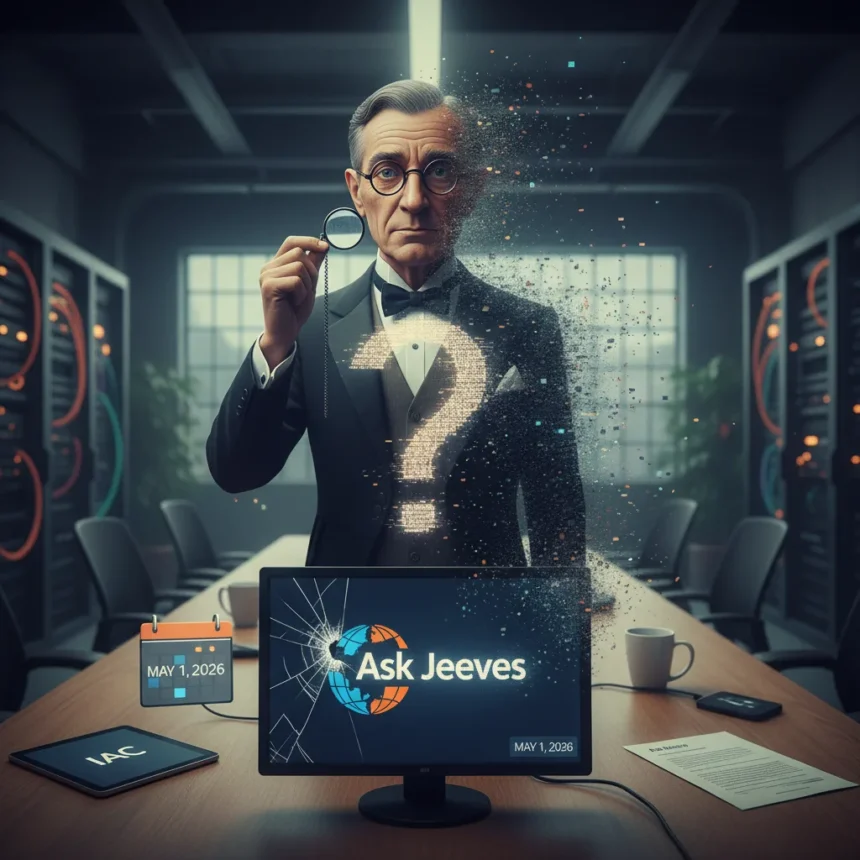
Ask Jeeves, the pioneering conversational search engine that let users ask questions in plain English rather than type keywords, officially shut down on May 1, 2026, after nearly three decades of operation. The closure marks the end of an era for a service that anticipated modern AI chatbots like ChatGPT and Gemini long before they dominated the search landscape. A conversational search engine is a web search tool designed to understand natural language questions posed by users, returning answers to those questions rather than forcing users to decode keyword syntax or parse search engine results pages.
Key Takeaways
- Ask Jeeves launched in June 1997 and operated for approximately 29 years before shutting down.
- The service pioneered natural language search, predating modern AI chatbots by more than two decades.
- Parent company IAC discontinued the entire search business to focus on other portfolio brands.
- An animated butler mascot named Jeeves differentiated the service from keyword-based competitors.
- The website now displays a farewell message thanking users for their loyalty and curiosity.
How Ask Jeeves pioneered conversational search engine technology
Ask Jeeves launched as AskJeeves.com in April 1997, with its full public launch arriving in June of that year. The service stood apart from competitors like Google, Yahoo, and AltaVista by embracing a radically different philosophy: instead of forcing users to guess the right keywords, Ask Jeeves invited them to ask questions as they would ask a person. “Can I get pizza delivered near me?” worked just as well as “pizza delivery nearby.” This natural language approach to the conversational search engine concept was revolutionary for the 1990s, when most users had barely figured out how to use the web at all.
The company reinforced this approachable philosophy with an animated butler mascot, also named Jeeves, who appeared on the homepage and in advertising. The mascot was not mere decoration—it signaled a fundamental shift in how the service wanted users to think about search. You were not querying a database; you were asking a knowledgeable assistant. This branding choice helped Ask Jeeves stand out in an increasingly crowded search market, even as Google’s algorithmic superiority began to dominate the industry.
Why a conversational search engine could not survive the AI era
The irony of Ask Jeeves’ shutdown is stark: the service that pioneered conversational search engine design was ultimately made obsolete by the very technology it prefigured. Modern AI chatbots like ChatGPT and Gemini do exactly what Ask Jeeves attempted in 1997—they accept natural language questions and return intelligent answers—but with vastly superior language understanding, reasoning, and contextual awareness. A user today asking ChatGPT a complex question receives not just a list of relevant links but a synthesized, nuanced response. Ask Jeeves, constrained by 1990s and 2000s technology, could never match that capability.



Parent company IAC, which acquired Ask.com in 2005, ultimately decided the search business no longer fit its strategic direction. IAC owns a diverse portfolio including AllRecipes, Better Homes and Gardens, Daily Beast, and People magazine—media and lifestyle properties that generate more consistent revenue than a perpetually struggling search engine. The decision to discontinue the entire search business reflects a hard truth: in a world where Google controls over 90 percent of search queries and AI chatbots are capturing user attention, maintaining a niche search engine is a resource drain with diminishing returns.
The legacy of Ask Jeeves in modern conversational AI
Ask Jeeves deserves recognition as a genuine pioneer, even if it failed to survive the transition to AI dominance. The service proved that users wanted to interact with search in natural language, a lesson that shaped how engineers and designers approached conversational AI decades later. ChatGPT, Gemini, and other modern chatbots are built on the assumption that users prefer asking questions to crafting queries—an assumption Ask Jeeves validated in the 1990s, when the concept was radical.



The closure also underscores how quickly technological superiority can render even visionary products irrelevant. Ask Jeeves was ahead of its time, but being ahead of your time is only valuable if you can survive long enough to see the future arrive. The service lasted 29 years, which is respectable by tech standards, but it could not bridge the gap between its early innovation and the modern era it had inadvertently predicted. IAC’s farewell statement captured this bittersweet reality: “We are deeply grateful to the brilliant engineers, designers, and teams who built and supported Ask over the decades. And to you—the millions of users who turned to us for answers in a rapidly changing world—thank you for your endless curiosity, your loyalty, and your trust”.
What happened to Ask Jeeves users after the shutdown?
When Ask.com shut down on May 1, 2026, the website displayed a farewell message and began redirecting users. The service provided no automatic migration path to another search engine, leaving users to choose their next platform. Most likely migrated to Google, which dominates search globally, or to AI chatbots like ChatGPT or Gemini, which offer the conversational experience Ask Jeeves pioneered.
Could Ask Jeeves have survived if it pivoted to AI?
Theoretically, yes—but the window for such a pivot likely closed years ago. By the time ChatGPT launched in late 2022 and demonstrated mainstream demand for conversational AI, Ask Jeeves was already a legacy property with minimal market share and limited investment. A pivot would have required significant engineering resources, rebranding, and marketing spend, none of which IAC was willing to commit to a declining business unit. The company chose to exit search entirely rather than chase a market it had already lost.
Ask Jeeves’ shutdown is a reminder that innovation alone does not guarantee survival in tech. The service invented a category—the conversational search engine—but could not compete when that category finally matured under the banner of AI. Its real legacy is not the search engine itself, which is now gone, but the validation it provided for natural language interfaces. Every time you ask ChatGPT a question in plain English, you are using a technology that Ask Jeeves proved users wanted, nearly 30 years earlier.


Edited by the All Things Geek team.
Source: TechRadar