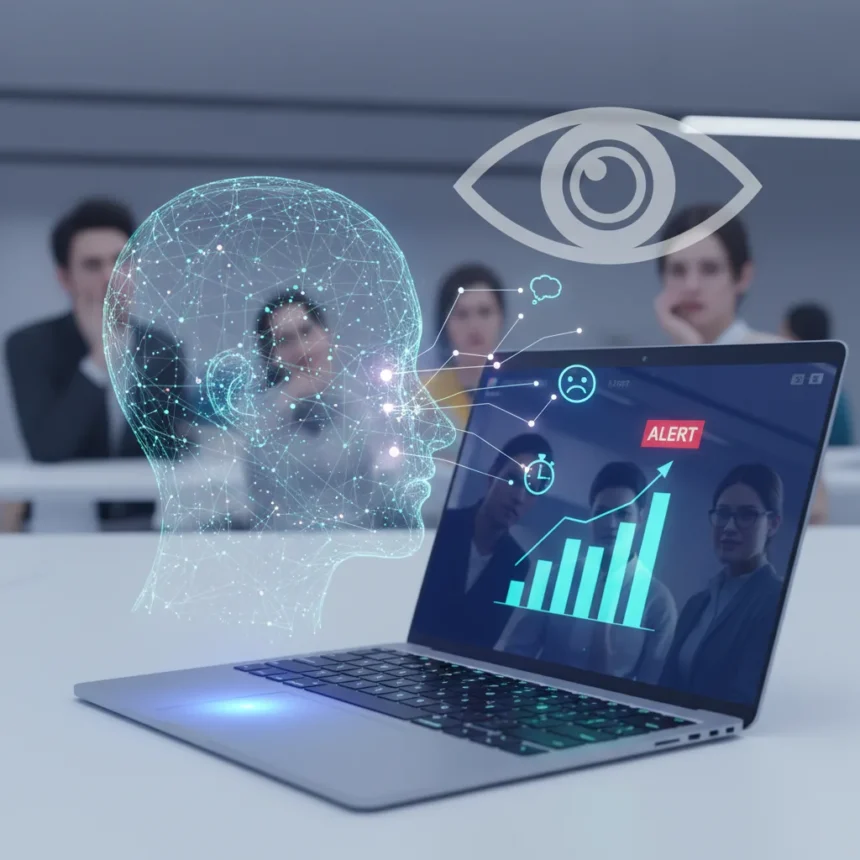
AI mental health prediction tools are emerging as a new frontier in workplace monitoring, with systems designed to detect signs of psychological distress before employees themselves recognize symptoms. These tools raise fundamental questions about privacy, consent, and whether algorithmic prediction of mental health states should ever be deployed in employment contexts where power imbalances are inherent.
Key Takeaways
- AI mental health prediction tools can identify psychological distress patterns before individuals are aware of them
- Employers deploying these systems raises serious privacy and consent concerns in power-imbalanced workplace relationships
- The technology lacks independent validation and relies on unproven diagnostic assumptions
- Regulatory frameworks for workplace mental health AI remain largely absent globally
- Experts warn that normalization of this surveillance could fundamentally alter workplace trust dynamics
What Are AI Mental Health Prediction Tools?
AI mental health prediction tools are software systems designed to analyze behavioral, communication, and usage patterns to forecast psychological distress, burnout, depression, or other mental health conditions. These systems typically process data from employee communications, work patterns, productivity metrics, or biometric inputs to generate risk assessments. Unlike traditional occupational health programs that rely on voluntary disclosure or periodic assessments, predictive AI operates continuously and invisibly, flagging individuals the system believes are at risk before they seek help or disclose struggles.
The underlying premise is appealing in theory: early intervention could prevent crises, reduce absenteeism, and support employee wellbeing. In practice, however, the deployment of such tools in employment settings creates a fundamental asymmetry. An employer armed with predictive mental health data about its workforce holds leverage that employees cannot easily refuse or escape. Even if participation is nominally voluntary, the power dynamic—the employer controls scheduling, compensation, and references—makes true consent questionable.
Why Employers Are Interested in AI Mental Health Prediction
Organizations are drawn to these tools because they promise to address real problems: unplanned absences, reduced productivity, and the costs associated with employee mental health crises. From a business perspective, identifying struggling employees before performance deteriorates seems like responsible management. Some vendors frame these systems as proactive care infrastructure, positioning them alongside health insurance and wellness programs.



The appeal intensifies in high-stakes industries where employee mental health directly affects safety and performance—aviation, healthcare, emergency services. In these contexts, predictive tools could theoretically prevent tragedies. However, the same logic can be weaponized: a system that flags an employee as “at risk” could become grounds for reassignment, reduced responsibilities, or termination justified as “accommodations.” The technology’s opacity makes it difficult for employees to challenge these decisions or understand why they were flagged.
The Ethical and Privacy Objections
Critics argue that deploying AI mental health prediction tools in workplaces fundamentally violates employee autonomy and privacy. One core concern is that these systems make diagnoses or predictions about protected health information without the consent frameworks that medical professionals require. An employee has not asked for a mental health assessment, yet receives one anyway based on algorithmic analysis of their behavior.



A second concern involves data use and scope creep. Communications analyzed for mental health signals could reveal union organizing, protected political speech, medical appointments, or personal relationships. Once data is collected and processed, its use can expand beyond the original stated purpose. An employer might use the same dataset to identify “flight risks” or workers unlikely to accept promotions, under the guise of mental health support.
There is also the question of accuracy. Most AI mental health prediction tools have not undergone rigorous clinical validation. They may produce false positives, flagging employees as mentally unwell based on patterns that are actually benign—a temporary dip in productivity during a family relocation, for example. False negatives are equally dangerous: a system might miss genuine distress because an individual masks their symptoms effectively. Unlike clinical assessment, which involves human judgment and patient input, algorithmic prediction is one-directional and unverifiable from the employee’s perspective.
Regulatory and Legal Gaps
In most jurisdictions, the legal landscape for workplace mental health AI is underdeveloped. Data protection regulations like GDPR in Europe and various state privacy laws in the US provide some guardrails around personal data collection, but they do not specifically address the unique risks of mental health prediction. Employment law protects against discrimination based on disability status, but an employer can argue that flagging an employee for early intervention is supportive, not discriminatory.
The absence of clear rules creates a vacuum. Without mandatory transparency, validation standards, or employee notification requirements, employers can deploy these systems with minimal accountability. Some organizations may use them responsibly; others may use them to identify and remove employees perceived as liabilities before mental health issues become legally protected disabilities.


What Should Happen Next?
Meaningful regulation would require several elements. First, any mental health prediction tool deployed in a workplace should undergo independent clinical validation before deployment, similar to how medical devices are evaluated. Second, employees should have explicit, informed consent rights—not just nominally, but with real ability to opt out without penalty. Third, there should be transparency about what data is collected, how it is analyzed, and what actions are taken based on predictions.
Fourth, there must be appeal mechanisms. If an employee is flagged as at-risk, they should be able to understand why, contest the assessment, and correct inaccuracies. Finally, regulators should consider whether some uses of mental health prediction in employment are simply incompatible with worker dignity and should be prohibited outright, regardless of how well-intentioned the employer claims to be.
Is workplace mental health AI inevitable?
Not necessarily. Technological capability does not mandate deployment. Employers can support mental health through traditional channels: accessible counseling services, flexible work arrangements, destigmatization of mental health discussions, and management training. These approaches do not require surveillance. The fact that AI mental health prediction tools can be built does not mean they should be normalized in workplaces where employees have limited power to refuse participation.
Can employees opt out of mental health prediction at work?
In many cases, no—not meaningfully. Even if a company offers opt-out language, employees often cannot refuse without signaling non-cooperation or facing subtle retaliation. True opt-out requires regulatory protection: explicit rights to refuse without penalty, combined with enforcement mechanisms. Until then, opt-out is theoretical rather than practical for most workers.
What is the difference between mental health support and mental health surveillance?
Support is voluntary, transparent, and initiated by the individual seeking help. Surveillance is coercive, opaque, and imposed by an external party. AI mental health prediction tools blur this line by framing invasive monitoring as care. The distinction matters because genuine support builds trust, while surveillance erodes it. A workplace that monitors employees for signs of distress is fundamentally different from one that provides resources for employees who choose to disclose struggles.
The rise of AI mental health prediction tools reflects a broader tension in modern work: the desire to support employees conflicts with the temptation to control and optimize them. Without clear ethical boundaries and regulatory safeguards, these tools will likely become another mechanism for workplace surveillance disguised as benevolence. The question is not whether the technology works, but whether it should be used at all—and if so, under what conditions.
Edited by the All Things Geek team.
Source: TechRadar