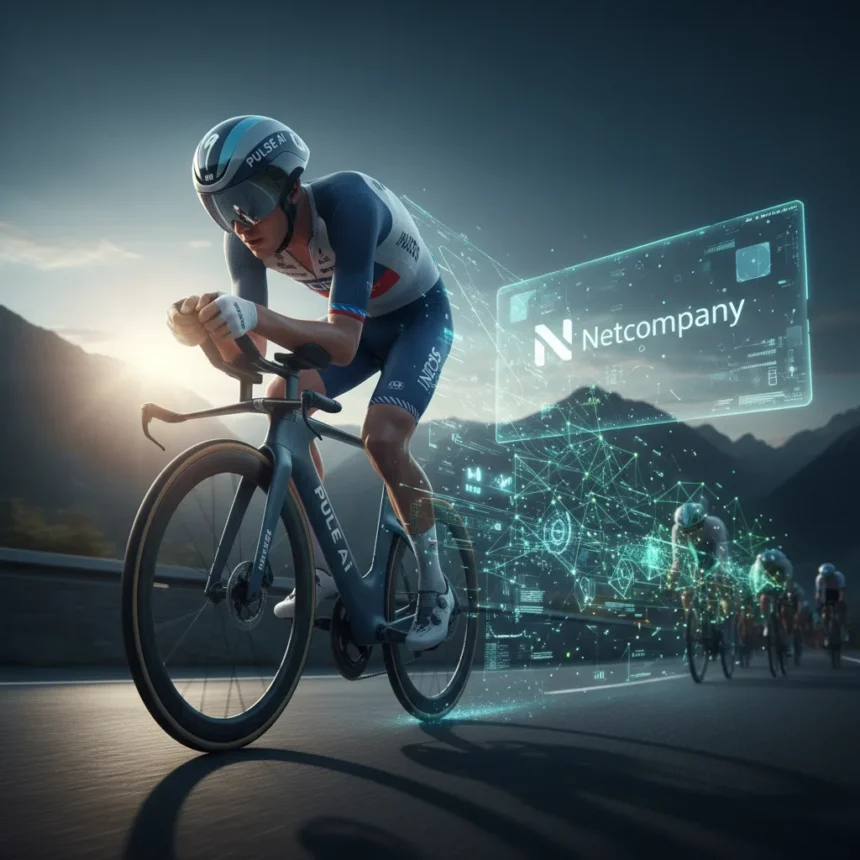
PULSE AI cycling is about to enter professional cycling in a way the sport has never seen before. INEOS Cycling has announced a five-year partnership with Netcompany, a Danish tech company, making Netcompany the team’s title sponsor starting with the 2026 Giro d’Italia on May 8. The renamed Netcompany INEOS Cycling Team will deploy PULSE, Netcompany’s AI-driven platform for real-time data analysis, to orchestrate what team leadership calls a “blizzard of data” into actionable race intelligence.
Key Takeaways
- PULSE AI cycling marks the first sports deployment of Netcompany’s AI platform, previously used in corporate environments like airports and energy grids.
- The platform aggregates rider biometrics, environmental conditions, and logistics into a unified data format for real-time decision-making.
- Netcompany CEO André Rogaczewski boldly claims the team will win the Tour de France within five years.
- INEOS Cycling competes against other AI-backed teams like UAE Team Emirates (Analog) and Visma-Lease a Bike (Vekta).
- The partnership begins deployment at the 2026 Giro d’Italia, with real-time race application from launch.
What PULSE AI Cycling Actually Does
PULSE AI cycling is not just another analytics dashboard. The platform unifies fragmented data sources—heart rates, power output, effort levels, nutrition intake, headwinds, weather patterns, hotel conditions, equipment status—into a single aligned format that the entire team can trust and act on in real time. Geraint Thomas, the team’s Director of Racing and a former Tour de France winner, explains the core value: “If that information is just aligned and clear, then you can use the best opportunity to make the right calls. At the end of the day, it’s still about a guy on his bike, riding to the top of a mountain as quick as he can!”
The platform goes beyond aggregation. It sifts signal from noise, runs predictive analysis including “what-if” scenarios for pacing strategies, rider roles, and timing decisions, and enables split-second calls on breakaways, sprint trains, nutrition, and recovery. What sets PULSE AI cycling apart is its deployment in a sport where data has historically been fragmented across separate systems—team buses, power meters, weather stations, logistics platforms—each siloed from the others. Thomas notes: “It’s just something that hasn’t been there before”.
PULSE AI Cycling vs. Cycling’s Data Problem
Professional cycling has long struggled with data fragmentation. Formula 1 leads the motorsports world in data orchestration, yet cycling—despite needing equally granular information about power, effort, and nutrition—has lagged in unified intelligence systems. Other teams are catching up. UAE Team Emirates partnered with Analog for AI insights, while Visma-Lease a Bike works with Vekta. But PULSE AI cycling positions Netcompany INEOS as the first to deploy a platform originally built for corporate crisis management—think airport operations, energy grids, rail networks—into the chaos of a Grand Tour.



Sir Dave Brailsford, team principal, frames the opportunity as a frontier in competitive cycling. “The next frontier is understanding individual response. If you can achieve that through AI, you will get better consistency. That’s where I see the big opportunity coming”. This hints at the Holy Grail of cycling analytics: predicting how each rider will respond to specific conditions, training loads, and race scenarios, then optimizing strategy accordingly.
The Five-Year Tour de France Bet
André Rogaczewski, Netcompany’s CEO, made a striking public commitment: “We will win the Tour de France within the next five years”. This is not a modest partnership announcement. It is a five-year sponsorship deal with a victory guarantee attached. Brailsford’s reaction—”I shouldn’t be as excited as I am, but I am”—signals confidence, though the team is candid about the unknowns. The partnership is currently in a “discovery phase,” meaning the team is still learning what PULSE AI cycling can and cannot reveal about race dynamics.



The timing matters. The 2026 season opens with the Giro d’Italia starting in Bulgaria, followed by the Tour de France where the team aims for an eighth title. PULSE AI cycling will be tested in real races from day one, with no luxury of a testing phase. Real-time data integration during a Grand Tour is vastly different from analyzing historical power files in an office. The pressure is immediate.
What PULSE AI Cycling Still Doesn’t Know
Brailsford acknowledged a key limitation: “You don’t know what you don’t know”. PULSE AI cycling begins with data aggregation and logistics optimization—hotel room allocation, equipment status tracking, unified race intelligence. Full predictive individualization, the ability to forecast exactly how rider A will respond to 40 kilometers at threshold power in a 28-degree headwind, remains aspirational. The platform can run “what-if” scenarios, but scenarios are only as good as the data and assumptions feeding them.
Early implementation focuses on creating alignment. When a team principal, directeur sportif, and nine riders are all working from the same data set, decisions become faster and more coordinated. That alone is a competitive advantage in a sport where breakaway success often hinges on split-second communication. But the leap from “aligned information” to “predictive dominance” is significant.
Does PULSE AI Cycling Change the Sport?
Cycling is not Formula 1. There is no salary cap, no tech regulation limiting data systems, and no governing body enforcing parity. Teams with deeper pockets can afford more sophisticated analytics. PULSE AI cycling gives Netcompany INEOS a platform advantage, but advantage is not destiny. A single mechanical failure, a rider crash, or a rival team’s superior tactical execution can erase months of algorithmic preparation. Brailsford knows this. The focus remains on removing friction so riders can race at their best, not on replacing human judgment with automation.


The broader question is whether PULSE AI cycling signals a shift in how professional cycling approaches data. If the partnership delivers results—visible improvements in race performance, faster decision-making, fewer logistics errors—other teams will follow. If it underperforms or proves to be an expensive curiosity, cycling may continue its slower adoption of unified analytics compared to other sports.
Is PULSE AI cycling only for elite teams?
PULSE AI cycling was built for Netcompany INEOS, so it is tailored to their infrastructure and needs. Whether Netcompany will license PULSE to other cycling teams remains unclear. The platform’s previous deployments were in corporate environments—airports, energy grids, rail networks—not sports. Scaling to other teams would require customization and support costs that may not align with Netcompany’s business model.
Can PULSE AI cycling predict race outcomes?
PULSE AI cycling can run “what-if” scenarios and forecast individual rider responses, but it cannot predict race outcomes with certainty. Too many variables—competitor tactics, weather surprises, mechanical failures, rider form on the day—fall outside any model’s scope. The platform is a decision-support tool, not a crystal ball. Its value is in reducing uncertainty and speeding up strategic choices, not eliminating them.
When does PULSE AI cycling debut in racing?
PULSE AI cycling launches with the 2026 Giro d’Italia on May 8, 2026. This is the team’s first real-world test of the platform under race conditions. Real-time data integration during a three-week Grand Tour will reveal quickly whether the system delivers the alignment and insight Brailsford and Thomas expect, or whether it becomes another layer of noise in an already complex race environment.
PULSE AI cycling represents a genuine shift in how professional cycling teams approach data—moving from fragmented systems toward unified intelligence. Whether that shift translates into an eighth Tour de France title for INEOS Cycling within five years depends not on the algorithm, but on the riders, the tactics, and the unpredictable chaos of racing. PULSE is a tool. The outcome still belongs to the sport itself.
Edited by the All Things Geek team.
Source: TechRadar