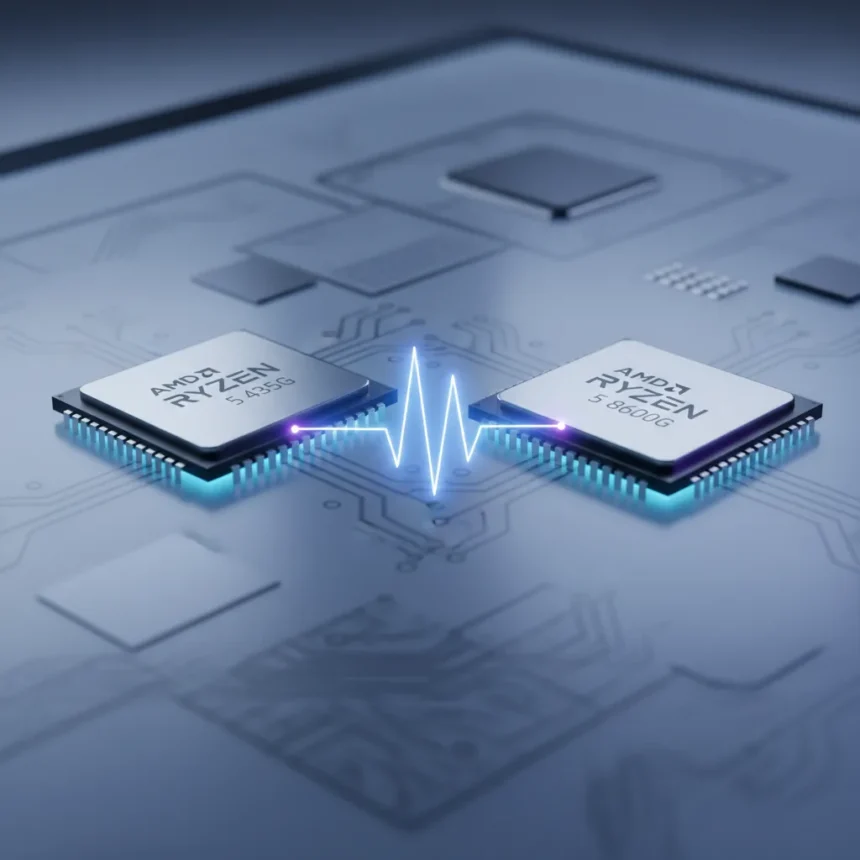
The AMD Ryzen AI 5 435G is a six-core Zen 5 APU with 12 threads, featuring integrated Radeon 840M graphics, that has begun appearing in early benchmarks as of Q1 2026. This budget-focused chip matches the performance of AMD’s Ryzen 5 8600G in Geekbench 6 testing, making it a compelling option for cost-conscious PC builders who want both CPU and GPU capabilities without a discrete graphics card.
Key Takeaways
- AMD Ryzen AI 5 435G scores 2620 single-core and 10,594 multi-core in Geekbench 6.5, matching the Ryzen 5 8600G
- Six-core design with 2x Zen 5 cores (up to 4.5 GHz turbo) and 4x Zen 5c cores delivers 18,359 CPUmark score
- 28W typical TDP and integrated Radeon 840M graphics eliminate the need for dedicated video hardware
- Socket FP8 placement targets desktop and entry-level laptop integration
- Ryzen AI 5 PRO 435 variant scores 9.5% higher in CPUmark benchmarks
AMD Ryzen AI 5 435G Performance Breakdown
Early benchmark leaks reveal the AMD Ryzen AI 5 435G delivering solid performance for its class. Geekbench 6.5 testing shows consistent single-core scores of 2620 and multi-core results of 10,594, placing it directly alongside the Ryzen 5 8600G. CPUmark rankings position the chip at 1066th in multithreading and 382nd in single-threading across 5,872 CPUs, with an overall score of 18,359.
The architecture splits duties between performance and efficiency cores. Two Zen 5 cores run at a 2.0 GHz base clock with turbo reaching 4.5 GHz and handle four threads, while four Zen 5c efficiency cores scale up to 3.4 GHz. This configuration targets workloads where sustained performance matters more than peak speed—office productivity, light content creation, and everyday computing rather than extreme gaming or rendering.
Integer and floating-point math benchmarks show 59,804 MOps/Sec and 39,871 MOps/Sec respectively, with single-threaded performance reaching 3,695 MOps/Sec. These numbers place the chip firmly in the budget segment but demonstrate enough headroom for multitasking and moderate productivity tasks.


How the AMD Ryzen AI 5 435G Stacks Against Competitors
Direct comparison to the Ryzen 5 8600G reveals near-perfect parity. Both chips achieve identical Geekbench 6 scores of 2620 single-core and 10,594 multi-core. This equivalence matters because the 8600G has already established itself in budget builds, so the 435G enters a market with a proven reference point rather than a question mark.
Step up to the Ryzen AI 5 PRO 435 variant and you see a 9.5% jump in CPUmark performance, reaching 20,104. That professional-tier option remains niche, but it signals that AMD’s engineering roadmap includes headroom for higher-end configurations using the same socket and architecture.



Intel’s competing Core Ultra 7 365 outperforms the 435G by 17.0% in CPUmark (21,471 vs 18,359), placing it in a different performance tier. For builders strictly focused on budget, the gap matters less than the integrated graphics quality and power efficiency both platforms offer.
Why the AMD Ryzen AI 5 435G Matters for Budget Builders
The 28W typical TDP is the real story here. That power envelope opens doors for fanless or passively cooled builds, small-form-factor PCs, and systems where electricity costs add up over years of use. The integrated Radeon 840M graphics eliminate the need to spend additional money on a discrete card, which alone saves budget-conscious builders $100 or more.
Socket FP8 positioning targets both desktop and laptop integration, suggesting OEMs will likely use this chip across multiple form factors. Early leaks appearing in Q1 2026 mean production silicon is likely already flowing through ODM channels, even if consumer availability remains unclear.
Benchmark variance across early runs—Geekbench multi-core scores ranging from 9,980 to 10,594—suggests these are preliminary engineering samples rather than final retail chips. That volatility is normal for pre-release hardware and should stabilize once production units reach reviewers.



Is the AMD Ryzen AI 5 435G Right for Gaming?
The Radeon 840M graphics handle light gaming and esports titles, but the CPU’s budget positioning means AAA gaming at high settings remains unrealistic. Integrated graphics excel at League of Legends, Valorant, and older competitive shooters, but demanding modern games will require either lower settings or a discrete GPU upgrade. The chip shines for productivity, streaming, and content creation workflows where GPU acceleration matters less than consistent CPU multithreading.
When Will the AMD Ryzen AI 5 435G Launch?
No official launch date or pricing has been announced. Benchmarks first appeared in Q1 2026, but retail availability and regional pricing remain unconfirmed. AMD typically follows engineering sample leaks with press briefings and official specs, so expect formal announcements within the next few months as OEMs begin integrating the chip into product lineups.
How Does the AMD Ryzen AI 5 435G Compare to Older Budget APUs?
The Ryzen AI 5 435G’s Zen 5 architecture represents a generational jump from older budget chips. The Ryzen 5 8540U, for comparison, scores 2489 in Geekbench 6.5 single-core—roughly 1% lower than the 435G’s 2513-2576 range. That modest gap reflects AMD’s iterative approach to efficiency cores, where each generation squeezes a few more percentage points of performance without major architectural overhauls.
The AMD Ryzen AI 5 435G arrives at a moment when budget PC building is shifting toward integrated graphics and lower power consumption. Early benchmarks confirm it delivers competitive performance against established rivals, making it a solid choice for builders prioritizing value, efficiency, and integrated capabilities over absolute peak performance. Expect this chip to define the entry-level desktop market throughout 2026.
Edited by the All Things Geek team.
Source: Tom's Hardware